
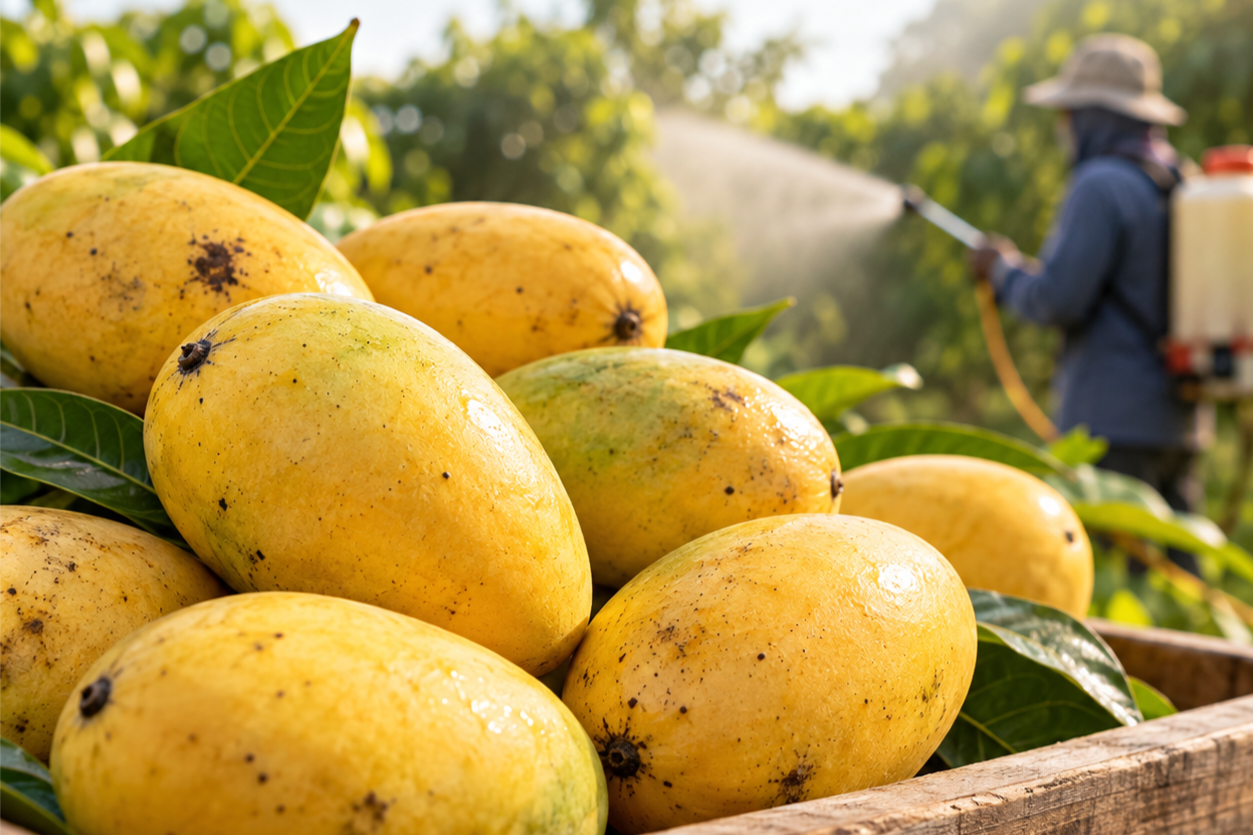

A new Australia-backed research project will seek to help Philippine mango growers reduce their reliance on pesticides while improving productivity, food safety, and the resilience of the country’s mango industry.
The 4.5-year, $5.82 million project, led by the University of Queensland, will examine why proven pest and disease-management practices have yet to gain wider adoption among mango farmers in the Philippines and Indonesia.
The project is co-funded by the Australian Centre for International Agricultural Research (ACIAR) and the Department of Science and Technology – Philippine Council for Agriculture, Aquatic and Natural Resources Research and Development (DOST-PCAARRD).
The Philippines is one of Southeast Asia’s major mango producers, with the crop serving both domestic consumers and export markets. Carabao mango, the country’s national fruit, is particularly important but remains vulnerable to pests and diseases that can reduce fruit quality and yields.
The new initiative brings together the University of Queensland, University of the Philippines – Los Baños (UPLB), the Department of Agriculture’s Bureau of Plant Industries, and research institutions in Indonesia. It will focus on pests affecting Philippine mangoes including cecid fly, thrips, Philippine fruit fly and leafhoppers, as well as diseases such as anthracnose and scab.
“Research supported through earlier ACIAR investments has generated a strong evidence base and demonstrated effective alternatives for managing key pests and diseases while reducing pesticide use,” said Dr. Sandra McDougall, ACIAR research program manager for horticulture.
“This new phase of research focuses on understanding and improving horticultural production systems to enable farmers, industries and institutions to adopt and sustain those practices over the long term.”
Pesticide use is a significant concern because excessive or inappropriate application can raise production costs, damage human and environmental health, affect beneficial insects and create food-safety risks that can limit market access. ACIAR said earlier research has already identified alternatives capable of reducing pesticide use while maintaining productivity and fruit quality, but adoption remains limited.
For the Philippine industry, the project will examine how data-driven and locally tailored pest-management strategies can be incorporated into farming practices. Researchers will combine biological pest control, artificial intelligence, digital modelling, economics, behavioral science, policy analysis, and environmental assessment.
Surveys, farmer engagement, and participatory workshops will also be used to understand how growers make decisions on pesticide use and what prevents them from adopting alternative approaches.
“Through the use of data-driven and context-specific pest management strategies, we also help policymakers and smallholder mango farmers in mitigating pest-related risks and fostering responsible pesticide use,” said Dr. Celia Medina of UPLB.
The project builds on previous research showing that area-wide management can help control fruit flies, although many farmers have continued to rely on conventional pesticide practices.
“Our studies have showed that effective alternatives such as area-wide management can be effective in controlling fruit fly, but many farmers have yet to change the way they use pesticides,” said Indonesian project lead professor Y Andi Trisyono of Universitas Gadjah Mada.
While pest pressures differ between the Philippines and Indonesia, researchers said the two countries face a common challenge in shifting growers away from excessive pesticide dependence. The collaboration is intended to allow both countries to share knowledge and adapt pest-management tools to local production systems.
For the Philippines, the research could have implications beyond farm-level production. The project is expected to generate digital tools, economic analyses and policy recommendations that can be used by government agencies, extension services, industry groups, and smallholder farmers.
“The systemic shift from pesticide reliance towards sustainable adoption of proactive pest management practices through smart technologies can help position Philippines, Indonesia and Australia as regional leaders in resilient mango production,” said Medina.
The initiative also aims to strengthen regional biosecurity by improving surveillance and preparedness for emerging pest and disease threats, while creating opportunities for farmers and researchers in the Philippines, Indonesia, and Australia to work together.
Stay updated—follow Philippines Today on Facebook and Instagram, and subscribe on YouTube for more stories.