
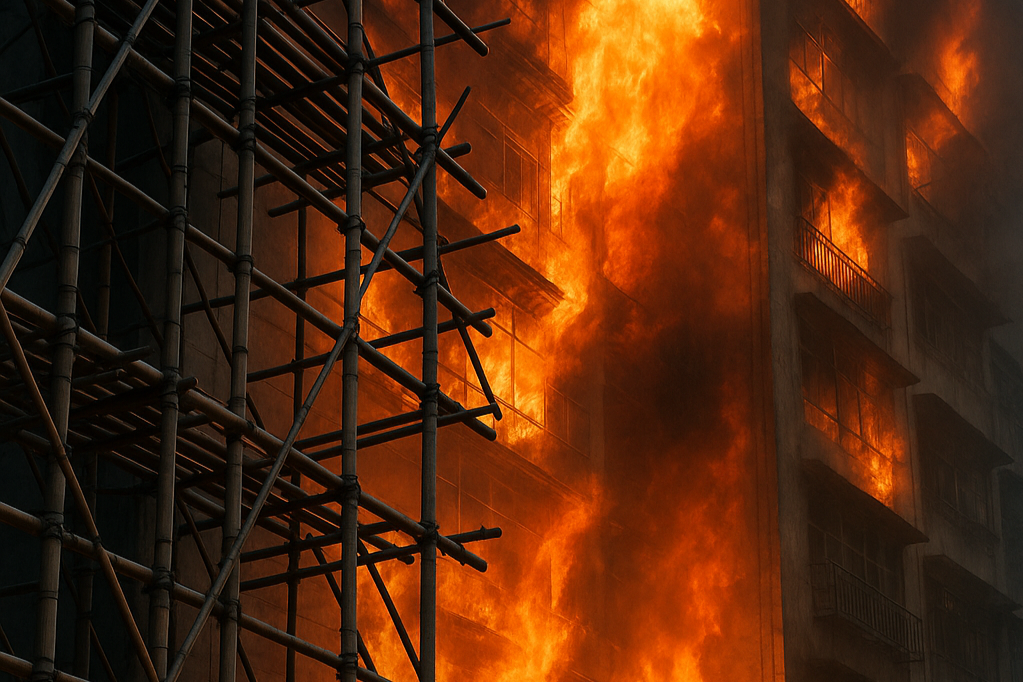

Bamboo scaffolding was being pointed as the main culprit in the deadly Tai Po fire in Hong Kong. That accusation, made as flames raced up seven residential towers, killing 151 people, including a Filipino domestic worker, and leaving 40 missing, may do more than sharpen public anger.
For a city long accustomed to seeing bamboo rise harmlessly around its skyline, the scale of the tragedy has cracked open a question Hong Kong officials have delayed for years: whether a defining element of the city’s built identity has finally reached its breaking point.
The catastrophe revived a debate that had simmered quietly even as bamboo remained ubiquitous. For decades, Hong Kong has defended its reliance on bamboo—lightweight, fast to assemble, and astonishingly adaptable.
Yet when a ferocious blaze engulfs a public housing estate encased in bamboo poles and safety netting, and when three people linked to a renovation contractor are arrested on suspicion of “gross negligence,” it becomes harder for authorities to argue that modernization can wait. The Tai Po fire, the deadliest in the city’s history, has turned an ongoing policy debate into an unavoidable reckoning.
The irony is that Hong Kong has been slowly preparing for such a shift. Earlier this year, the Development Bureau ordered half of all new public projects to use metal scaffolding, citing worker safety after two dozen bamboo-related deaths since 2018. But enforcement has been uneven. Bamboo still accounts for roughly 80% of the scaffolding on city buildings, propped up not only by tradition but by efficiency: bamboo is cheaper, faster to erect, easier to shape on the fly, and perfectly suited to Hong Kong’s tight, vertical work sites.
That practicality is how bamboo became Hong Kong’s default building skeleton. Its history stretches from Song dynasty paintings to the rise of the city’s modern skyline, where even marquee projects like Norman Foster’s HSBC Building used bamboo at critical stages. Generations of sifu, or master scaffolders, honed a craft that is part engineering, part choreography, tying knots by feel and reading the quirks of each pole. They helped shape everything from skyscrapers to temporary Cantonese opera theaters, flower plaques, and festival pavilions. Bamboo didn’t just build Hong Kong; it animated its streetscape.
Which is why the news that Hong Kong may finally move to phase it out lands with cultural weight. Architect Ying Zhou captured that sentiment succinctly: “It’s part of what makes Hong Kong, Hong Kong.”
For many residents, bamboo scaffolding is not a relic but a living heritage—one that defines the city as much as its neon signs or wet markets. Even as places like mainland China banned bamboo scaffolding in 2022, Hong Kong held on, arguing that its regulated, licensed, and meticulously trained industry remained safe.
But safety is no longer merely technical. It is visceral. Footage of bamboo poles igniting in the dry November air—a “highway” for flames, as several fire experts said—forces a collective reassessment. Bamboo is flexible, sustainable, even futuristic compared to carbon-intensive steel. Yet its advantages matter little when it becomes the vector of catastrophe. As Xinyan Huang of Hong Kong Polytechnic University warned, the material’s vertical orientation means that “the fire is basically spreading up without any resistance.”
None of this means bamboo scaffolding is inherently unsafe. The problem in Tai Po appears to be a lethal mix of flammable materials, questionable renovation practices, and weak compliance with fire-retardant requirements. Investigators are rightly focusing on whether illegal polystyrene boards and substandard protective nets amplified the blaze. In that sense, bamboo may be less culprit than accomplice.
But public confidence, once shaken, rarely returns unchanged. Hong Kong leaders now face a dual obligation: preserve what is culturally essential while protecting lives in a city where any external fire can scale a building in minutes. The answer is unlikely to be an abrupt ban. Rather, it will require disciplined enforcement of fire codes, stricter certification of scaffolding contractors, and a clearer distinction between where bamboo remains appropriate – small-scale repairs, cultural structures, bespoke installations – and where metal should become mandatory.
Bamboo scaffolding is a marvel of human skill, and its disappearance from Hong Kong would be a cultural loss. But tradition alone cannot outweigh evidence. If the Tai Po inferno proves anything, it is that heritage must evolve to remain safe. Hong Kong can honor its past without allowing it to burn through its future.
The Philippine model
The debate over bamboo’s future is not confined to Hong Kong. The Philippines, where bamboo has long been part of vernacular building culture, has taken a more calibrated regulatory approach—one that preserves limited use while clearly defining its boundaries.
Under the Department of Labor and Employment’s Department Order No. 128-13, bamboo scaffolding is permitted, but only for painting and light construction work, and only within a tightly controlled safety framework.
The rules are explicit. Bamboo scaffolds may rise no higher than six meters, and each must be strong enough to carry four times the imposed load. A span can support only one worker at a time, and the distance between poles may not exceed 2.4 meters. Whenever work exceeds two meters in height, fall protection becomes mandatory. All components must be built of sound, defect-free bamboo and inspected by a competent person, with erection, use, and dismantling supervised accordingly.
This approach does not eliminate bamboo; it constrains it to the context where it remains safest and most effective. The Philippines treats bamboo as a practical material for low-rise, low-risk tasks—not as a structural partner in high-rise construction. The result is a system that preserves traditional practice while sharply limiting the possibility of catastrophic failure.
Follow PHILIPPINES TODAY on Facebook and Instagram, and subscribe on YouTube for the latest updates.