
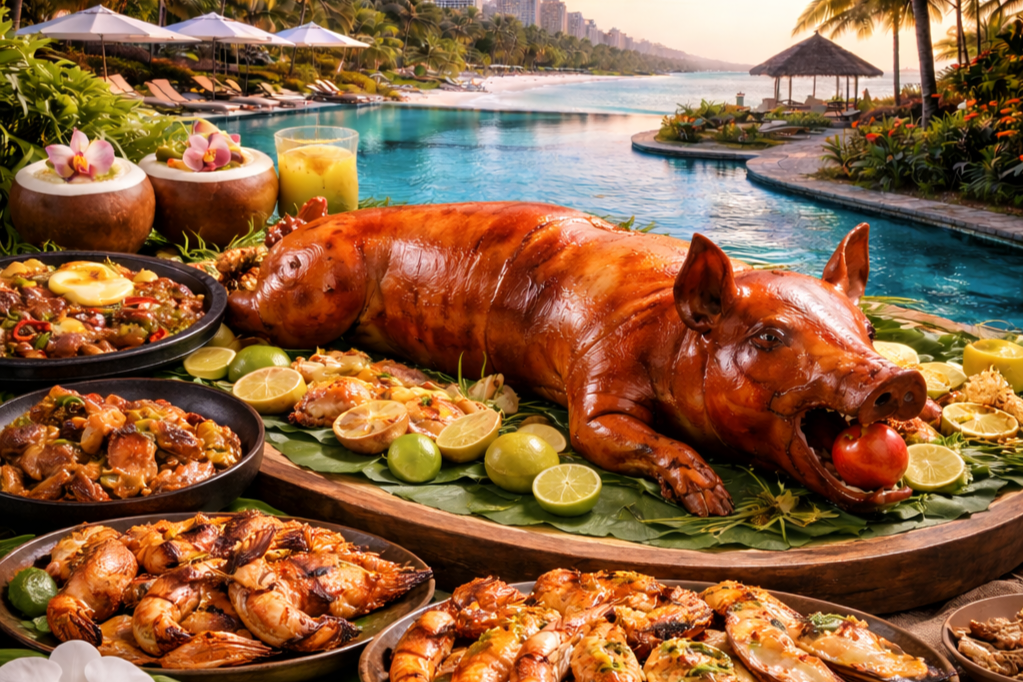

There is a moment in the Philippines when a meal stops being about what’s on the plate and becomes a quiet lesson in place. It might happen over a sizzling platter of sisig, a bowl of sinigang sharpened with calamansi, or lechon carved with ritual care—food that does not announce itself, yet lingers long after the table is cleared.
That instinctive intimacy is now being noticed well beyond the archipelago. The MICHELIN Guide has named the Philippines one of the world’s most exciting food destinations for 2026, placing it among 16 global locations where travel increasingly begins—and often ends—at the table.
For decades, Filipino cuisine evolved without courting international approval. It thrived in homes, carinderias, wet markets, and coastal kitchens where cooking followed memory rather than menus. The MICHELIN Guide’s arrival does not change that foundation; it reframes it, offering global context to a food culture that has long been confident in its own voice.
Manila and Cebu emerge as the natural focal points—cities where tradition and modernity meet with unusual ease.
The recognition was welcomed by the Department of Tourism, which described the inclusion as a meaningful affirmation of the country’s growing presence on the global gastronomy map. For the agency, the spotlight on Manila and Cebu reflects more than restaurant accolades—it acknowledges the broader ecosystem of farmers, cooks, and small food businesses that have quietly shaped Filipino cuisine over generations. It is, in effect, an overdue moment of visibility.
In Manila, that visibility plays out against a backdrop of striking contrasts. Glass towers rise beside old neighborhoods, and the dining scene mirrors that tension. Classic dishes—sisig, sinigang, adobo—remain central, grounding the city’s palate in familiarity. Around them, a new generation of chefs is refining Filipino flavors through contemporary techniques, informed by global experience yet firmly rooted in local taste. The result is not fusion for effect, but confidence—food that knows where it comes from and no longer feels the need to explain itself.
That confidence was formally acknowledged with the debut of the MICHELIN Guide Philippines, announced in October 2025 for the 2026 edition, covering Manila and Cebu. The inaugural selection marked a historic milestone. Helm by Josh Boutwood earned the country’s first Two Michelin Stars, while eight restaurants received One Star honors: Toyo Eatery, Hapag, Gallery by Chele, Linamnam, Celera, Asador Alfonso, Kasa Palma, and Inatô. Together, they signal not a culinary reinvention, but a sharpening of intent.
Cebu offers a quieter, coastal counterpoint. Long celebrated for its beaches and resorts, the country’s second-largest metropolitan area is equally defined by its relationship with the sea. Seafood dominates, fire plays a central role, and lechon remains both everyday indulgence and ceremonial centerpiece. The city’s growing food scene is less about spectacle and more about clarity—allowing regional produce and techniques to take precedence. Between January and March, when weather and harvest align, Cebu feels especially assured.
Across both cities, Michelin inspectors pointed to dishes that capture the essence of Filipino cooking: sisig, sinigang, inasal, and adobo. Each reflects the cuisine’s defining balance—sweet against salty, richness cut with acidity—achieved through native fruits, spices, and time-honored methods such as marinating and grilling. Year-round access to fresh produce, enabled by the country’s climate, remains the understated backbone of the table.
Michelin’s own assessment is direct. On its website, it wrote: “Why go now: Filipino food claims its global moment in Manila and Cebu… In Cebu, inspectors added 18 restaurants, including six Bib Gourmands. In Manila, 88 restaurants were selected, including one Two-Star, (eight) One-Star establishments, and 19 Bib Gourmands.”
Luxury, here, feels measured rather than performative. The MICHELIN Guide highlights hotels that quietly complement the dining experience—from Grand Hyatt Manila and Shangri-La at the Fort in the capital to Cebu’s beachfront Dusit Thani Mactan Cebu Resort, holder of a One-Key distinction under Michelin’s newly introduced hotel awards, alongside Crimson Resort & Spa Mactan.
What makes the Philippines compelling in 2026 is not novelty, but assurance. Filipino cuisine does not seek validation; it offers hospitality, depth, and restraint. As the world finally leans in, the country’s greatest strength is that its food remains anchored—to place, to memory, and to a way of eating that has always known exactly what it is.
Stay updated—follow Philippines Today on Facebook and Instagram, and subscribe on YouTube for more stories.