
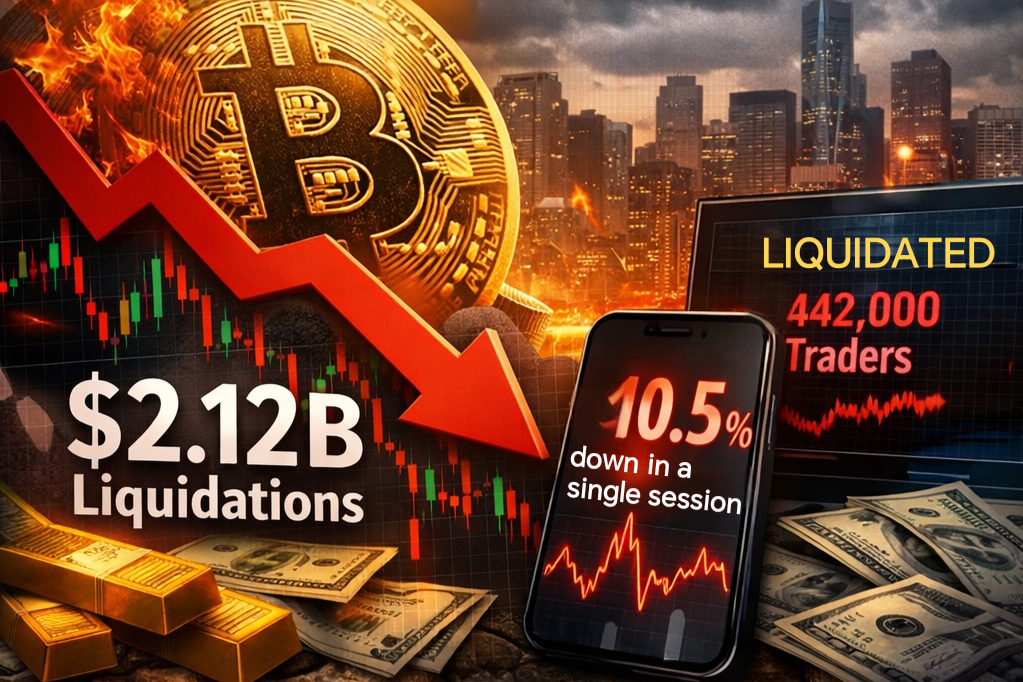

Bitcoin’s brutal slide on Thursday, February 5—which wiped out an estimated $2.12 billion in leveraged crypto positions and marked its steepest one-day decline since the FTX collapse in November 2022—underscored how tightly digital assets are now bound to broader market stress.
More than 442,000 traders were liquidated as Bitcoin fell over 10% in a single session, according to data cited by BitPinas. Long positions absorbed the bulk of the damage, accounting for roughly $1.84 billion, or 87% of total liquidations, while about $272 million in short bets were wiped out. The largest single forced order—a BTC/USDT position worth just over $12 million—was executed on Binance, highlighting how concentrated leverage had become in major offshore venues.
The sell-off unfolded alongside a broader retreat from risk assets globally. Weak U.S. labor data and growing unease over stretched valuations in artificial intelligence-linked equities triggered a flight from speculative trades, dragging down commodities and equities alongside crypto. Silver plunged sharply and gold retreated, blurring the line between traditional hedges and high-beta assets as investors scrambled for liquidity.
Some technical indicators, however, are beginning to signal that the sell-off may be approaching exhaustion. According to market data cited by CoinDesk and Yahoo Finance, Bitcoin’s relative strength index (RSI) has fallen to levels seen only a handful of times in its trading history—most notably during the 2018 bear-market bottom and the March 2020 pandemic-driven crash. Such readings have historically coincided with capitulation phases, though analysts caution that oversold conditions can persist if broader risk sentiment continues to deteriorate.
Some analysts noted that a failure to reclaim key technical support such as the 200-day moving average could leave Bitcoin vulnerable to a deeper drawdown, reflecting a commonly cited concern among market technicians as prices test long-term levels.
For the Philippines, which has emerged as an active market for digital-asset trading, the February 5 rout highlighted the risks faced by investors with direct exposure to cryptocurrencies. Participation is concentrated among retail and professional traders rather than the broader population, but sharp price swings can still translate into meaningful losses for those involved, particularly as offshore platforms expand access to leveraged products that amplify both gains and downturns.
Local industry leaders have underscored the importance of investor education and risk awareness in the Philippines’ growing crypto community. Luis Buenaventura, head of crypto at GCash, said in the context of a beginner initiative that “understanding why crypto matters is the first step to learning how to use it wisely,” and that helping users grasp the “balance of ‘high risk, high reward’” is key before they dive into investing.
Against that backdrop, regulators have stepped up scrutiny of unlicensed exchanges as participation grows, even as the speed and scale of Thursday’s sell-off underscored how quickly global market shocks can spill into domestic trading activity.
It remains unclear whether the February 5 sell-off represents a short-term capitulation or the early stages of a broader market adjustment. During the episode, cryptocurrencies moved largely in line with other risk assets, reflecting their growing correlation with global financial markets.
For market participants and regulators in the Philippines, the sell-off showed how rapidly shocks in global crypto markets can spill over into domestic trading activity.
Stay updated—follow Philippines Today on Facebook and Instagram, and subscribe on YouTube for more stories.