
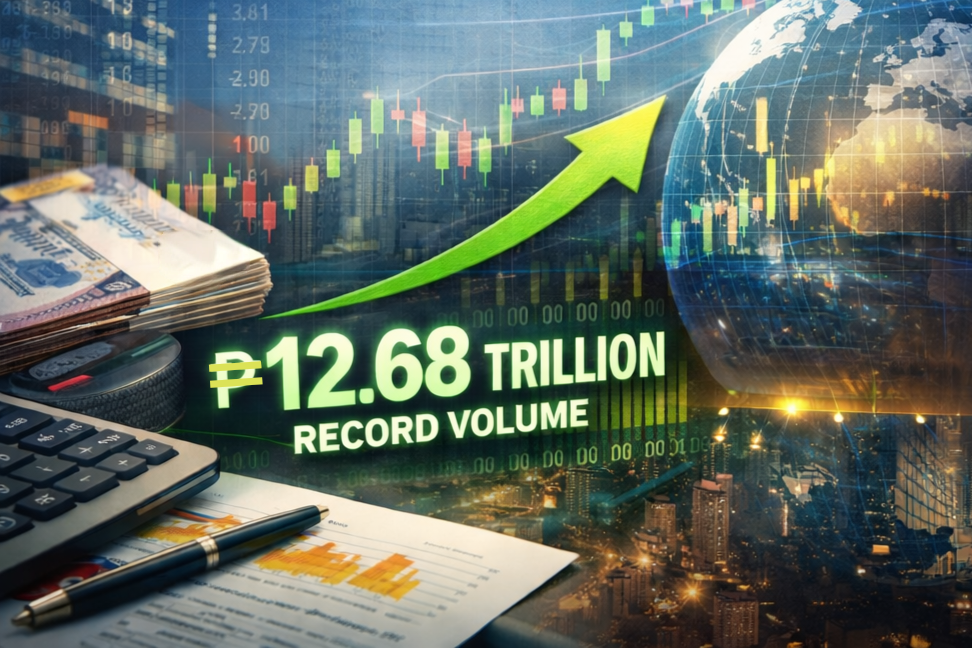

Trading in Philippine government bonds hit an all-time high in 2025, underscoring a sharp turnaround in market liquidity that has strengthened the country’s case for entry into a major global bond index. The surge signals growing investor confidence after years of post-pandemic thin trading.
Annual turnover in government securities climbed to ₱12.68 trillion by end-2025, according to the Bureau of the Treasury, rebounding from a low of ₱2.98 trillion in 2022 as secondary market activity intensified. The Treasury attributed the gains to regular issuance of bills and bonds, consolidation of similar securities, and a push to build clear benchmark tenors—steps aimed at making bonds easier to trade and price.
“The strength we are seeing in the secondary market is the clearest validation of our long-term strategy to deepen the government securities market,” National Treasurer Sharon Almanza said. “By building reliable benchmarks, modernizing market infrastructure, and working closely with our primary dealers, we are creating a market that is more liquid, transparent, and resilient, while ensuring that government financing remains efficient and that the capital market continues to support sustainable economic growth,” she added.
Measures of trading intensity back the shift. The overall turnover ratio for government securities reached 1.05 in 2025, while key benchmarks showed even sharper gains, with five-, seven- and 10-year bonds changing hands 2.5, 1.6 and 3.1 times, respectively—multiples of their 2023 levels.
Retail Treasury Bonds also became more actively traded, posting a turnover ratio of 2.4, a sign that liquidity is broadening beyond institutional players. The Treasury said the rebalancing supports efficient yield formation across maturities, improving price signals for other local debt issuers.
Foreign participation has also picked up, rising to nearly 5% in 2025 from about 2% two years earlier, momentum that has moved the Philippines closer to inclusion in the J.P. Morgan Government Bond Index – Emerging Markets (GBI-EM), a benchmark closely tracked by global investors.
To recall, Finance Secretary Ralph Recto announced in September last year that the country had been placed on Index Watch-Positive by J.P. Morgan, the final review stage before potential admission. “This is a promising development for the Philippines as the potential inclusion of our government bonds into this global index means increased capital inflows; and therefore, more funds for the government to better serve Filipinos. This is an excellent opportunity for us to promote our capital markets to a wider range of investors,” he said.
Index inclusion would raise exposure of peso-denominated government bonds to global portfolios, potentially lowering borrowing costs and channeling more funding into public services and infrastructure. The GBI-EM, launched in 2005, is widely regarded as the industry standard for tracking local-currency emerging market debt, and entry typically prompts automatic inflows from index-tracking funds.
The Philippines’ placement on Index Watch-Positive followed months of discussions led by the Department of Finance and the Bureau of the Treasury and reflects reforms enacted over the past three years, including streamlined tax treaty procedures, expansion of the repurchase agreement market, the launch of a peso interest rate swap market, broader access through Euroclear, and consolidation of benchmark tenors.
J.P. Morgan also cited improved secondary market liquidity and eased tax hurdles as factors that could support scalable index replication. The assessment period is expected to last six to nine months, with peso-denominated government bonds issued from 2023 and with maturities of up to 20 years under review.
Stay updated—follow Philippines Today on Facebook and Instagram, and subscribe on YouTube for more stories.