
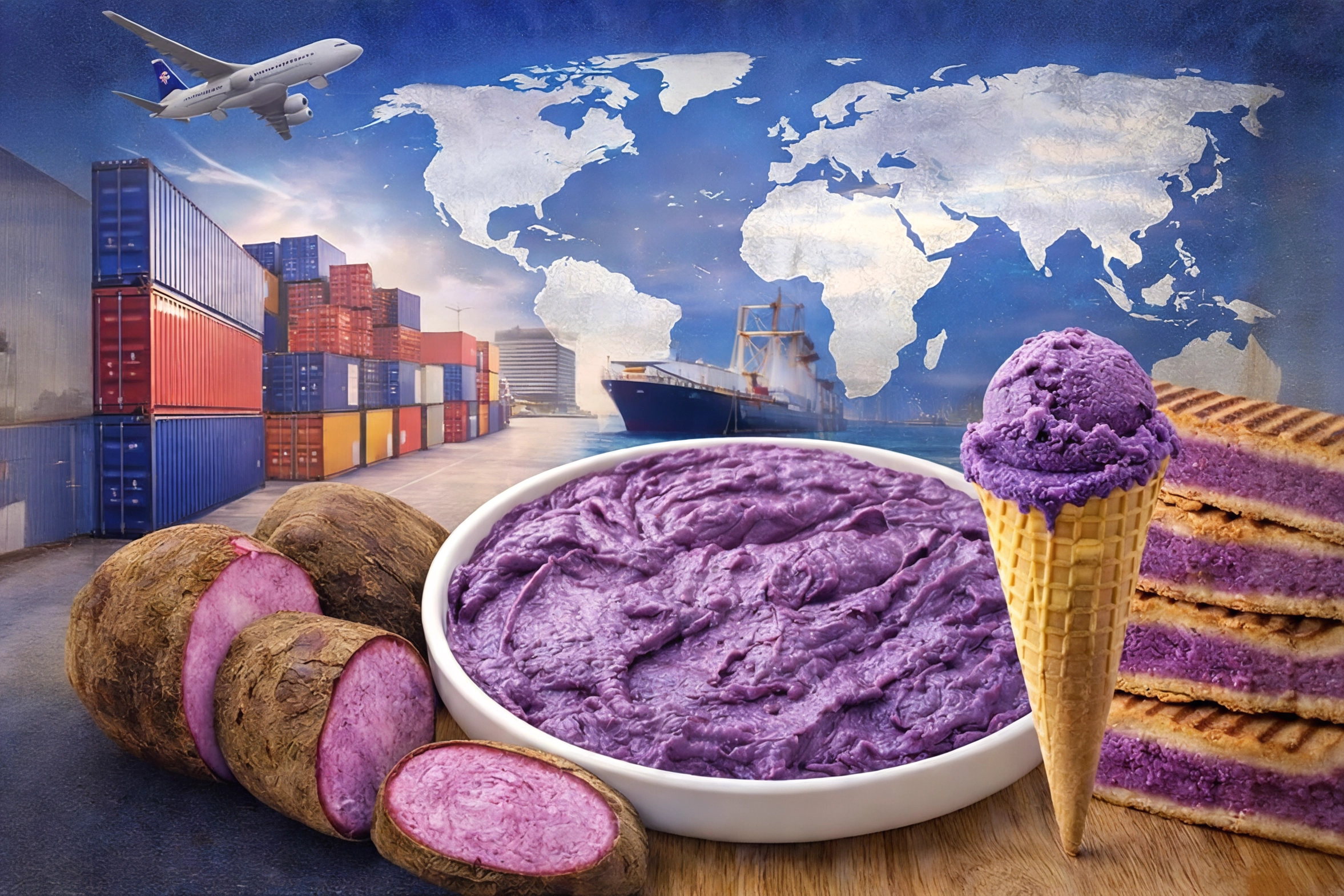

The Philippines’ search for high-value agricultural exports may have found an unlikely frontrunner in a vivid purple yam long associated with local desserts. Surging global demand for natural colorants and authentic Asian flavors pushed ube exports to $3.06 million in 2025, marking its rise from pantry staple to premium ingredient abroad.
The Department of Trade and Industry (DTI) said strong orders from the Middle East, the United States, the United Kingdom, and Italy buoyed shipments of ube and ube-based products last year, underscoring how the once homegrown delicacy is gaining ground as a competitive, value-added export.
Industry data show steady expansion in processed forms such as powder, puree, halaya, and flavor extracts, as foreign manufacturers incorporate ube into ice cream, baked goods, confectionery, specialty beverages, and ready-to-eat desserts. Demand is being driven not only by its distinct flavor profile—mildly sweet and nutty with hints of vanilla—but also by its natural violet hue, prized as an alternative to artificial food coloring.
Exporters said improvements in post-harvest handling, processing, and quality control helped meet stricter international standards, enabling Philippine suppliers to expand beyond niche ethnic markets into mainstream retail and food service. Diversified formats have also extended shelf life, supporting shipments to more distant markets.
Global product development reflects that momentum. Mintel’s Global New Products Database recorded 359 product launches worldwide featuring ube in 2025. While the Philippines accounted for the largest share—largely in cakes, pastries, sweet goods, and dairy products such as ice cream and frozen yogurt—innovation is accelerating overseas.
Japan, China, and the United States have emerged as key markets for new applications. In Japan, ube appears in chilled and shelf-stable desserts. In China, it is used in cakes, pastries, malt drinks, and hot beverages. In the United States, it is gaining traction in dairy-based ice cream and frozen yogurt, as well as sweet biscuits and cookies.
Trade Secretary Cristina Aldeguer-Roque said the crop’s growing international footprint opens doors for exporters to move into higher-value segments and highlights the country’s ability to transform a traditional farm product into a globally competitive offering.
“Behind every ube product enjoyed overseas are Filipino farmers and MSMEs whose dedication sustains their families and rural communities. That is why we continue to strengthen support for the sector by improving quality standards and reinforcing supply chains, so Philippine ube can compete confidently and sustainably in international markets,” Roque said.
The DTI, through its Export Marketing Bureau, said it will continue providing trade promotion support, market intelligence, and capacity-building programs to help exporters deepen and expand their presence in global markets, positioning ube as one of the country’s emerging export stars.
Stay updated—follow Philippines Today on Facebook and Instagram, and subscribe on YouTube for more stories.