


A vow destined for Manila took root in Naga, where the Church of Nuestra Señora de Peña de Francia—known as the Our Lady of Peñafrancia Parish Church—now stands. What was planned to rise along the Pasig River instead shaped a different city, anchoring a devotion that began in the early 18th century.
While much of the Philippines marks Lent through re-enactments of suffering and sacrifice, Naga’s central devotion traces a quieter origin—one grounded in gratitude, healing, and a pledge redirected by circumstance. Long before the large September observances, the story of Inâ began as a personal act of thanksgiving.
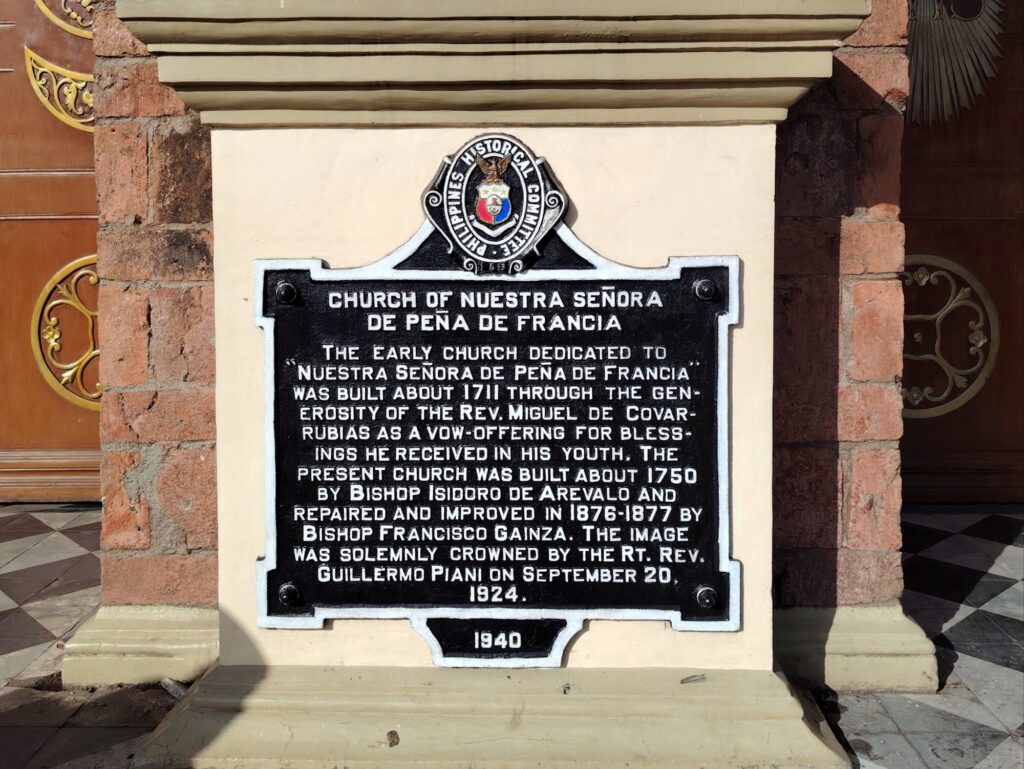
The site, marked in 1940 by the Philippines Historical Committee as a Level II historical landmark, traces its beginnings to around 1710, when Rev. Miguel Robles de Covarrubias, a Spanish priest from San Martín del Castañar in Salamanca, built a small chapel of bamboo and nipa along the river in Naga. Devoted to the Lady of Peña de Francia in Spain, Covarrubias had vowed to build a shrine in her honor after receiving what he regarded as miraculous favors during his youth while studying at the University of Santo Tomas.
That vow was first intended for Manila, where he had planned to construct a stone church along the Pasig River. His path shifted when he accepted an invitation from Dominican Bishop Andrés Gonzales to serve in Nueva Cáceres. There, he became parish priest of the cathedral and later vicar general, serving a community that would ultimately receive the fulfilment of his pledge.

From a small devotional print he carried, Covarrubias commissioned a wooden image of the Virgin, which became the focus of growing devotion. People gathered for novenas and Masses, drawn by accounts of healing attributed to the image. When his left eye became totally blind, he renewed his vow to build a permanent church.
Construction of a more permanent stone church began in 1742 under Bishop Isidoro de Arevalo, replacing the earlier chapel. The structure was completed around 1750 and consecrated in 1759, becoming the original home of the image of Our Lady of Peñafrancia. As devotion grew, the church drew increasing numbers of devotees from across the region.
In 1864, the image was first transferred to the Naga Metropolitan Cathedral due to space constraints, marking the beginning of what would become the Traslación. This practice was later formalized by Bishop Francisco Gainza, who also oversaw repairs and improvements to the church between 1876 and 1877, ensuring it could better accommodate the expanding devotion.

The image itself carries a lineage that predates its arrival in the Philippines. On May 19, 1434, Simón Vela is said to have discovered a hidden image of the Virgin and Child in the mountains of Peña de Francia in Spain, where it had been concealed during Moorish incursions in the 12th century. The discovery followed reported visions, including a voice urging him, “Simón, vela y no duermas,” and earlier prophecies attributed to Juana Fernández, who spoke of signs that would mark the finding of the image and the rise of a shrine. The image became associated with healing, drawing pilgrims to Salamanca, where a sanctuary and convent were later established under Dominican care.
The devotion was carried to the Philippines through clergy and personal piety, taking root in Nueva Cáceres and gradually assuming a more local character. In Naga, the Virgin came to be known simply as Inâ, or mother, reflecting a familiarity shaped by language and practice. Its significance was affirmed in 1895, when Pope Leo XIII declared her the principal patron of Nueva Cáceres and fixed her feast in July. In 1905, Pope Pius X reassigned the celebration to its present September schedule, aligning it with the Nativity of Mary. The image was canonically crowned on September 20, 1924, by apostolic delegate Guillermo Piani, following approval granted in Rome in 1920.
The 20th century brought both expansion and disruption. The shrine was established as a parish on October 30, 1973, with Bishop Concordio Sarte as its first parish priest. Plans for a larger sanctuary eventually led to the construction of a new basilica, while the original church remained a key site of devotion and the starting point of the annual Traslación. In 1981, the original image was stolen, an event that unsettled the region. It was recovered in pieces and returned on September 8, 1982, drawing large crowds despite a typhoon. In 1985, the new church was elevated to a minor basilica under Pope John Paul II and later recognized as a national shrine.

During Lent, when the pace of devotion shifts from large gatherings to quieter forms of prayer, the parish church continues to receive visitors drawn to its history as much as its religious significance. As the original home of the image and the site where the Traslación begins, it remains closely tied to the 18th-century vow that led to its founding.
Stay updated—follow Philippines Today on Facebook and Instagram, and subscribe on YouTube for more stories.