
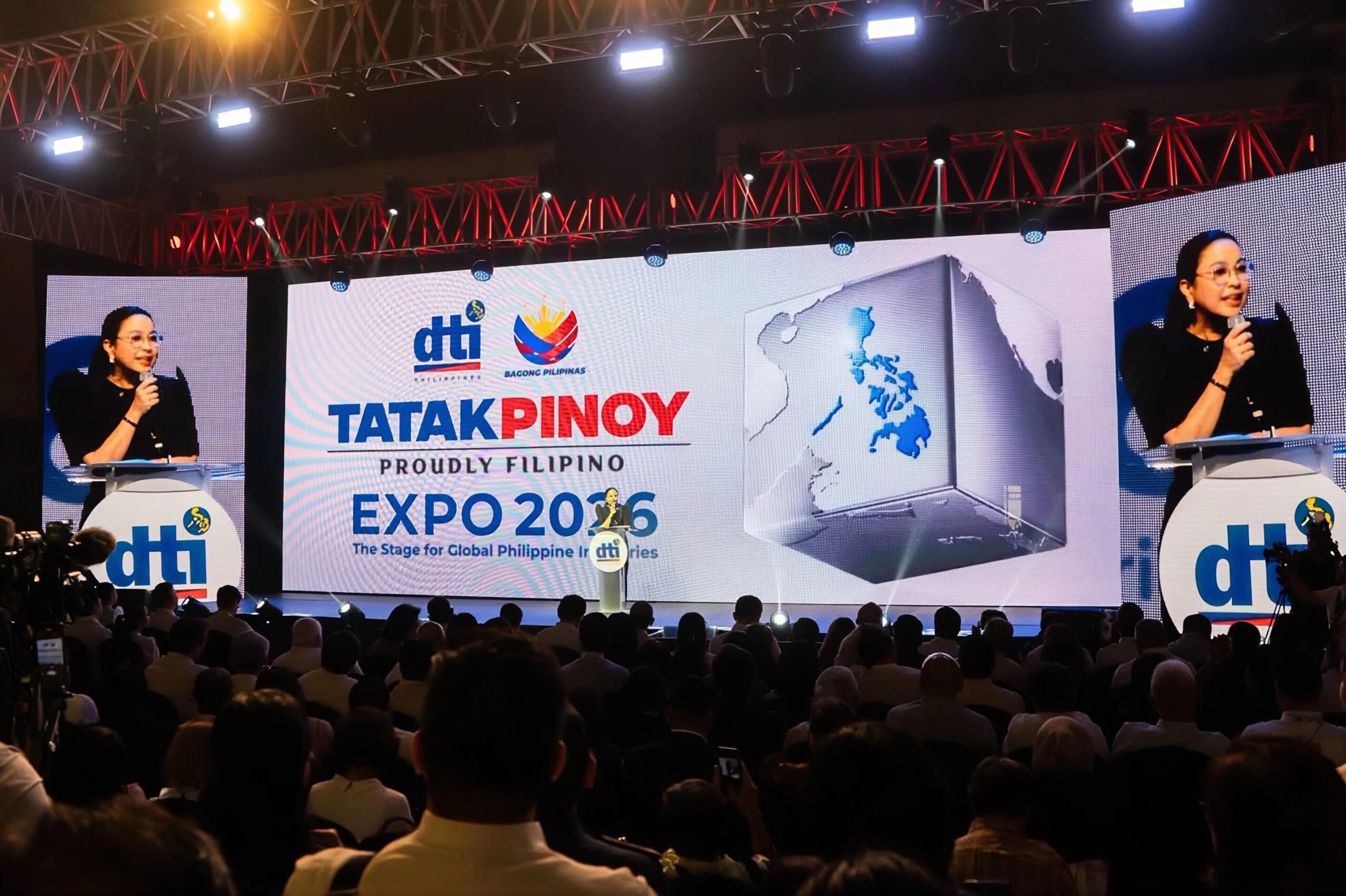

The Philippine government has launched a national certification mark aimed at turning public procurement into a catalyst for industrial growth, as policymakers seek to strengthen domestic manufacturing and increase the visibility of Filipino-made products in global markets.
The Department of Trade and Industry (DTI) formally unveiled the “Tatak Pinoy” seal on May 25 during the Tatak Pinoy: Proudly Filipino Expo 2026 in Pasay City, introducing what officials described as a new benchmark for products and services that meet government standards for quality, innovation, and competitiveness.
The move signals a shift in the government’s industrial strategy—from promoting local products through marketing campaigns to creating economic incentives that reward companies capable of competing globally.
At the center of the initiative is Republic Act No. 11981, or the Tatak Pinoy Act, the country’s first legislated industrial policy. The law seeks to strengthen priority industries, deepen domestic manufacturing capabilities, and help Filipino firms capture a larger share of value within global supply chains.
“The seal is our symbol of high-quality, innovative, and globally competitive products,” Trade Secretary Maria Cristina Aldeguer-Roque said.
The certification is expected to become a key mechanism for identifying firms eligible to benefit from incentives under the Tatak Pinoy framework, including preferential treatment in government procurement.
For businesses, the policy’s most significant feature may be its procurement provisions.
The Tatak Pinoy Act allows local suppliers to secure government contracts even when their bids are up to 25% higher than the lowest foreign offer, provided they meet the law’s requirements. The measure effectively uses the government’s purchasing power to support domestic industries and encourage local production.
“By giving products bearing this seal a direct aggressive preference in government procurement, we are ensuring that public funds are used strategically to buy Filipino, support Filipino, and grow Filipino,” Roque said.
The DTI has positioned the seal as more than a branding tool. Officials said it is intended to signal that Philippine-made products meet standards that can compete in both domestic and international markets.
“We want them now to have a seal. We want them to be branded na ‘Tatak Pinoy’ ito… We need to now put our ‘Tatak Pinoy Proudly Filipino’ seal for the products that are really making it globally,” Roque said.
The initiative comes as the Philippines seeks to build on stronger export performance and expand its role in global manufacturing networks.
According to the DTI, Philippine exports reached a record $22.7 billion in the first quarter, up 12.7% from a year earlier. Roque also cited continued momentum in monthly export growth.
“January nag-increase din again 7.9%, then February we hit an all-time high of 8%, and March we hit again high of 20.4% which is the highest since 1991,” she said.
The government is simultaneously pursuing new free trade agreements with the European Union, Canada, and Chile, while negotiations with India continue.
The Tatak Pinoy program focuses on nine priority industries, including semiconductors, electronics, information technology – business process management, food and agro-processing, automotive and electric vehicles, pharmaceuticals, construction materials, defense manufacturing, and chemical inputs.
Many of these sectors already supply multinational companies but often operate behind globally recognized brands. Policymakers hope the new seal will help create greater recognition for products developed and manufactured in the Philippines while encouraging companies to invest further in local production.
The DTI said consultations for the seal’s implementing guidelines involved more than 300 stakeholders representing 96 companies and industry groups. The guidelines are now in the final stages of approval.
Once fully implemented, the broader Tatak Pinoy Strategy is projected by the government to generate 11.13 million jobs, contribute ₱7.04 trillion to the economy, and produce as much as ₱900 billion in additional state revenues.
For Philippine manufacturers, the launch represents a test of whether industrial policy can move beyond incentives and promotion into a system where government spending directly shapes investment decisions, strengthens domestic supply chains, and builds globally competitive Filipino brands.
Stay updated—follow Philippines Today on Facebook and Instagram, and subscribe on YouTube for more stories.