
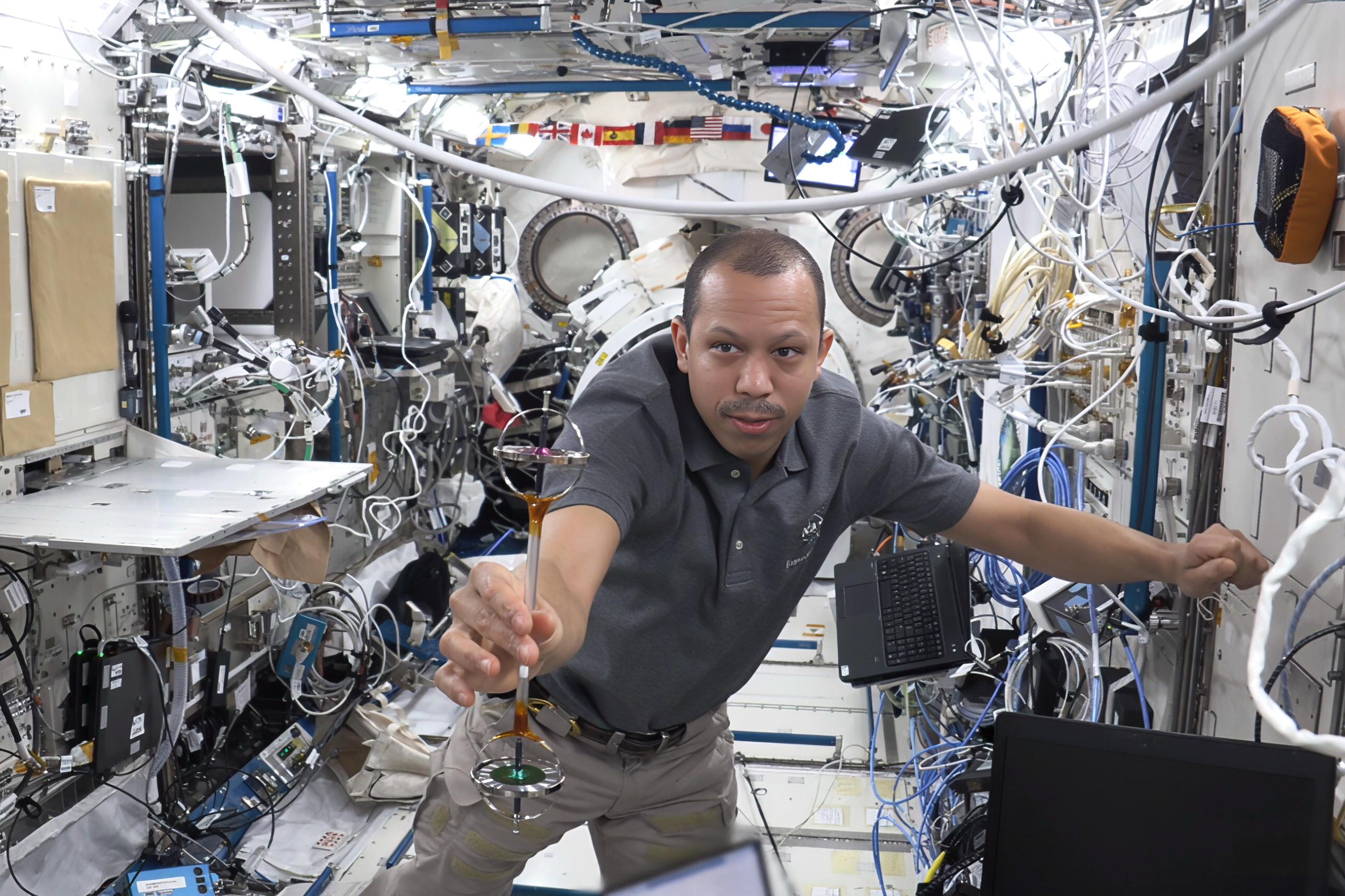

A simple device made of two spinning gyroscopes and a stick has carried three Filipino students into one of the most exclusive laboratories on Earth—the International Space Station (ISS).
What began as a classroom concept at Rizal Technological University became a spaceborne experiment after astronomy students Christopher Tumamac, Ryan Andrew Doña, and Rose Ann Cezar designed a study to explore how paired gyroscopes behave in microgravity. Their project, called “Double Gyroscope,” was selected to represent the Philippines in the 2025 Asian Try Zero-G (ATZG) competition organized by the Japan Aerospace Exploration Agency (JAXA).
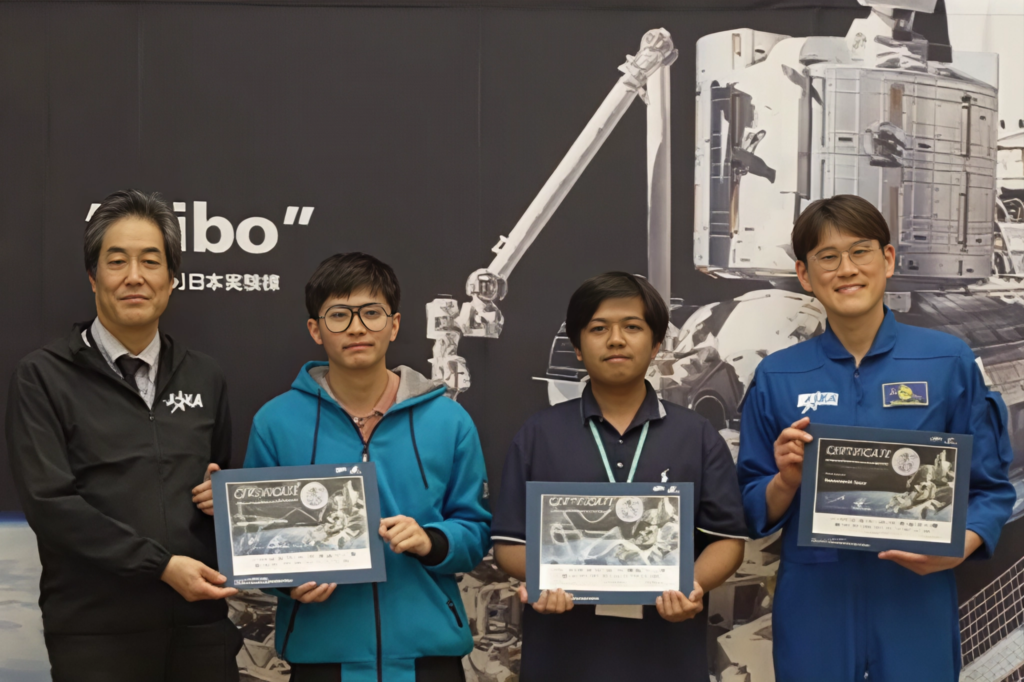
The students were among 11 finalists from across the Asia-Pacific region whose experiments were chosen for testing aboard the orbiting laboratory. Their proposal emerged from 89 submissions nationwide before advancing as one of the Philippines’ official entries to the competition.
NASA astronaut Christopher Williams on March 24 carried out the Double Gyroscope experiment inside the Japanese Kibo module of the ISS while finalists watched through a livestream at the JAXA Tsukuba Space Center in Ibaraki, Japan.
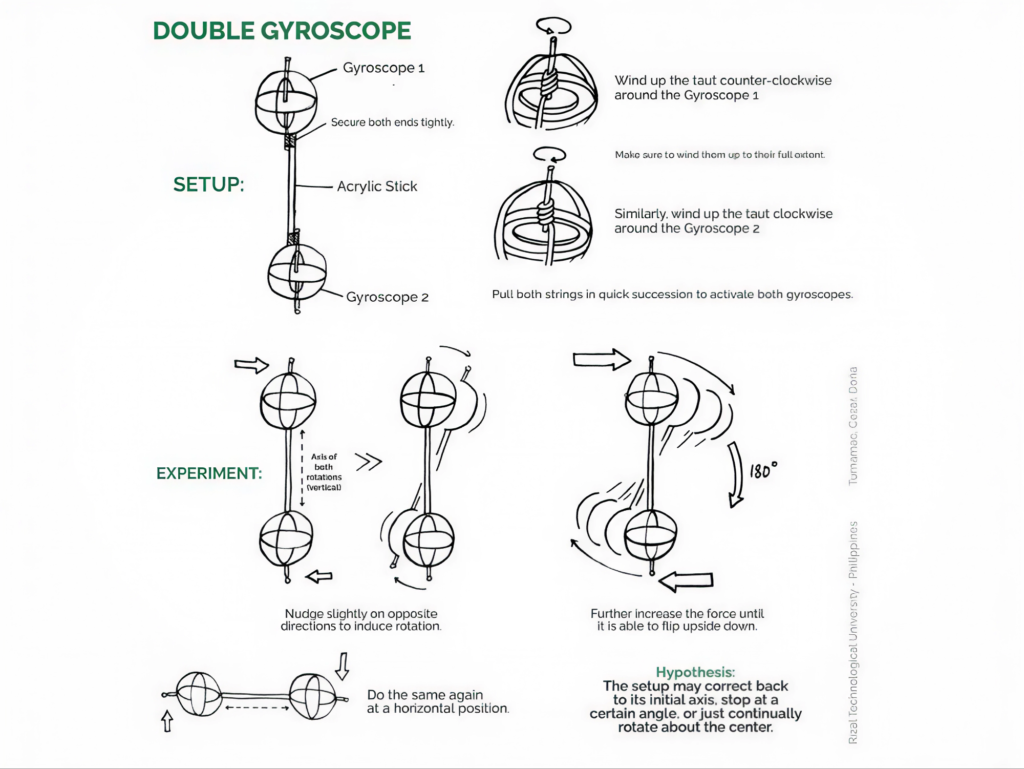
The experiment sought to answer a deceptively simple question: How do spinning objects interact when gravity is largely removed from the equation? The students designed a system consisting of two gyroscopes mounted at opposite ends of a stick and developed predictions about how the device would behave depending on the direction of the spins.
In a video released by JAXA before the demonstration, the team said the system would likely “exhibit precession at a certain angle” when both gyroscopes spun in the same direction. When spinning in opposite directions, they expected the setup to “rotate freely with little to no resistance.”
The study explores principles that reach far beyond the experiment itself. According to the Philippine Space Agency (PhilSA), the behavior of spinning gyroscopes in microgravity helps illustrate how satellites and spacecraft maintain or adjust their orientation in space. Technologies such as reaction wheels and control moment gyroscopes rely on the same fundamental physics to maneuver spacecraft without consuming large amounts of fuel.
PhilSA said the students also hypothesized that opposite spins could largely cancel one another out, creating a system that appears stable or nearly motionless. Small differences in rotational speed, however, could gradually alter the direction the device points over time.
To test those ideas, Williams repeatedly spun the gyroscopes and closely observed their movement aboard the station. PhilSA said the results observed during the demonstration aligned with the hypotheses outlined in the students’ study.
For the three students, the experience offered a rare opportunity to watch an idea developed on Earth tested more than 400 kilometers above it.
Following the event, JAXA Kibo Utilization Center director, Dr. Masaki Shirakawa, and JAXA astronaut Norishige Kanai presented certificates of recognition to the finalists.
Reflecting on the experience, the team described conducting experiments in a weightless environment as both challenging and rewarding, noting that objects can behave differently in space despite careful planning and preparation.
“We are very thankful for this opportunity given to us by PhilSA and (we) hope in the next batches of ATZG, more Filipino students will apply so they can also experience proposing an experiment in zero-gravity, see their experiment carried out, and learn a lot,” the team said.
The achievement continues a growing Philippine presence in space science education. Since 2022, Filipino student experiments selected for ATZG have been conducted aboard the ISS, including studies on the rotation of dumbbell-shaped objects in space, the movement of an oloid in microgravity, and the effectiveness of elastic resistance band exercises in a zero-gravity environment.
The competition is part of the Kibo-ABC program, or Asian Beneficial Collaboration through Kibo Utilization, established under the Asia-Pacific Regional Space Agency Forum. The initiative promotes the use of the Kibo laboratory aboard the ISS, strengthens cooperation among participating countries, and encourages young people to explore how science behaves beyond the limits of Earth.
Results from the 2025 ATZG experiments, including the competition winners, will be presented during a wrap-up session later this year.
Stay updated—follow Philippines Today on Facebook and Instagram, and subscribe on YouTube for more stories.