
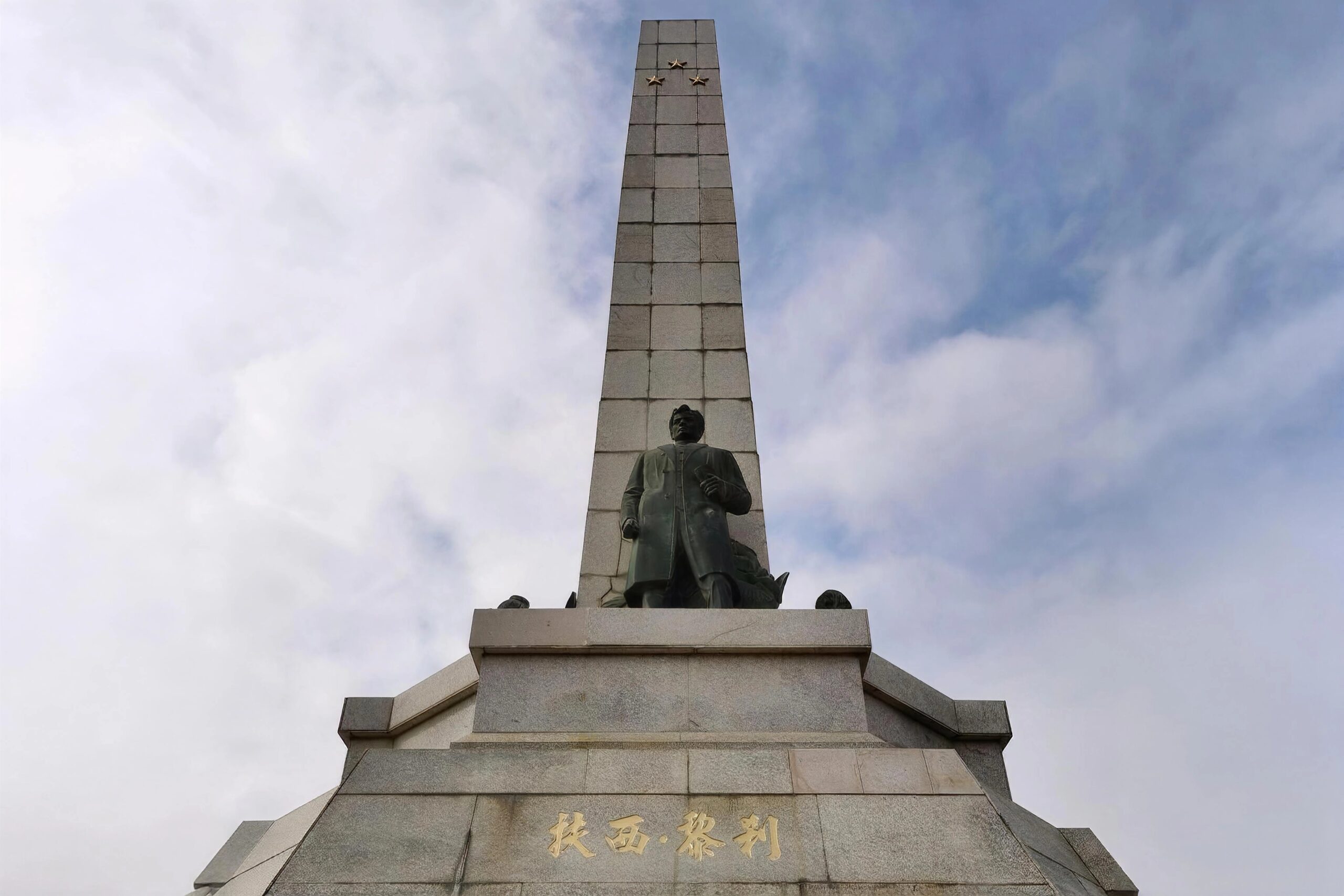

June 19 marks the birth anniversary of Jose Rizal, widely regarded as the Philippines’ national hero, whose novels helped ignite a movement against Spanish colonial rule and whose execution in 1896 transformed him into a symbol of the nation’s struggle for freedom.
But beyond the familiar story of the physician, writer, and reformist lies a lesser-known chapter of his identity: Rizal’s roots can be traced to a Chinese immigrant who arrived in the Philippines more than two centuries before his birth.
For many Filipinos, Rizal is remembered as the author of Noli Me Tangere and El Filibusterismo, the books that exposed the abuses of colonial authorities and challenged a system built on inequality. He is celebrated as a doctor, linguist, educator, scientist, artist, and patriot whose ideas continue to shape the country’s understanding of nationhood.
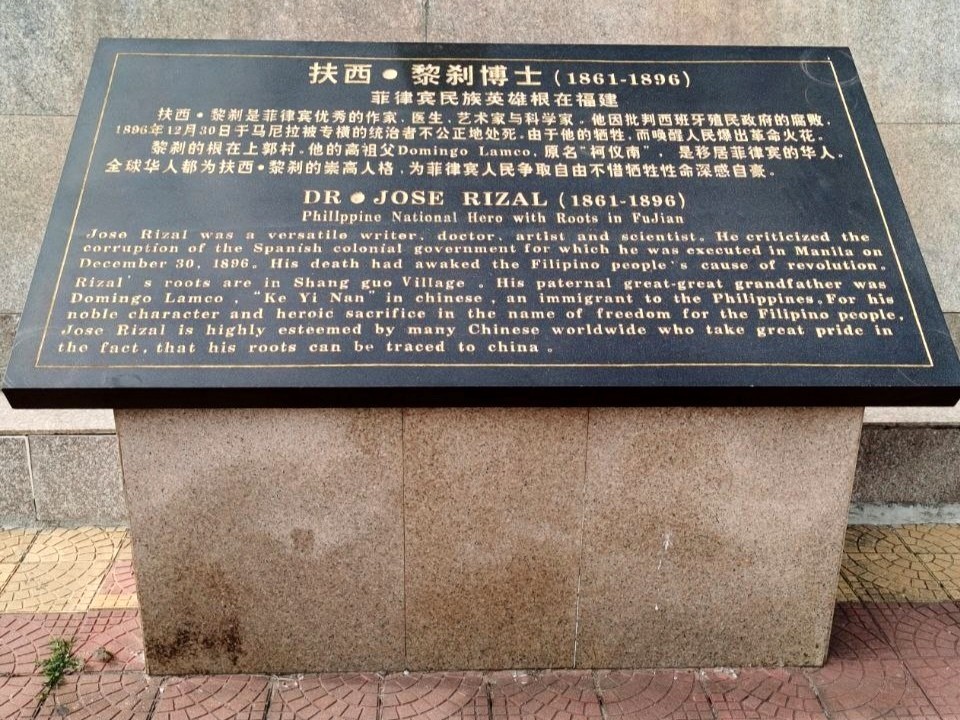
Yet historians in both the Philippines and China have long documented that part of Rizal’s ancestry originated in Fujian province on China’s southeastern coast, a region that has supplied generations of migrants to Southeast Asia.
The story begins with Domingo Lamco, a Chinese immigrant from Fujian who was known in Hokkien as Cua Yi-Lam and in Mandarin as Ke Yi-Nan. Born in the village of Shangguo in Jinjiang City, Quanzhou, Lamco left China during the Qing Dynasty and sailed to the Philippines in the late 17th century.
Like many Chinese migrants of his era, Lamco arrived in a society where opportunities were often accompanied by discrimination. Under Spanish colonial rule, Chinese residents were frequently confined to the Parián, a segregated district in Manila where traders and artisans lived under close supervision. Periodic crackdowns and restrictions made life uncertain for the Chinese community.
Despite those obstacles, Lamco built a successful life. He eventually moved to Laguna province, where he engaged in agriculture and commerce. Seeking to adapt to colonial society, he adopted the surname Mercado for his descendants, a decision that would later become a significant part of one of the Philippines’ most influential family histories.
In 1849, Governor-General Narciso Clavería ordered Filipinos to adopt standardized Spanish surnames from the Catálogo Alfabético de Apellidos. It was during this period that the family acquired Rizal as a second surname, derived from the Spanish word ricial, meaning a green field or pasture.
Several generations later, one of those descendants would be born in Calamba, Laguna, on June 19, 1861.
Jose Protacio Rizal Mercado y Alonso Realonda inherited not only the entrepreneurial spirit and resilience associated with his forebears but also the advantages of a family that valued education. The Mercado family became part of the educated Filipino class known as the ilustrados, whose members played key roles in shaping political and intellectual life during the closing decades of Spanish rule.
Rizal’s Chinese ancestry was never the defining feature of his identity. He saw himself as a Filipino and devoted his life to advancing the rights and dignity of his countrymen. Yet his family history reflects a reality that remains relevant today: the Philippines has long been shaped by migration, cultural exchange, and the blending of different communities.
In many ways, Rizal’s lineage mirrors the story of the nation itself. Chinese traders and settlers had been arriving in the Philippine archipelago long before the Spanish colonial period. Over centuries, they intermarried with local communities, established businesses, and contributed to economic and social development. Their descendants became woven into the fabric of Philippine society.
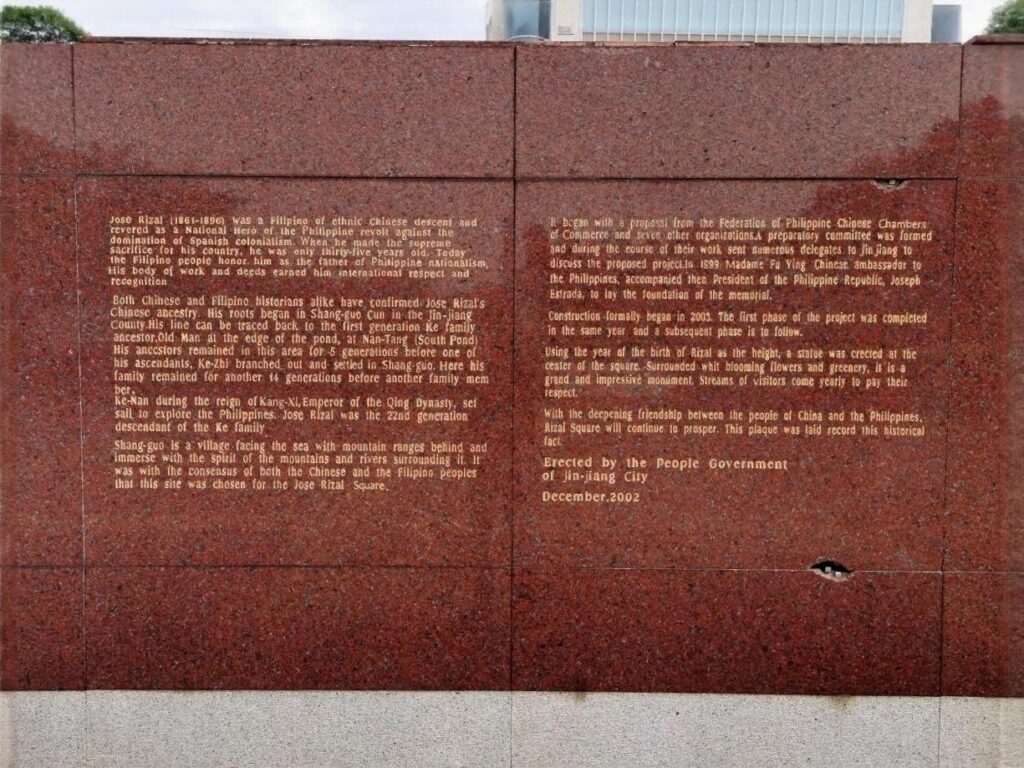
Rizal was among the most prominent examples of this integration. His life demonstrated that identity could be layered rather than singular. He was a Filipino nationalist with Chinese ancestry, educated in Europe, and deeply engaged with global ideas, yet firmly committed to the future of his homeland.
That multicultural heritage resonates in modern-day Philippines, where millions of citizens trace at least part of their ancestry to Chinese immigrants. It also offers a reminder that the country’s history is not a story of isolated communities but of connections forged across seas, generations, and cultures.
The link remains visible today in Shangguo Village, where memorials and markers commemorate Rizal’s ancestral roots. Visitors from both China and the Philippines continue to visit the site, reflecting a shared recognition of a figure whose legacy transcends national borders.
More than 160 years after his birth, Rizal remains revered for his intellect, courage, and sacrifice. But his Chinese ancestry adds another dimension to a life already rich with meaning. It tells a story not only of one man’s journey but also of migration, perseverance, and the enduring contributions of immigrant communities to the making of a nation.
As Filipinos commemorate Rizal’s 165th birth anniversary today, his family history offers an intriguing reminder: the hero who helped define the Filipino nation was himself the product of diverse roots. In an age when questions of identity and belonging continue to shape societies around the world, that aspect of Rizal’s story feels as relevant as ever.
Stay updated—follow Philippines Today on Facebook and Instagram, and subscribe on YouTube for more stories.