
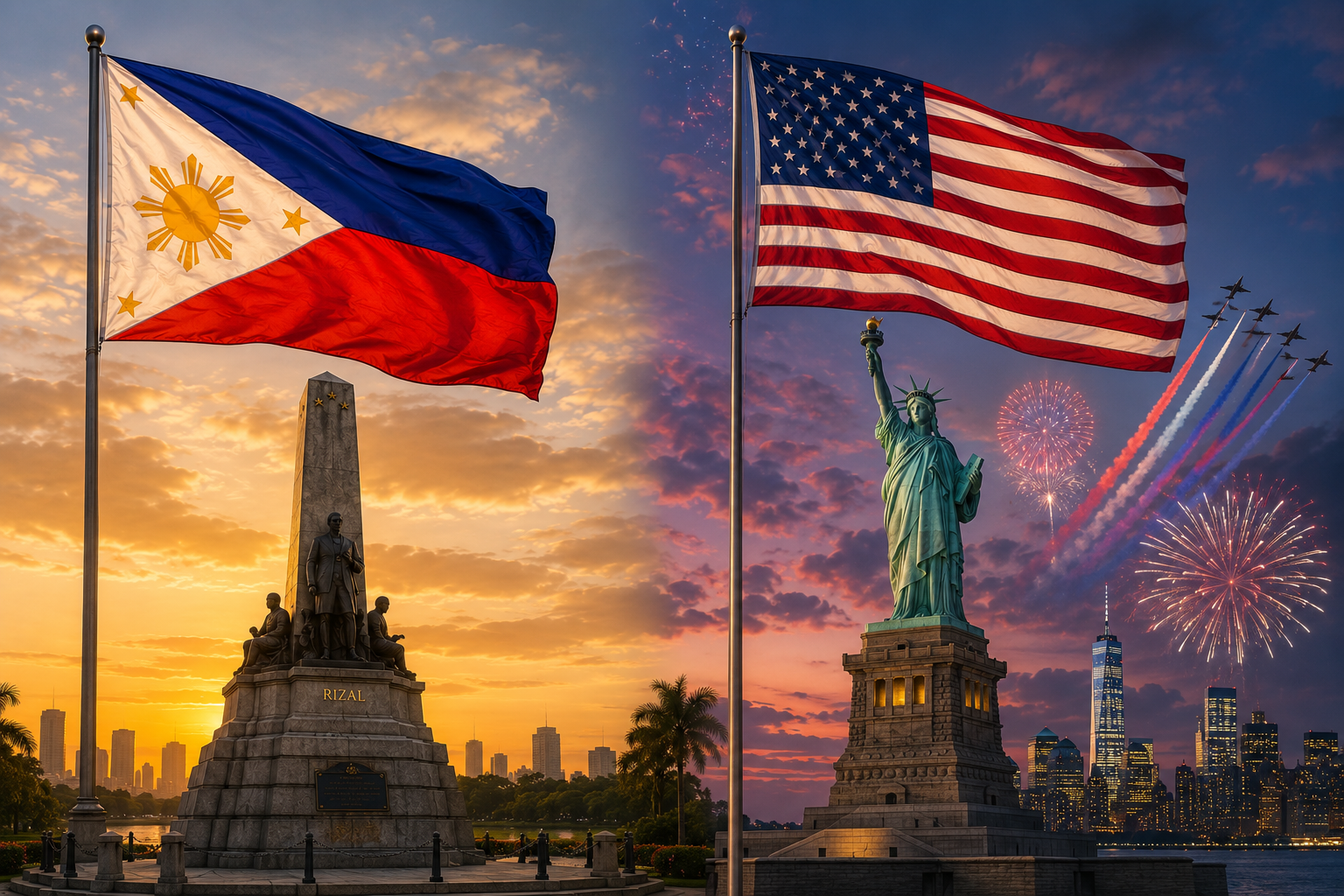

As Americans celebrate Independence Day on July 4, the date evokes a different chapter of history in the Philippines.
For Filipinos, July 4 was once the country’s Independence Day. It marked the moment in 1946 when the United States formally ended nearly five decades of colonial rule, transferred sovereignty to the Philippines and recognized the newly independent republic.
Today, however, it is no longer a public holiday, with the country instead commemorating its independence on June 12.
The shift reflects a conscious effort to redefine Philippine nationhood by placing greater emphasis on the country’s own revolutionary struggle rather than the formal transfer of sovereignty by a former colonial power.
From 1946 to 1962, July 4 was celebrated as Philippine Independence Day. The date commemorated the inauguration of the Third Philippine Republic under President Manuel Roxas after the United States fulfilled its commitment under the Tydings-McDuffie Act and formally recognized Philippine independence through the Treaty of Manila.
The ceremony at Manila’s Luneta Park featured the lowering of the American flag and the raising of the Philippine flag, symbolizing the end of American sovereignty over the archipelago. The occasion came after World War II had devastated the country, making independence not only a political milestone but also a symbol of national recovery.
The road to that moment, however, had been far longer. Filipino revolutionaries led by Emilio Aguinaldo declared independence from Spain on June 12, 1898, in Kawit, Cavite, after more than three centuries of Spanish colonial rule. The declaration introduced the Philippine flag and the national anthem, but the fledgling republic never gained international recognition.
Instead, Spain ceded the Philippines to the United States under the Treaty of Paris later that year, triggering the Philippine-American War as Filipino forces resisted a new colonial ruler. American administration lasted for almost five decades before the Philippines entered a 10-year Commonwealth period in 1935 under the Tydings-McDuffie Act, with independence originally scheduled for 1946.
The transition was interrupted by the Japanese occupation during World War II. Although Japan proclaimed the Philippines independent in 1943 under President Jose P. Laurel, historians generally regard the wartime republic as a Japanese-sponsored government that lacked genuine sovereignty. Following Japan’s defeat, the Commonwealth government was restored, paving the way for the long-promised independence on July 4, 1946.
The country’s official Independence Day changed under President Diosdado Macapagal, who argued that the nation’s birth should be traced to the Filipino declaration of independence rather than to its later recognition by another country.
In 1962, Macapagal moved the national celebration to June 12 through a presidential proclamation. Two years later, Congress enacted Republic Act No. 4166, which formally designated June 12 as Independence Day while redesignating July 4 as Philippine Republic Day.
Macapagal maintained that June 12 represented the Filipino people’s assertion of their right to self-determination. He frequently compared the move to the United States’ own observance of July 4, 1776, even though Britain formally recognized American independence only in 1783.
The change also reflected a broader effort to strengthen a distinctly Filipino historical narrative. While July 4 celebrated international recognition of sovereignty, June 12 highlighted the aspirations and sacrifices of Filipinos who fought for freedom long before independence was formally acknowledged by foreign powers.
Although Philippine-American Friendship Day had already been established by President Ramon Magsaysay in 1955 and observed every November 15, the meaning of July 4 continued to evolve after Independence Day was moved to June 12. During the administration of President Ferdinand Marcos Sr., the July 4 observance increasingly became identified with Philippine-American Friendship Day, shifting the focus from the republic’s founding to the two countries’ alliance. Republic Day gradually receded as Manila and Washington strengthened their political, military, and economic partnership during the Cold War.
The observance remained largely unchanged until the presidency of Corazon Aquino. In 1987, Aquino signed the Administrative Code, which omitted July 4 from the list of regular national holidays. She took the view that there was no compelling reason to retain a public holiday centered on Philippine-American relations, ending the date’s official status on the national calendar.
Although no longer a holiday, July 4 remains one of the most consequential dates in Philippine history. It marked the formal end of American colonial rule, the birth of the Third Philippine Republic, and the transfer of sovereignty that established the Philippines as an independent nation.
Today, Filipinos celebrate Independence Day every June 12, honoring the 1898 declaration in Kawit that proclaimed the Philippines’ independence from Spain and the country’s long struggle for self-determination.
July 4, meanwhile, remains a pivotal chapter in Philippine history—not as the country’s Independence Day, but as the date its sovereignty was formally recognized, underscoring the complex legacy of Philippine-American relations that continues to shape ties between the two allies.
Stay updated—follow Philippines Today on Facebook and Instagram, and subscribe on YouTube for more stories.