
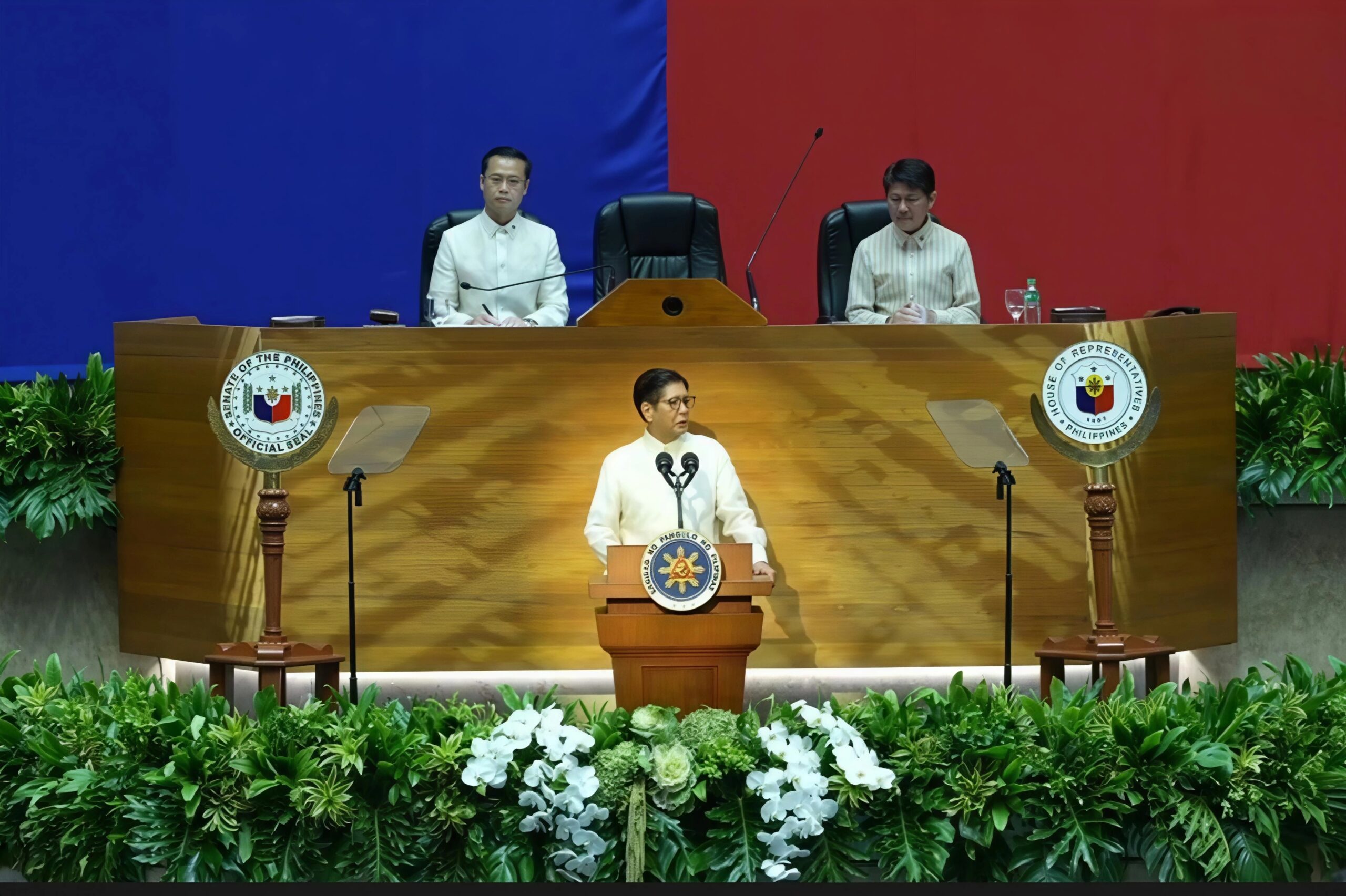

President Ferdinand Marcos Jr. returned to Congress on Monday, July 27, with a message that looked beyond the crises his administration has confronted over the past year and toward what he described as the country’s long-term security.
In a State of the Nation Address (SONA) that lasted 1 hour and 26 minutes, Marcos reported on the government’s anti-corruption campaign; its response to the economic effects of the conflict in the Middle East; and measures to strengthen disaster preparedness, energy security, transport, education, and national defense.
Together, he framed them as part of a broader effort to make the Philippines more secure and self-sufficient in the years ahead.
The reckoning begins
Marcos began his address by returning to the issue that dominated last year’s SONA—alleged irregularities in flood control projects.
He said the government carried out what he described as a broad and thorough investigation, following the evidence wherever it led.
“Gaya ng aking ipinangako sa inyo, nagsagawa tayo ng malawakan at malalimang imbestigasyon, na walang pagkiling kahit kanino man. Masusi nating sinuri, at sinundan kung saan tayo itinuro ng ebidensya.”
According to the President, the investigation has resulted in criminal cases against contractors, senior government officials, and lawmakers. He added that the Office of the Ombudsman is nearing the filing of multiple cases against former House speaker Martin Romualdez, his cousin.
Marcos acknowledged that pursuing the investigations carried personal consequences.
“Masakit man sa akin ito ngunit kailangan nating gawin ang tama.”
He then delivered one of the speech’s defining lines.
“Hindi ako Pangulo ng aking pamilya. Hindi ako Pangulo ng aking kaibigan. Ako ay Pangulo ng Pilipinas at ang tungkulin ko ay sa inyo: ang aking mga kapwa Pilipino.”
The statement drew sustained applause inside the Session Hall of the House of Representatives at the Batasang Pambansa Complex.
Marcos said the government also acted to recover public funds and stop payments for projects he described as defective, fake, or non-existent.
Nearly ₱25 billion in money and assets had been recovered, frozen, or preserved, he said, while more than ₱800 million had already been returned to the National Treasury.
He said all funds eventually recovered from those found liable would likewise be returned to the Treasury.
The President said prosecution of the cases would continue before the Office of the Ombudsman, the National Prosecution Service, and the courts.
Beyond the investigations, Marcos said the administration had begun reforms within the Department of Public Works and Highways.
He said the government recruited new engineering graduates alongside existing personnel, reviewed projects from planning to implementation, checked material costs against prevailing market prices, and strengthened oversight through the Transparency Portal, Integrity Chain, and partnerships with civil society organizations.
Marcos also credited the Isumbong sa Pangulo platform for helping expose irregularities.
“Ang inyong pagbabantay at pakikialam sa pamahalaan ay ang susi sa paglaban sa katiwalian.”
He argued that protecting public funds enabled the government to redirect resources toward programs intended to help Filipinos during a period marked by rising energy costs and global uncertainty.
Weathering a turbulent world
Marcos said the conflict in the Middle East prompted the government to immediately declare a State of National Energy Emergency in March, allowing agencies to focus resources on mitigating its impact on Filipinos.
He said the government’s first priority was assisting overseas Filipino workers caught in the conflict.
More than 12,000 overseas Filipino workers (OFWs) have been safely repatriated since the war began, while more than 140,000 others received assistance that included food, financial aid, medical care, and temporary shelter.
Returning workers were assisted through the AKSYON Fund, the OWWA-Kabuhayan Program, Public Employment Service Office referrals, and Bayanihan para sa Balikbayang Manggagawa job fairs.
Marcos also announced that returning OFW teachers would be deployed to public schools where they are most needed.
To stabilize domestic fuel supply, the President said the Philippines secured alternative oil imports from Japan, South Korea, Oman, India, Russia, and China despite disruptions in the Strait of Hormuz.
He said these supplies were sufficient to meet the country’s requirements for nearly two months.
Marcos said the government also coordinated with Iran to help ensure the safety of thousands of Filipino seafarers in the Strait of Hormuz.
To cushion consumers from higher fuel prices, he said the administration worked with oil companies to stagger price increases and later required successive price rollbacks.
The government also suspended for three months the excise tax on liquefied petroleum gas (LPG) and kerosene after Congress passed the necessary law.
Other measures included limiting increases in the price of imported rice, arresting and filing charges against those accused of profiteering during the energy emergency, expanding job fairs nationwide, encouraging banks and e-wallet providers to reduce online transaction fees, and granting loan payment relief through banks, the Government Service Insurance System (GSIS), Social Security System (SSS), National Home Mortgage Finance Corporation (NHMFC), and the Pag-IBIG Fund.
Marcos said the government, likewise, expanded food assistance.
More than 26,000 metric tons of rice have been distributed to over 2.5 million families, with the program intended to eventually reach 8 million families.
He added that the Benteng Bigas Meron Na program now benefits more than 12 million Filipinos, while more than 800 KADIWA outlets continue connecting consumers directly with farmers and fisherfolk.
The government also provided assistance to nearly 2 million farmers and fisherfolk under the Presidential Assistance to Farmers, Fisherfolk, and Families (PAFFF) during the period of elevated fuel prices.
Marcos said safeguarding public funds made these interventions possible.
“Ang pera ng taumbayan na muntik mapunta sa bulsa ng mga tiwaling opisyal, ay naisalba natin. At sa halip ay nagamit natin sa mabuti, at para sa tunay na kapakanan ng mamamayan.”
He said the experience underscored three lessons for the administration: the importance of energy and food security, the need for government to respond quickly to crises, and the resilience of Filipinos in the face of adversity.
Building resilience
If the Middle East crisis underscored the need for stronger institutions and faster government action, Marcos said recent disasters at home reinforced another priority: building a country better prepared for future emergencies.
The President cited the powerful earthquake that struck parts of the Visayas and Mindanao earlier this month, saying the government had shifted from simply responding to disasters toward anticipating them.
More than 600,000 families received assistance following the earthquake, while over ₱3 billion was released for food, medicine, financial aid, and shelter, he said. Electricity, water, telecommunications, and road access have since been restored in affected communities.
Marcos said the experience affirmed the administration’s move away from what he described as a reactive approach to disaster management.
“We have moved on from the reactive approach. Now, we are not only proactive, but predictive as well, aided by digital tools.”
He said the government has built a nationwide disaster logistics network designed to move relief supplies more quickly during emergencies.
The system consists of primary disaster resource centers in Luzon and the Visayas, with another being established in Mindanao, supported by 15 hubs, 76 spokes, and 919 last-mile facilities across the country.
According to Marcos, the network now enables emergency food and relief supplies to reach affected communities within 24 hours, significantly reducing response time after disasters.
The President also highlighted the deployment of Mobile Energy Systems, portable power units intended to restore electricity in disaster-hit areas while damaged infrastructure is being repaired.
He said the government has, likewise, strengthened emergency communications through the Government Emergency Communications System and the country’s first satellite-to-mobile service, allowing communication even when conventional networks fail.
Marcos also announced the adoption of a State of Imminent Disaster, which he said would allow government agencies to prepare and mobilize resources before calamities strike rather than waiting until after damage has occurred.
Drawing together the lessons from the Middle East conflict and the recent earthquake, Marcos said the administration’s priorities have evolved beyond simply responding to crises.
“And so, taking all these lessons to heart, our overarching mission and all our conscious efforts henceforth must not be to simply uplift, but to ensure security and self-sufficiency of our nation and of our fellow Filipinos.”
Powering the future
Marcos said achieving that goal would require long-term investments in infrastructure, transportation, food security, and energy—areas he described as essential to making the country more resilient and self-reliant.
He said major railway projects are beginning to reshape public transportation, with the North-South Commuter Railway expected to significantly reduce travel time between Central Luzon and Metro Manila.
The President also cited the progress of MRT-7, which he said would provide an alternative route linking Quezon City and Bulacan, while ongoing bus rapid transit projects are intended to improve urban mobility.
Marcos said the government continues to promote the transition to electric vehicles through expanded charging infrastructure and incentives aimed at encouraging wider adoption.
He also pointed to major road projects, including the South Luzon Expressway Toll Road 4 (SLEX TR4) and new bridge projects intended to improve connectivity and reduce travel time between regions.
Beyond transportation, Marcos said the government is strengthening disaster-resilient infrastructure.
He cited the construction of Ligtas Pinoy Centers, which are designed to serve as evacuation centers during calamities and as community facilities during normal times.
The administration is also pushing for the passage of a new National Building Code, which Marcos said would establish safer and more climate-resilient construction standards.
To address persistent flooding, he said the government has begun implementing Oplan Kontra Baha, while also calling for stricter enforcement of the Ecological Solid Waste Management Act, saying clogged waterways continue to worsen flooding in many communities.
Marcos then turned to agriculture, describing food security as a central component of national resilience.
He said the administration is expanding irrigation systems, increasing farm mechanization, and investing in technologies intended to improve agricultural productivity and reduce dependence on imported food.
Energy security, however, occupied the largest portion of the President’s vision for the future.
Marcos said the government is accelerating petroleum exploration by opening new service contracts, including areas in the Bangsamoro Autonomous Region in Muslim Mindanao, to strengthen domestic energy supply.
He also announced plans to develop the country’s hydrogen industry as part of efforts to diversify future energy sources.
The President reiterated his support for introducing nuclear energy into the country’s power mix, saying it would help ensure a more stable and reliable electricity supply while reducing dependence on imported fuel.
Marcos also renewed his call for the passage of the Sariling Kuryente Act, saying the measure would allow consumers to generate electricity for their own use and sell excess power back to the grid.
He, likewise, urged Congress to amend the Electric Power Industry Reform Act (EPIRA) to modernize the country’s electricity sector and make it more responsive to changing technologies and consumer needs.
The President also called for reforms to reduce systems loss, saying unnecessary costs resulting from inefficiencies in power distribution should no longer be passed on to consumers.
Taken together, Marcos said, the initiatives form part of a broader effort to strengthen the country’s capacity to withstand future shocks while reducing its dependence on external sources of food and energy.
“Kung tunay nating nais ang isang bansang ligtas, matatag, at may kakayahang harapin ang anumang pagsubok, kailangan nating tiyakin ang ating seguridad at sariling kakayahan sa pagkain at enerhiya.”
Investing in people
Marcos said investments in infrastructure and energy would have little meaning without parallel investments in the people expected to drive the country’s future.
He said the administration’s social protection floor, introduced at the start of his term, was designed to provide support during times of crisis through programs such as DOLE Integrated Livelihood and Emergency Employment Program (DILEEP), Tulong Panghanapbuhay sa Ating Disadvantaged/Displaced Workers (TUPAD), Assistance to Individuals in Crisis Situations (AICS), and the Risk Resiliency Program, while creating more stable employment remained the government’s long-term goal.
The President said the SSS, GSIS, and Pag-IBIG Fund continue to provide workers with protection throughout their careers—from retirement and emergencies to affordable housing. He noted that more than 500,000 housing units have been completed or financed under the expanded Pambansang Pabahay para sa Pilipino Program (4PH), while the Pag-IBIG housing loan ceiling has been increased to ₱10 million to make homeownership more accessible.
Marcos also cited expanded benefits for migrant workers, including insurance now covering nearly 7 million OFWs, higher minimum wages for Filipino domestic workers in several countries, and increased pensions for retired uniformed personnel. He added that about 44 million Filipinos are now covered by the SSS, including workers in the informal sector, while contract-of-service and job-order personnel in government have received additional support for their mandatory contributions.
He described education as the administration’s foremost investment, emphasizing lifelong learning, stronger Senior High School work immersion, expanded technical-vocational education, and improved access to higher education. The President said the number of Philippine institutions included in the World University Rankings for Innovation has grown from 12 in 2022 to 140, while the Office of the President has launched the Presidential Scholars program, providing ₱100,000 each to five students in every barangay.
Marcos said preparing Filipinos for an increasingly digital economy also requires new skills.
“AI is here to stay; and so we adopt it to harness its potential to enhance critical sectors, from our educational system to our industries.”
According to the President, government-led AI readiness programs have already reached at least 1.8 million students, parents, and teachers, while scholarships, training, and innovation programs seek to strengthen critical thinking, creativity, and competitiveness.
The President also highlighted expanded healthcare initiatives, saying the Yaman ng Kalusugan Program (YAKAP) has already served 4.5 million Filipinos, while the Guaranteed and Accessible Medications for Outpatient Treatment (GAMOT) program now provides access to essential medicines through more than 2,000 accredited providers. He added that the list of medicines exempt from value-added tax has grown to more than 2,000, covering treatments for cancer, hypertension, diabetes, and mental health conditions.
“Sa buwis na ito na ating tinanggal, ang side effect diyan ay mas mababang presyo nito sa botika.”
Securing the nation
Marcos closed his address by linking the country’s future security to sustained economic growth, stronger regional cooperation, and the continued defense of Philippine sovereignty.
The President said the government continues to attract investments through policies that streamline business processes and reduce red tape. Over the past three years, he said, more than ₱6 trillion in investments have been facilitated through the Green Lanes initiative, with projects expected to generate over 400,000 jobs.
He also highlighted the expansion of economic zones and the country’s push into emerging industries, including advanced manufacturing, technology, and logistics. Among them is the Pax Silica Industrial Hub, which he described as an AI-driven industrial ecosystem. Marcos also announced plans for the country’s first spaceport in Cagayan, with a sounding rocket launch test scheduled for next year in partnership with a South Korean aerospace company.
Marcos said regional cooperation remains vital to addressing common challenges. During the country’s ASEAN chairmanship this year, he said member states strengthened cooperation on food, energy, and digital connectivity, citing the ASEAN Plus Three Emergency Rice Reserve System, the ASEAN Digital Economy Framework, and the Framework Agreement on Petroleum Security.
“Peace and order are the foundations of security, for our country, for our region, and for the world.”
He also pointed to progress in the government’s peace process, including the planned formalization of the peace agreement with the Cordillera Bodong Administration (CBA) and the Cordillera People’s Liberation Army (CPLA) and preparations for the first regular parliamentary elections in the Bangsamoro Autonomous Region in Muslim Mindanao.
Turning to the West Philippine Sea, Marcos reaffirmed the government’s commitment to uphold the landmark 2016 Arbitral Award through peaceful and lawful means.
“Your government will do all that is necessary to continue upholding this Award, utilizing every peaceful and legal means available to the Republic against any attempt, foreign or domestic, to undermine this achievement.”
The President also honored members of the Armed Forces of the Philippines, the Philippine Coast Guard, and Filipino fisherfolk, saying they continue to defend the country’s rights despite persistent risks.
Marcos ended his fifth State of the Nation Address with a call for unity, urging Filipinos to stand together in the face of challenges at home and abroad.
“We are respectful, and we are dignified. We are Filipinos, and we do not yield.”
With two years remaining in his term, the President pledged to complete his administration’s priorities and appealed for continued public support.
“Let us continue the work that we have started to make the Philippines the country that Filipinos deserve,” Marcos said.
“We do this for our children. We do this for our future. We can but do this, because we love our country and we love our people.”
Stay updated—follow Philippines Today on Facebook and Instagram, and subscribe on YouTube for more stories.