
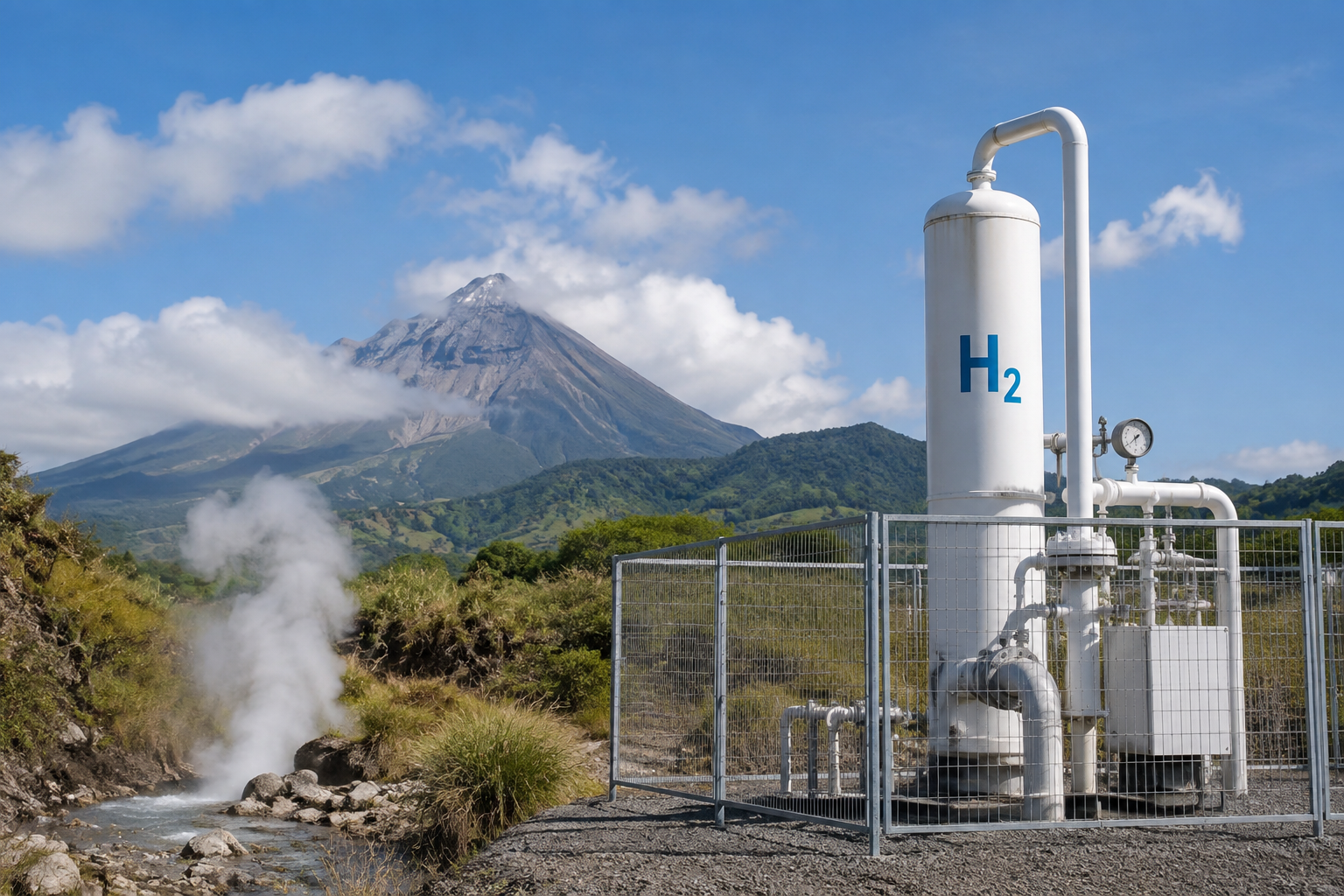

The global race to unlock naturally occurring hydrogen has shifted to the Philippines, where U.S.-based startup Koloma has secured exclusive rights to explore one of the world’s most promising geological regions for the emerging clean energy resource.
The company announced that the Philippine government has awarded it Service Contract 92, covering parts of western Zambales, expanding its footprint in Central Luzon to more than 4,100 square kilometers (1,600 square miles). The latest award marks Koloma’s third hydrogen exploration contract in the country following two service contracts granted in October 2025 during what the government described as the world’s first competitive bidding round for natural hydrogen exploration.
The move underscores growing confidence that the Philippines could hold commercially viable deposits of natural, or geologic, hydrogen—hydrogen gas produced underground through natural geological processes rather than manufactured using electricity or fossil fuels.
“The Philippines has the largest natural hydrogen seeps anywhere on the planet,” Koloma Inc. chief executive Pete Johnson said. “We have reason to believe that these seeps are connected to very large accumulations.”
Natural hydrogen has drawn increasing attention since scientists confirmed that the Earth continuously generates hydrogen through serpentinization, a process in which groundwater reacts with iron-rich rocks such as olivine and pyroxene. Unlike conventional hydrogen production, the resource already exists beneath the Earth’s surface and requires exploration rather than industrial manufacturing.
The U.S. Department of Energy estimates that underground formations worldwide may contain trillions of metric tons of natural hydrogen, although the industry’s biggest challenge remains identifying deposits large enough to support commercial production.
Koloma has emerged as one of the sector’s leading explorers, backed by about $400 million from investors including Bill Gates’ Breakthrough Energy, Mitsubishi Heavy Industries, and Amazon. The company has been evaluating geological formations across the United States, Australia, and other regions before expanding its search in the Philippines.
Johnson said the newly awarded area lies within the broader geologically active Zambales region, though not directly adjacent to Mount Pinatubo. While the project could become Koloma’s first commercial production site, determining whether the area contains recoverable hydrogen reserves will require at least two years of exploration and evaluation.
A commercial discovery would represent a milestone for the nascent natural hydrogen industry while offering the Philippines a potential domestic energy source as it seeks to reduce reliance on imported fuel.
“It’s the fastest-growing country in Asia, with an economy that’s growing really fast and modernizing really fast. And their incremental unit of power is made by burning diesel,” Johnson said.
The Philippines relies heavily on imported oil, coal, and natural gas, leaving it exposed to global fuel price volatility. Government officials believe a successful natural hydrogen discovery could strengthen long-term energy security while supporting the country’s decarbonization goals.
“If discovered in commercially viable quantities, natural hydrogen could strengthen the country’s energy security at no cost to taxpayers, while providing a zero-emission fuel source for our power grid, industries, and agricultural sectors. We look forward to continuing our collaboration with Koloma in this effort,” Energy Secretary Sharon Garin said.
Natural hydrogen is increasingly viewed as a potential new primary energy source—the first since the commercialization of nuclear power in the 1950s. Because the hydrogen already exists underground, it avoids many of the energy-intensive processes required to produce so-called green or blue hydrogen, reducing the need for large electricity inputs, water consumption, and carbon management infrastructure.
If commercially viable reservoirs are found, natural hydrogen could supply low-carbon fuel for electricity generation, fertilizer production, data centers, sustainable aviation fuel, heavy transport, and other hard-to-abate industries. Unlike wind and solar power, underground hydrogen reservoirs could provide a continuous energy supply independent of weather conditions.
Koloma says its exploration strategy combines proprietary geological datasets, advanced geochemical analysis, and geophysical surveys to identify areas where hydrogen has formed, migrated, and accumulated beneath dome-shaped rock structures before drilling exploratory wells.
The company is also advancing work under its earlier Philippine contracts. According to the Department of Energy, Koloma has begun a 2D seismic survey across its native hydrogen exploration projects in Pangasinan and Zambales and could drill its first exploratory well by late 2026 or the first quarter of 2027.
Department of Energy Undersecretary Alessandro Sales said Koloma has committed US$8 million to US$9 million over a seven-year development period covering its existing service contracts, including the cost of drilling the first exploration well.
Beyond the Philippines, Koloma is pursuing natural hydrogen exploration projects and partnerships across four continents as competition intensifies to commercialize what many in the energy industry see as a potentially transformative source of carbon-free fuel.
Stay updated—follow Philippines Today on Facebook and Instagram, and subscribe on YouTube for more stories.