


National Gallery Singapore has opened the first solo exhibition in about six decades devoted to Lai Foong Moi, one of the pioneering women of the Nanyang art movement, bringing renewed attention to an artist whose paintings captured the quiet human experience of a region undergoing profound change.
Lai Foong Moi: Crossings, running from August 14, 2026 to October 3, 2027, brings together paintings and archival material that trace Lai’s development from a young artist in postwar Malaya and Singapore to an internationally trained painter and influential educator.
Born in Malaya in 1931, Lai graduated from the Nanyang Academy of Fine Arts (NAFA) in 1954 before receiving a French government scholarship to study at the École Nationale Supérieure des Beaux-Arts in Paris. She exhibited her work while in France and returned to Singapore in the late 1950s.
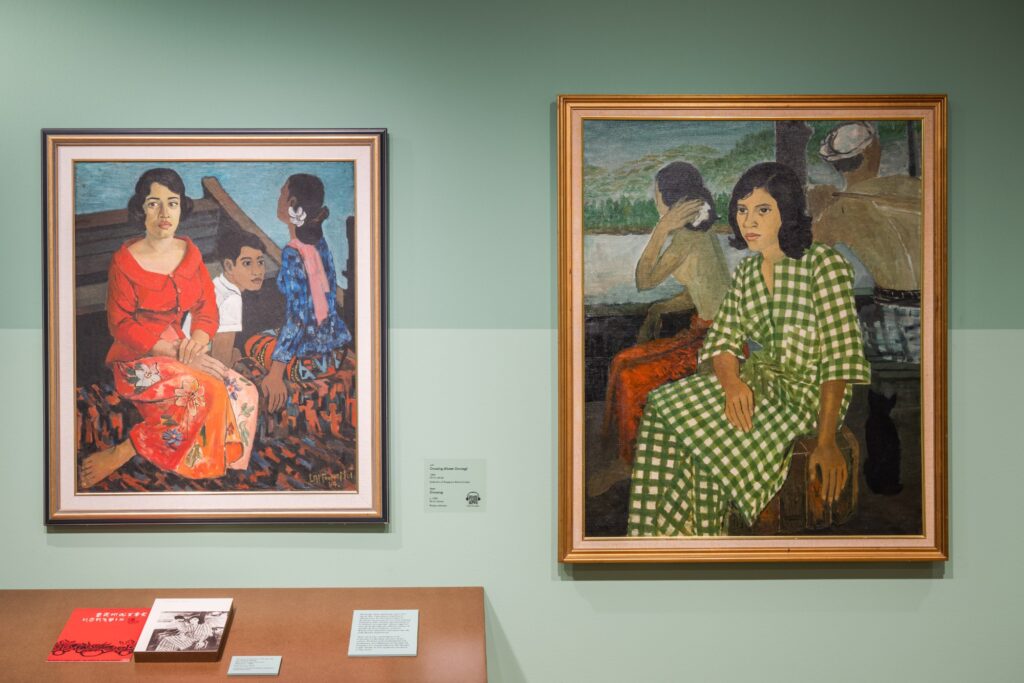
Her achievements were considerable. Lai became the first Malayan-born woman to hold solo exhibitions in Singapore and Malaya, and later returned to NAFA as an educator, where she taught for more than three decades. She continued to influence Singapore’s artistic community until her death in 1995, nurturing younger generations of artists.
Yet the recognition she received during her lifetime did not translate into sustained scholarly attention after her death. Crossings seeks to bring her work back into view, presenting Lai not simply as a pioneering woman artist but as an important witness to the social and cultural transformations of 1960s and 1970s Singapore.
Her rediscovery matters beyond Singapore because Lai’s career sits within a broader Southeast Asian story: artists across the region were grappling with how to define modernity, represent local identities, and negotiate the cultural legacies of colonialism as new nations took shape.
The exhibition takes its title from two paintings Lai made in 1964 and 1965. “Crossings” refers to moments of transition, encounter, and becoming, reflecting both Lai’s own movements between Malaya, Singapore, and France and a region negotiating new ideas of identity, nationhood and belonging.
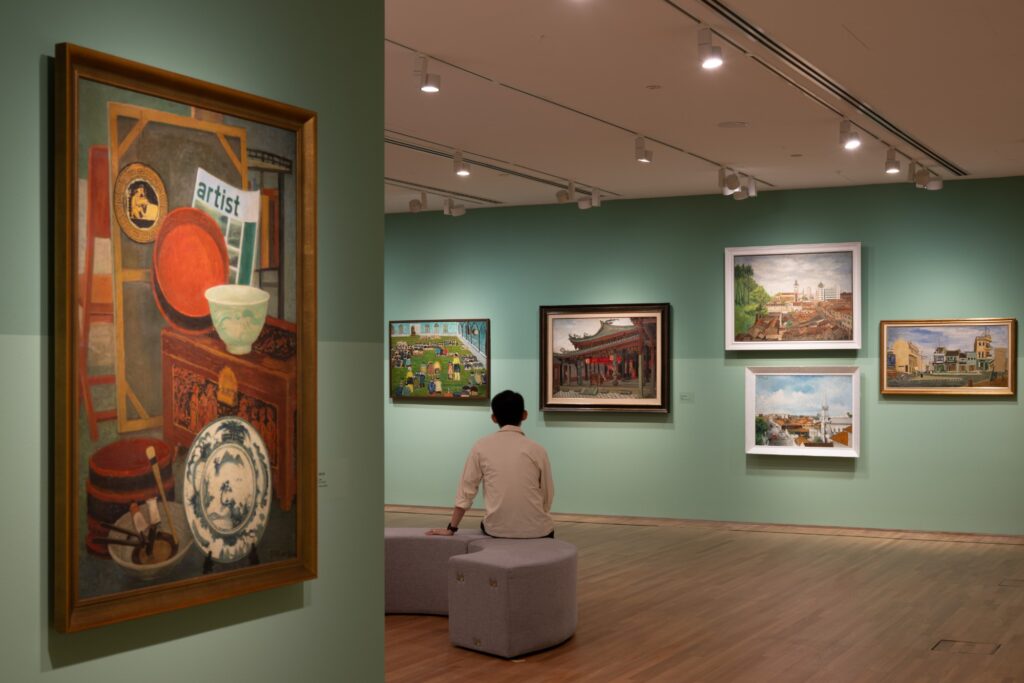
That sense of transition is central to Lai’s paintings. Working across portraiture, still life, and landscape, she developed an individual approach to Nanyang subjects, with particular attention to women, laborers, and the changing city. Rather than focusing exclusively on the spectacle of modernization, she often found her subjects in quieter moments: laborers taking a break, individuals absorbed in thought, or still corners of an urban landscape undergoing rapid change.
There is a particular sensitivity in these scenes. Lai’s Singapore is not simply a city moving confidently toward modernity. Her paintings suggest what can be lost, unsettled or left unresolved along the way. They invite viewers to consider how large historical changes are experienced by ordinary people—through work, displacement, solitude, and everyday routines.
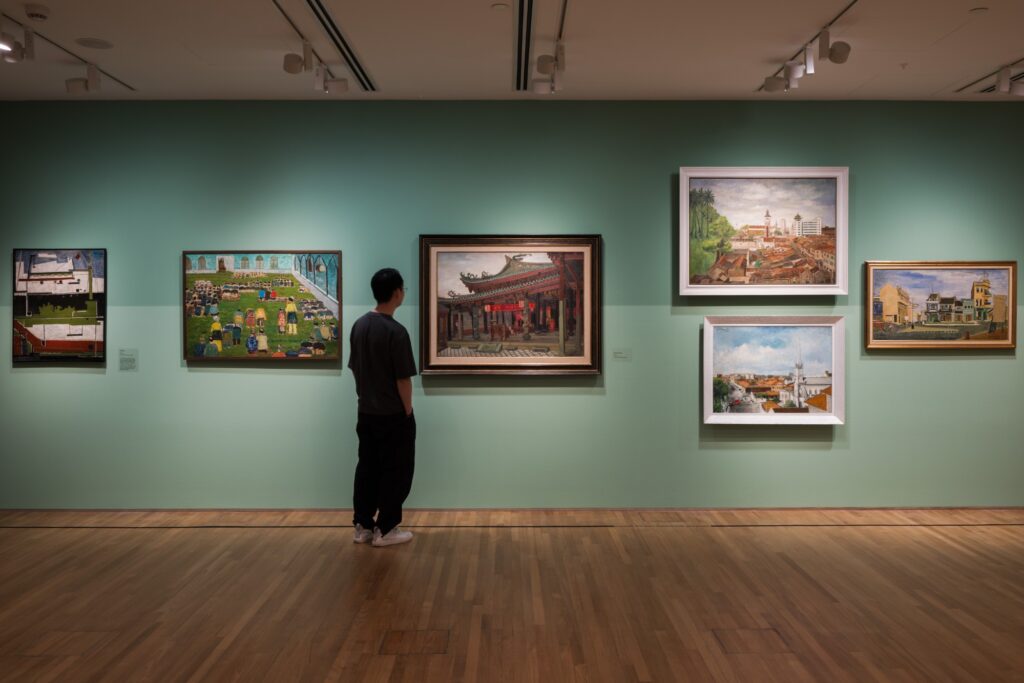
Labourer (Lunch Break), for example, centers on a worker in a moment of rest, turning an otherwise ordinary pause into an introspective study of labor and individual experience. The painting also places different immigrant working communities within the same frame, reflecting the social complexity of the Malayan world Lai was observing.
This attention to everyday experience gives Crossings a relevance beyond Singapore. Lai was working within a wider Southeast Asian moment in which artists were confronting related questions: how to develop modern artistic languages after colonialism, how to represent local people and places, and how to negotiate inherited European traditions while asserting distinctly regional identities.
Her own trajectory reflects that movement of artists and ideas across borders. Trained in Singapore and France before returning to a rapidly changing Southeast Asia, Lai occupied a position between different artistic traditions and cultural environments. Her story complicates the idea that the region’s art histories developed neatly within national boundaries.
That regional perspective is also what may make the exhibition rewarding for Filipino audiences, even though there is no clear documented evidence that Lai herself visited the Philippines or maintained a significant personal or professional relationship with Filipino artists.
Her career offers an intriguing point of comparison with the development of Philippine modernism. Filipino artists of the postwar period were likewise navigating Western artistic influences while seeking forms capable of expressing local realities. The comparison does not suggest that the two artistic histories were identical. Rather, it highlights how artists in different parts of Southeast Asia were responding to related questions about identity, cultural independence, and modern life.
For Filipino visitors, that makes Crossings worth seeing not because it contains a hidden Philippine connection, but because it provides another way of looking at questions that also shaped Philippine art and society. Lai’s paintings offer a neighboring perspective on urbanization, labor, cultural identity, and the experience of societies moving between inherited traditions and new forms of modernity.
The exhibition also complicates the way Nanyang art itself is remembered. Lai’s work demonstrates that the movement was not simply about establishing a recognizable Southeast Asian visual style. It could also be a means of examining how people experienced a changing society, including those whose lives were rarely placed at the center of grand narratives of nation-building.
Through paintings, photographs, exhibition catalogues, and other archival material, Crossings reconstructs Lai’s artistic journey while giving greater visibility to an artist whose contribution has been overshadowed by more extensively studied figures in Singaporean and Malaysian art. The National Gallery describes her as once celebrated but now little remembered, making the exhibition part of a broader effort to reconsider lesser-known figures in Singapore’s art history.
The exhibition is the second edition of National Gallery Singapore’s Dalam Singapore series, which focuses on significant but underexplored artists and stories from Singapore’s art history. Its approach is particularly apt for Lai, whose career sits at the intersection of several histories—woman artist, Malayan-born painter, Singapore educator, Nanyang practitioner, and internationally trained modernist.
Seen today, her paintings offer something more than a record of a vanished Singapore. They provide a way of thinking about how people inhabit moments of historical transition, and how artists make sense of societies still working out who they are.
That may ultimately be why Lai Foong Moi’s rediscovery matters. Her significance lies not only in filling a gap in Singapore’s art history, but in revealing another strand of Southeast Asian modernism—one shaped by movement across borders, encounters between cultures, and a close observation of ordinary lives during extraordinary change.
For Filipino audiences, Lai Foong Moi: Crossings offers a chance to look beyond the more familiar narratives of Philippine art and see how related questions unfolded elsewhere in the region. The value of the exhibition is not in finding a Philippine connection that may not exist, but in recognizing the connections between Southeast Asian histories—and in seeing how an artist once overlooked can open a new window onto the region’s shared experience of modernity.
Stay updated—follow Philippines Today on Facebook and Instagram, and subscribe on YouTube for more stories.