
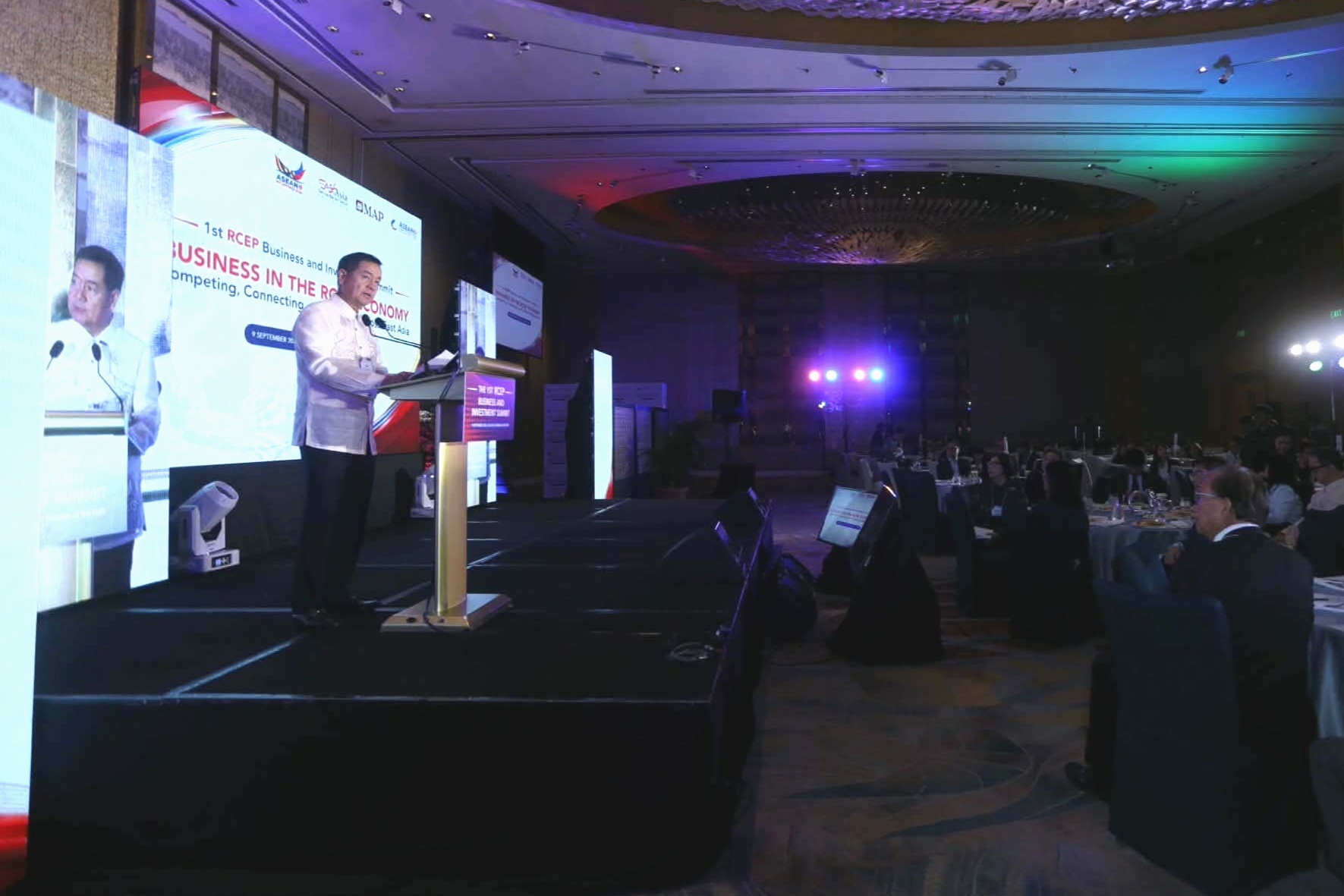

Business leaders and government officials gathered in Manila for the first RCEP Business and Investment Summit, urging reforms to help companies better use the Regional Comprehensive Economic Partnership (RCEP) as the trade deal heads into its first General Review.
Organized by the East Asia Business Council (EABC), the summit focused on strengthening regional trade and investment as businesses face geopolitical tensions, protectionist policies, tariff uncertainty, and supply chain disruptions across Asia.
EABC chairperson Jay Yuvallos said companies must build resilience into their operations as global trade becomes more volatile.
“The business model that served us for decades was built around ‘Just-in-time.’ Now, ‘Just-in-time’ must increasingly be matched with ‘Just-in-case,’” Yuvallos said on Thursday at the summit. “In other words, resilience has to become part of how we design our value chains.”
He said regional integration has become a strategic advantage as businesses adapt to a more uncertain global economy.
“This is where I believe regional integration becomes a strategic advantage,” he said.
Trade Secretary Ma. Cristina Roque called on businesses to identify obstacles they encounter under RCEP so the government can bring those concerns into the agreement’s General Review.
“We need your feedback. Tell us what needs to work better—customs procedures, sourcing requirements, and other barriers that affect your operations,” Roque said.
She said the Philippines must maximize its existing free trade agreements, noting exports grew 15.4% in 2025 to a record high.
“These FTAs remain as agreements unless we maximize or use their full potential,” Roque said.
Roque said RCEP gives Philippine businesses access to a market of more than 2.3 billion people while expanding supplier networks, production bases and export opportunities.
Discussions also centered on the Philippines’ role within the ASEAN+3 economy, with participants saying the country should deepen its participation in regional supply chains and move into higher-value manufacturing and services.
The summit also highlighted the need to help micro, small and medium enterprises participate in regional value chains, not only as exporters but also as suppliers, distributors and service providers.
“We need businesses—especially our MSMEs—to participate in regional value chains, and we need to make it easier for companies to understand and actually use the opportunities that RCEP provides,” Yuvallos said.
As RCEP members prepare for the General Review, EABC said the private sector should help shape the next phase of the trade pact by identifying barriers and proposing measures to improve connectivity, investment, competitiveness, and resilience.
“The future of regional integration will not be written by agreements alone. It will be built by the businesses, institutions, and people who choose to connect,” Yuvallos said.
Stay updated—follow Philippines Today on Facebook and Instagram, and subscribe on YouTube for more stories.