
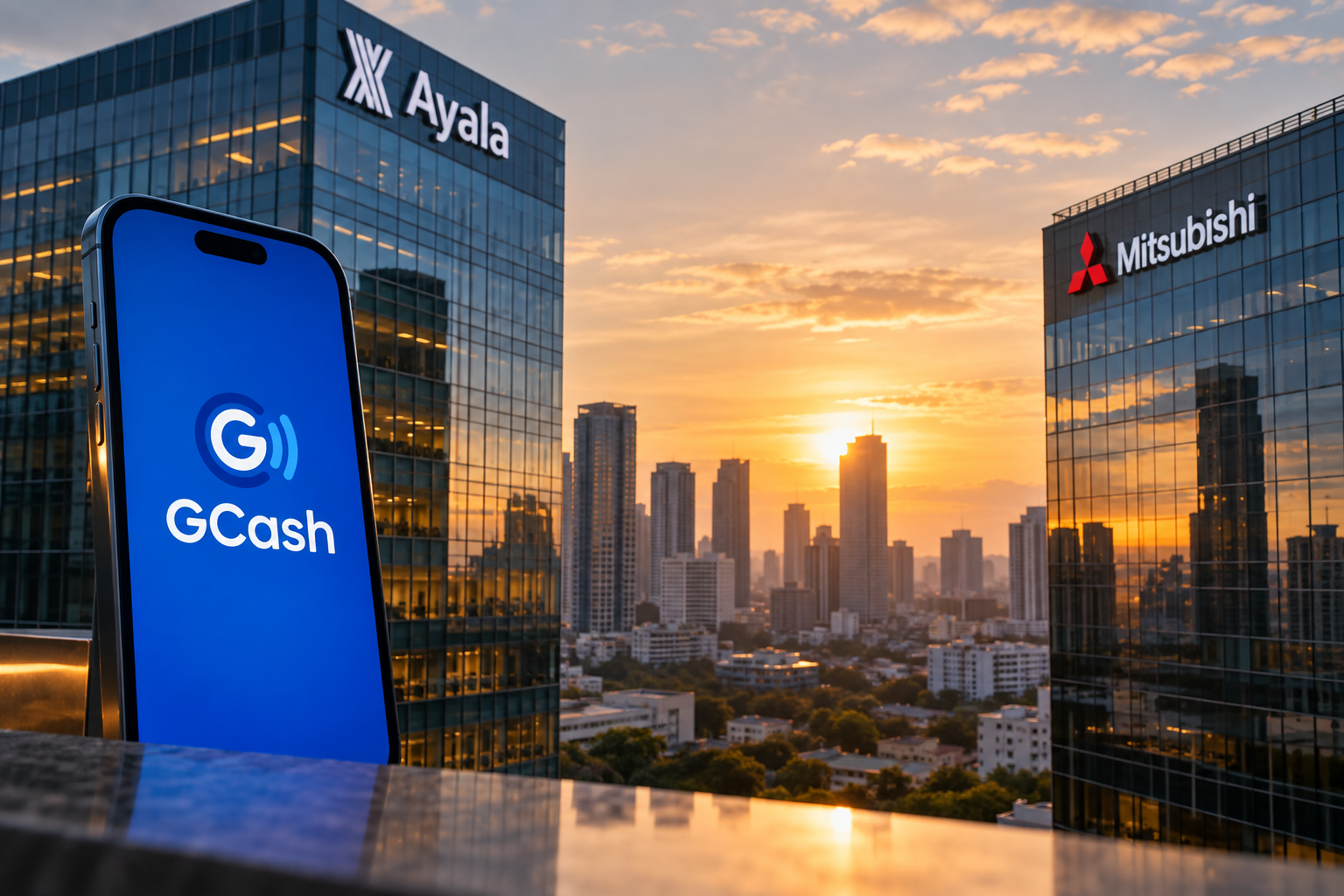

The timing of Ayala Corporation and Mitsubishi Corporation’s expanded partnership is hard to ignore. Just as Mitsubishi is committing substantially more capital to Ayala, Mynt—the parent of GCash and an existing investment of the two groups—is preparing to enter the Philippine stock market in what could become the country’s biggest initial public offering (IPO).
But the GCash listing is not the reason for Mitsubishi’s larger Ayala investment. Rather, it offers a useful glimpse into what the 52-year relationship has already produced—and raises a bigger question about what the partners can build together next.
Mynt priced its IPO at ₱6.60 a share on October 1, valuing the firm offering at about ₱53 billion. The deal could rise to ₱60.9 billion if the overallotment option is fully exercised, potentially making it the largest IPO in Philippine history. Trading is scheduled to begin on October 20, subject to final conditions.
For Ayala and Mitsubishi, the significance is straightforward. Mynt is one of the clearest examples of the two groups moving beyond a traditional corporate partnership and combining their respective strengths in a fast-growing Philippine business. Mitsubishi already has an indirect interest in Mynt through AM50 Ventures, an Ayala subsidiary in which it owns 50%. AM50 holds about 13% of Mynt, according to Mitsubishi.
The IPO now puts a market value on that investment while giving Mynt fresh capital to expand its digital financial services. Up to 1.61 billion shares in the firm offering are primary shares, with proceeds going to Mynt, while the rest are secondary shares.
That makes the listing relevant to the Ayala-Mitsubishi relationship, but not because the two companies need GCash to justify their partnership. It is relevant because it demonstrates the kind of business they can create or support together: a Philippine company with a strong local platform, access to global capital, and the potential to scale financial services through technology.
The next question is whether that model can be extended beyond financial technology.
Their 2024 alliance initially focused on deepening cooperation in areas including financial services, telecommunications and retail, while also expanding collaboration in Ayala’s core businesses such as real estate and energy. More recent initiatives have added intelligent cities, digital finance, and data-driven services to the agenda.
An initiative involving Ayala, Mitsubishi, Mitsubishi UFJ Financial Group (MUFG), KDDI Corporation, Globe Telecom, and Mynt, for example, is exploring intelligent-city applications in Makati using artificial intelligence, internet-of-things technology, and advanced connectivity across areas such as mobility, retail, energy, and infrastructure.
This is where the partnership becomes more consequential. The Philippines does not simply need more investment; it needs investment that can bring technology, expertise, and international connections into sectors where the country faces persistent capacity constraints.
Energy is one example. The World Bank estimates that the Philippines’ first offshore wind auction could support 3.3 gigawatts of contracted capacity by 2030 and mobilize about $7 billion in private investment. The transition will require not only generation capacity but also transmission, storage, and supporting infrastructure.
Infrastructure presents another opportunity. The Philippine government’s public-private partnership pipeline was valued at about ₱2.81 trillion across 251 projects heading into 2026, according to the Public-Private Partnership (PPP)9 Center. Projects span transportation, water, digital infrastructure, and public facilities.
These sectors are capital intensive and often require capabilities that extend beyond the balance sheet of a single company. Mitsubishi’s international network and experience across industries could complement Ayala’s Philippine platforms, while Ayala provides the local operating presence needed to navigate the market.
That, rather than the increase in Mitsubishi’s shareholding itself, is the more interesting proposition.
The financial terms are nevertheless significant. Mitsubishi plans to increase its economic stake in Ayala to 15% from 4.7%, while its voting interest will rise to 20%, subject to regulatory and shareholder approvals. The transaction is valued at about ₱44.5 billion and includes primary and secondary shares and a voluntary tender offer for up to 30 million Ayala shares at ₱650 each.
Ayala expects to receive about ₱20 billion in proceeds, which it plans to use to reduce debt, continue its share-buyback program, and support future growth initiatives.
The larger stake also gives Mitsubishi a more meaningful voice in Ayala’s future direction without giving it control. That makes the relationship more strategic than a conventional financial investment and raises the stakes for both sides to demonstrate that the alliance can produce businesses and projects with attractive long-term returns.
The Mynt (GCash) IPO arrives at a useful moment in that evolution. It will give public investors a market-based valuation for one of the most successful digital businesses to emerge from an Ayala-Mitsubishi partnership, while providing Mynt with additional capital to pursue its expansion.
But the real test lies elsewhere.
Can the two companies replicate the combination of local market knowledge, technology, capital, and global expertise that helped GCash scale across other businesses? Can Mitsubishi’s global network add something beyond capital, while Ayala’s local reach provides more than market access?
Those questions will determine whether the partnership’s next 50 years look substantially different from its first.
The GCash IPO may be the most visible milestone on the horizon. The larger story is whether Ayala and Mitsubishi can turn a relationship built over five decades into a more systematic way of bringing capital, technology, and international expertise into the Philippine economy.
That is a considerably bigger ambition than owning more shares in Ayala—and a much harder one to execute.
Stay updated—follow Philippines Today on Facebook and Instagram, and subscribe on YouTube for more stories.