
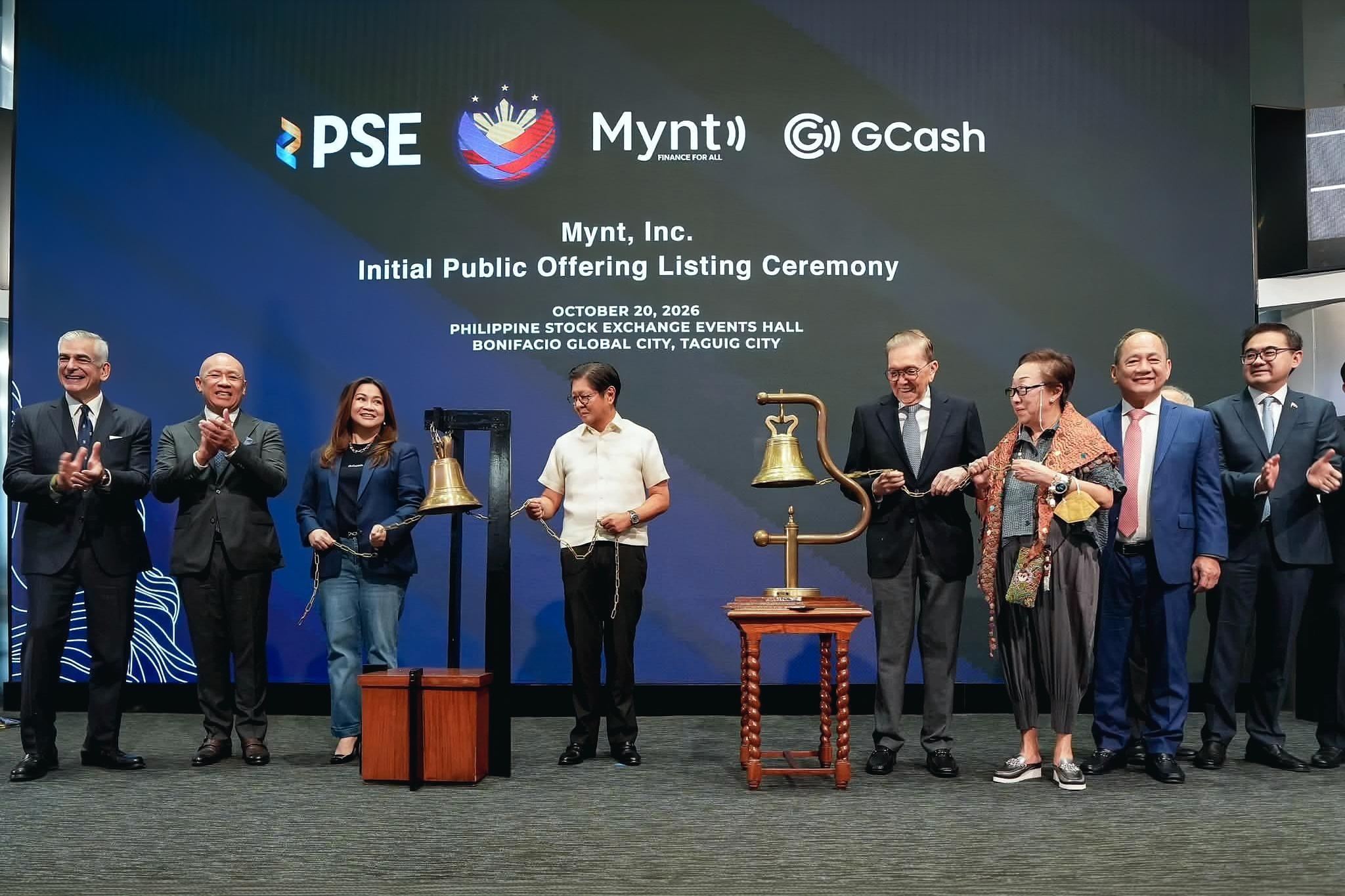

Mynt Inc., the operator of the Philippines’ biggest digital wallet GCash, raised ₱60.9 billion in the country’s largest initial public offering (IPO), giving the Philippine stock market its biggest new listing as the government seeks to deepen local capital markets and attract more investors.
Mynt began trading on Tuesday, October 20, on the Philippine Stock Exchange (PSE) under the ticker GCASH after pricing its shares at ₱6.60 apiece. The offering valued the company at about ₱441.5 billion, making it one of the largest companies on the local exchange.
The listing surpasses the previous Philippine IPO record set by Monde Nissin Corporation in 2021 and is the largest Southeast Asian IPO of 2026, according to market data.
President Ferdinand Marcos Jr. attended the listing ceremony at the PSE Tower in Bonifacio Global City, Taguig, where he said the transaction demonstrated the ability of Philippine companies to develop and expand businesses capable of attracting international capital.
“This is a significant achievement, demonstrating that world-class innovation can be built and scaled here in the Philippines,” Marcos said.
The IPO attracted strong demand from domestic and international investors, including large global asset managers and institutional investors. The offering included about 8.03 billion shares, with around 1.61 billion primary shares issued by Mynt and the remainder sold by existing shareholders.
The primary proceeds will be used to support the company’s expansion, product development, and general corporate purposes.
The listing comes as activity in the Philippine equity market has weakened. Companies raised about $227 million (approximately ₱14 billion) through share sales during the first nine months of 2026, down 71% from the same period a year earlier, according to London Stock Exchange Group (LSEG) data cited by Reuters.
The Philippines accounted for about 1.7% of the $13.06 billion raised through Southeast Asian equity markets during the period.
Mynt’s offering has also expanded retail participation in the stock market. About 140,725 GCash subscribers invested around ₱1.1 billion through the GCash app during the IPO, according to PSE president and chief executive Ramon Monzon.
“Most inspiring is how broadly this offer reached ordinary Filipinos. 140,725 GCash subscribers invested about ₱1.1 billion in this IPO through the GCash app, and for many of them, it was their first time owning shares in a listed company. This is what market inclusion looks like: technology giving more Filipinos a stake in the growth of the businesses they rely on every day,” Monzon said.
Qualified GCash users were able to subscribe to 100 shares for ₱660 through GStocks PH during the October 6 to 12 offer period.
Marcos said the participation of GCash users showed how digital platforms could expand access to investments.
“This just shows that digital technology can make investment opportunities more accessible to everyone,” he said.
GCash has grown from an electronic money transfer service into a digital financial platform offering payments, savings, loans, insurance, and investment products.
The company reported first-half net income of ₱10.82 billion, up 7.3% from a year earlier, while revenue increased 10.4% to ₱43.27 billion. GCash had 41.5 monthly million active users and processed ₱9.84 trillion in transactions during the first half of 2026, according to company data cited by Reuters.
The company’s growth has coincided with wider adoption of digital financial services in the Philippines, particularly after the COVID-19 pandemic accelerated the shift toward electronic payments.
Marcos said digital wallets have also helped micro, small, and medium enterprises gain access to payment systems and financial services that can support business expansion and employment.
The Philippine president also cited the Capital Markets Efficiency Promotion Act, which reduced the stock transaction tax to 0.1% from 0.6%, as part of efforts to improve market activity and encourage investment.
He said reforms by the Securities and Exchange Commission were also intended to improve market liquidity and broaden participation.
Marcos said the government would continue efforts to improve the ease of doing business, promote fair competition, and support responsible innovation.
He also called for stronger consumer safeguards as digital financial services expand, including measures on data privacy, financial literacy, scams, phishing, and identity theft.
“The strong interest it has attracted from local and international investors is proof of the continued confidence in Filipino enterprises,” Marcos said.
The government hopes the listing will encourage more Philippine companies to raise capital locally, expand their businesses and create jobs.
“May this milestone mark the beginning of greater opportunities for Filipino enterprises, renewed confidence in our capital market, and broader participation in our country’s economic growth,” Marcos said.
Stay updated—follow Philippines Today on Facebook, Instagram, and TikTok, and subscribe on YouTube for more stories.