


Seventy works drawn from one of the most influential private collections of Asian art in the United States are now on view in New York, as the Asia Society marks its 70th anniversary with Buddha and Shiva, Lotus and Dragon: Celebrating 70 Years of Asia Society and the Rockefeller Legacy.
Open since March 18, 2026 and running through January 3, 2027 at the Asia Society Museum, the exhibition distills decades of collecting into a focused presentation that speaks as much to the present as it does to the past.
At the center is a collection assembled between the 1950s and 1970s by philanthropists John Davison Rockefeller III and Blanchette Hooker Rockefeller, a husband-and-wife team whose efforts helped shape early American engagement with Asian art.
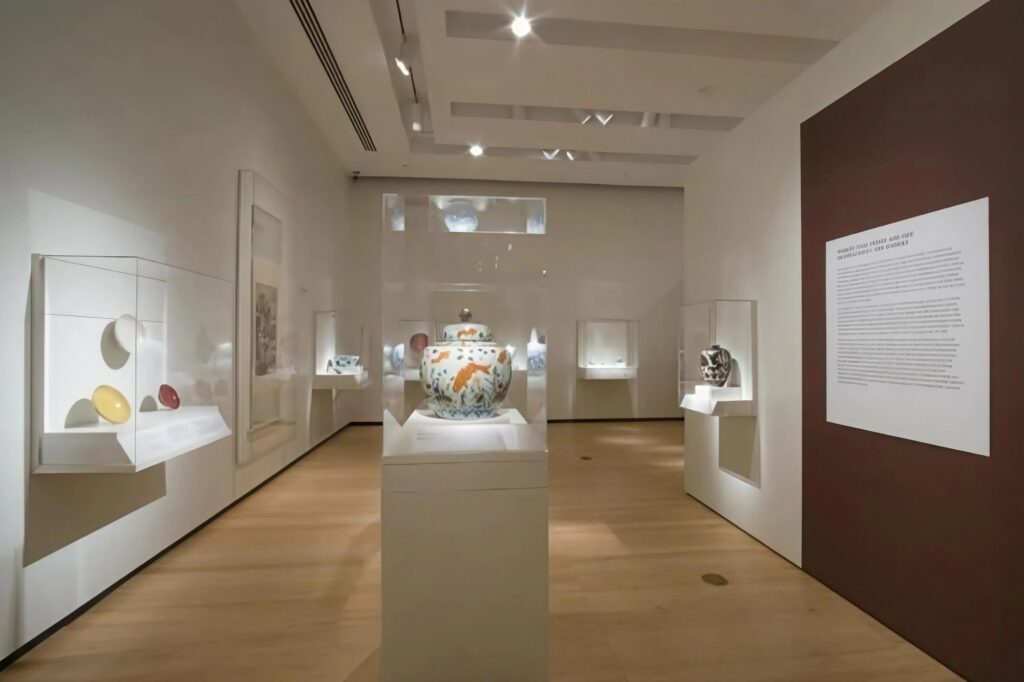
When the works were bequeathed to Asia Society in 1979, they formalized an institutional belief that exposure to art could deepen cultural understanding. That premise underpins the current exhibition, but it is presented with greater clarity and restraint: the objects are allowed to articulate their own histories across time, geography, and belief.
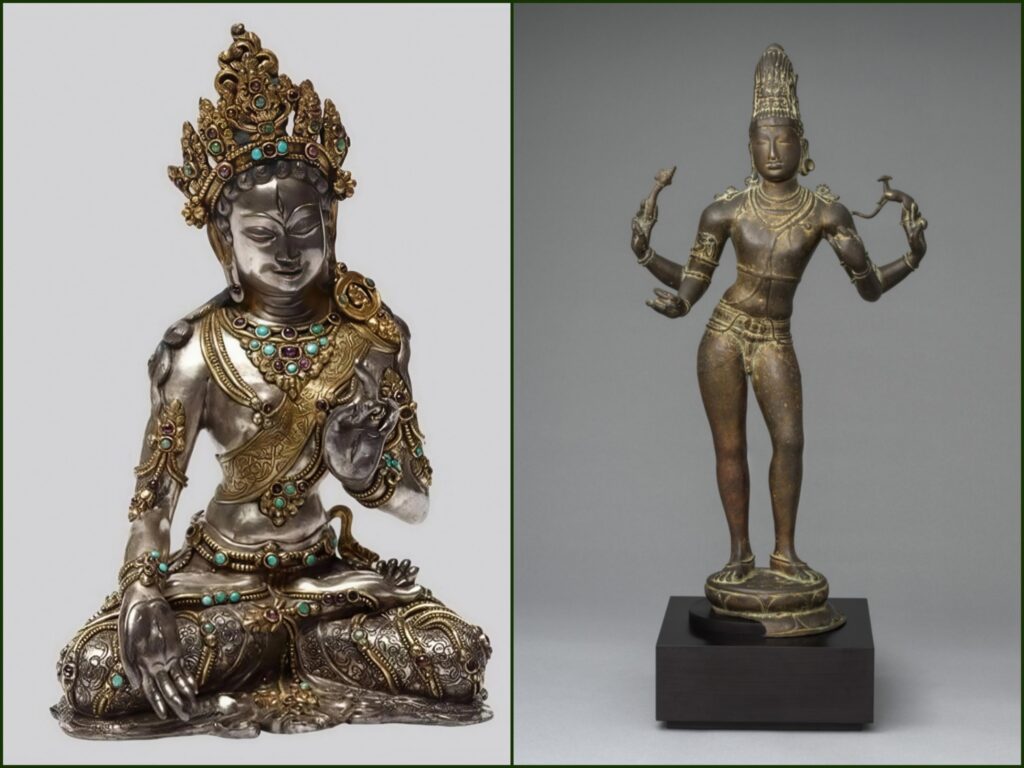
The selection spans more than two millennia, moving across regions without forcing a rigid chronology. A group of Buddhist sculptures establishes the exhibition’s foundation, tracing how the religion moved across Asia and was reinterpreted along the way. The variations in form and expression are subtle but telling, reflecting shifts in material, patronage, and local aesthetics as Buddhism took root in different societies.
Hindu sculpture from South and Southeast Asia follows, largely from the 10th to 14th centuries. These works introduce a different rhythm—more kinetic, more architectonic—revealing a period of strong artistic production linked to temple culture and regional power centers. Rather than isolating them as religious artifacts, the exhibition places them within a broader conversation about artistic continuity and transformation across Asia.
The largest section turns to ceramics and metalwork from China, Korea, and Japan. Here, the emphasis shifts to exchange. Techniques, motifs, and materials moved across borders through trade, producing objects that are at once local and interconnected. The refinement of ceramics in particular points to sustained technical innovation, while also reflecting the circulation of taste across regions.
These patterns echo strongly across Southeast Asia, including the Philippines, where precolonial sites have yielded Chinese ceramics that attest to early participation in regional trade networks—an enduring reminder that the archipelago has long been part of Asia’s cultural and commercial currents.
Originally conceived with the American Federation of Arts and presented in this iteration under the curation of Xiaohan Du, an art historian specializing in pre-modern East Asian art, the exhibition avoids overstatement. It does not attempt to be comprehensive; instead, it is selective, relying on the strength of individual works and their placement in relation to one another. This approach gives the presentation a measured pace, encouraging sustained attention rather than spectacle.
Two concurrent displays extend the narrative without interrupting it. One introduces recent acquisitions from Rockefeller’s daughters, Hope Aldrich and Sandra Ferry, pairing eight new works with five pieces from the museum’s holdings. Another presentation highlights five works originally received from Blanchette Hooker Rockefeller, reinforcing the continuity of the collection while allowing for comparison across generations.
For Asia Society, founded in 1956 at a time when Asia was often framed in narrow political terms in the United States, the anniversary arrives with a different set of expectations. Its museum has since broadened to include modern and contemporary works, yet this exhibition returns to the origins of its collection with a more deliberate focus. The emphasis is not on scale but on coherence—on how a relatively concise group of objects can illuminate longer histories of movement, exchange, and belief.
This broader mandate continues to resonate across its global network, including in Southeast Asia, where Filipino audiences and institutions, through Asia Society Philippines, take part in ongoing cultural dialogue.
What emerges is a presentation that is both grounded and precise. It avoids excess, but remains compelling in its scope. By foregrounding works shaped by religion and trade—two of the most enduring forces in Asian history—the exhibition offers a clear view of how art operates within larger systems of meaning. It also reinforces the continued relevance of the Rockefeller collection, not as a static legacy, but as an active framework for understanding Asia in a global context.
Seventy years on, the founding premise of Asia Society—that cultural knowledge can bridge divides—remains intact, but it is articulated here with greater discipline. Buddha and Shiva, Lotus and Dragon does not seek to persuade through narrative flourish. Instead, it builds its case through the works themselves, arranged with enough intention to keep the viewer engaged from beginning to end.
Stay updated—follow Philippines Today on Facebook and Instagram, and subscribe on YouTube for more stories.