


A week after making history as the first all-Filipino act to perform at the Coachella Valley Music and Arts Festival, BINI returned with something more assured. The second weekend was not about repeating a first impression but refining it. What began as a breakthrough now read as confirmation: they were not just passing through; they had found their place.
The Mojave Stage on April 17 (April 18 in Manila) felt different even before the first note. Anticipation carried a sharper edge—less curiosity, more certainty. When the octet stepped out—Aiah, Colet, Maloi, Gwen, Stacey, Mikha, Jhoanna, and Sheena—the response was immediate, a chorus that had learned their name in just seven days and was ready to say it back.
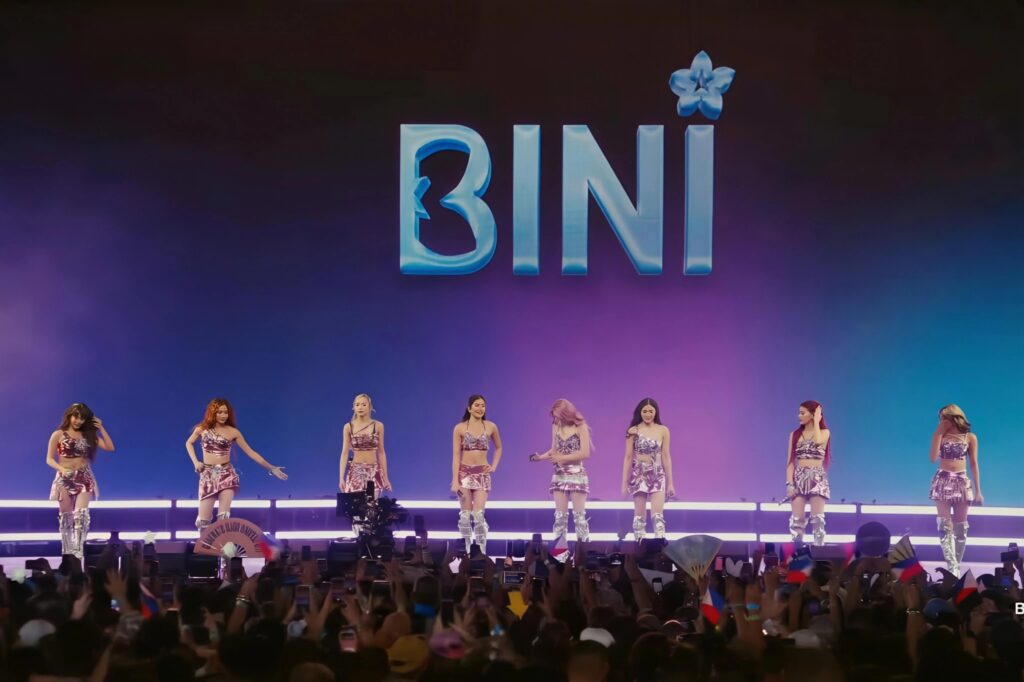
They opened not with explanation, but with intent. A kulintang-infused dance break cut through the desert air, rooting the performance in Filipino sound while widening its reach. Sunglasses arced into the crowd; red-and-blue, Y2K-glittered silhouettes caught the light.
“Strings” followed with a Filipino rap that set the tempo for what would be a 45-minute set both familiar and newly sharpened. Movements landed cleaner, transitions tightened, and the shift from reveal to reveal—metallic outfits, silver boots—felt less like spectacle than fluency in their own language of pop.
The difference from weekend one was not louder production, but control. “Zero Pressure” and “Out of My Head” surged with a renewed intensity, met by a crowd that now knew when to answer back.
“Coachella, are you ready to jump with us?” Maloi called, and the tent obliged, rising in unison. Mid-set, the conversation softened into something more intimate. “Coachella make some noise… Wow that’s the noise we needed,” Jhoanna said, the line landing like a shared exhale. Then, a turn inward: greetings in their native dialects, a map of the Philippines carried in eight voices.
“Grabe ang daming Pinoy! Maraming salamat po! It feels so special to be back here for weekend 2,” Jhoanna added. “For everyone who’s watching around the world, we see you!” Sheena said.
If weekend one introduced, weekend two connected. The tent filled deeper; flags rose higher. “Karera” and “Salamin, Salamin” unfolded into collective memory, their choruses answered line by line, language no longer a barrier but a bridge. The stage glowed in the colors of the Philippine flag, a quiet assertion that traveled without translation.
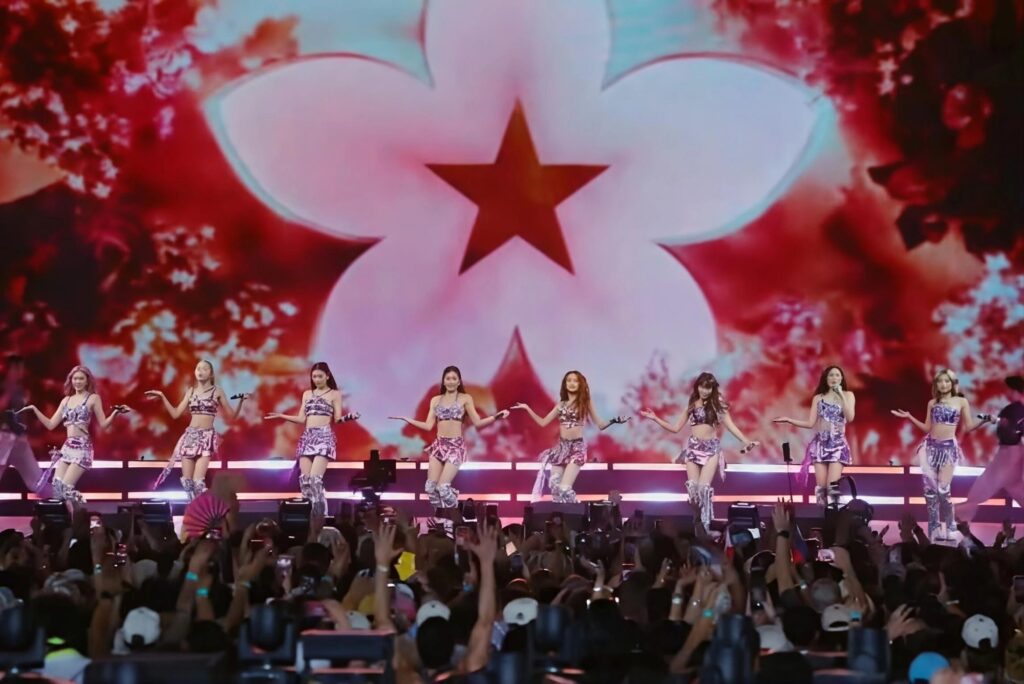
A standout arrived with “Blink Twice,” reworked into something more kinetic, its precision amplifying the group’s chemistry—eight distinct presences moving as one. “Cherry on Top” followed with saturated reds and a playful edge that never lost its bite.
“Being for weekend 2 and seeing your faces mean so much to us, grabe!” Maloi said, before Mikha checked the room with their now-familiar “eyy” gesture, a small signal that carried across the tent. “Blush” tipped into a high-energy stretch, the crowd chanting “Oh Kalami, oh kalami” in rhythm, while “Bikini” turned the space into a sunlit release.
They closed with “Pantropiko,” threaded again with kulintang, the arrangement deepened rather than repeated. As Maloi shouted “Pilipinas!” the answer came back louder than before—Filipinos and international fans folding into one voice. The final dance break hit with greater force, and when the music fell away, the chant remained: “BINI, BINI!”
In the stillness that followed, the Philippine flag filled the backdrop. The group bowed; emotion surfaced without performance. It was not only a set completed, but a distance crossed. Around them, fans held their flags high—less a gesture of fandom than of recognition.
Across both weekends, BINI’s run became one of the festival’s most-watched online moments, drawing audiences beyond the diaspora and into a broader conversation about where Filipino pop can stand. Inside the Mojave tent, it also became a gathering—Anne Curtis, Piolo Pascual, Maja Salvador, Darren Espanto, and Kyle Echarri among those in the crowd—folding into the same rhythm as festival-goers who had arrived simply to listen and stayed to belong.

A full set delivered largely in Tagalog at one of the world’s most influential festivals did not ask for permission; it assumed presence. The choreography, the live vocals, the precision—these were the expected. The language, held steady at the center, was the statement.
What BINI completed in the desert extends beyond two weekends. Their next appearances—at the GRAMMY Museum for “Global Spin Live” on April 21, and at Billboard Women in Music on April 29, where they are set to receive the Global Force Award—suggest a trajectory already in motion. Yet the more telling shift is quieter: the world did not need to be introduced again.
The first weekend drew attention; the second consolidated it. Between the opening beat and the final bow, BINI moved from introduction to recognition. Across both weekends at the Coachella Valley Music and Arts Festival, their performances reached a wider audience with a set built on original Filipino tracks and live vocals. The response—from the Mojave tent to global livestream viewers—reflected growing familiarity with their music. Could this signal a broader breakthrough for P-pop on the global stage?
Stay updated—follow Philippines Today on Facebook and Instagram, and subscribe on YouTube for more stories.