
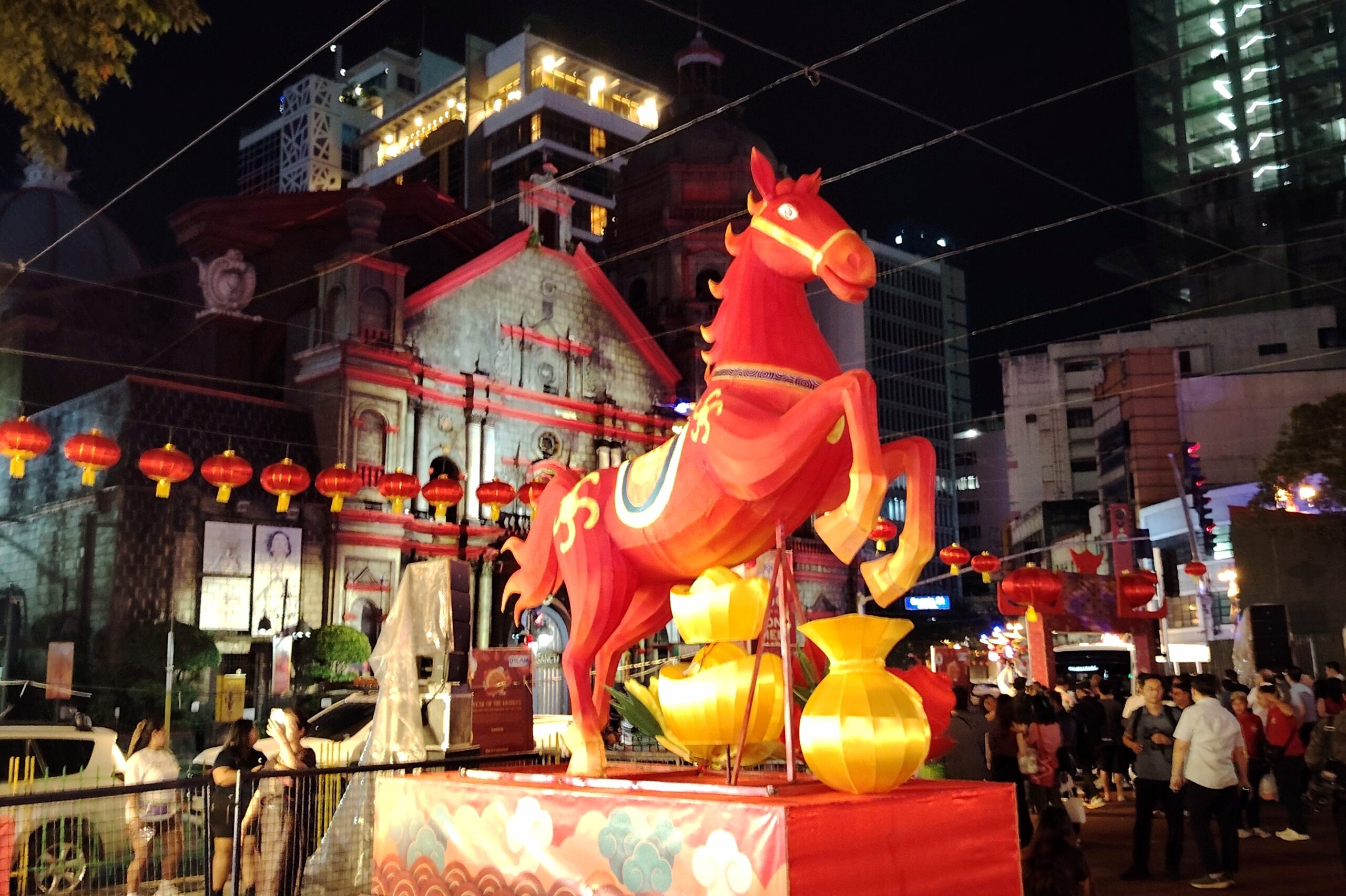

Manila’s historic Binondo district takes center stage on Friday, February 13, as the government and business leaders roll out Phase II of a ₱200-million rehabilitation project aimed at recasting the world’s oldest Chinatown as a modern heritage destination.
The new phase expands a district-wide lighting program designed to highlight centuries-old churches, bridges, and gateways, reinforcing Binondo’s enduring role as a hub of trade, faith, and Filipino-Chinese culture while positioning it as a focal point for tourism and urban renewal.

Established in 1594, Binondo has long stood at the crossroads of commerce and culture. Its narrow streets and stone churches have endured colonial rule, war, and modern redevelopment, even as generations of Filipino-Chinese entrepreneurs helped shape the country’s commercial life. Today, the district remains a dense patchwork of gold shops, herbal stores, banks, and century-old eateries—a setting the new phase seeks to highlight rather than transform.
The project is spearheaded by First Lady Liza Araneta-Marcos in cooperation with the Federation of Filipino Chinese Chambers of Commerce & Industry Inc. (FFCCCII), the country’s largest federation of Filipino-Chinese business groups.
Organizers describe the effort as community-driven, with funding drawn largely from private sector contributions, and framed as an exercise in stewardship rather than large-scale reconstruction.

It builds on the earlier illumination of Jones Bridge, which formed Phase I and drew inspiration from the riverfront revival under the Pasig River Bigyang Buhay Muli Project. Supporters say that program demonstrated how heritage restoration can catalyze broader urban renewal and civic pride—momentum they hope to replicate in adjacent historic districts such as Binondo.
Phase II will extend architectural lighting to prominent landmarks including La Madre Filipina, also known as the Four Mother Pillars; MacArthur Bridge as viewed from Yuchengco Plaza; and Santa Cruz Church. Traditional Chinatown gateways—Qing Shan Gate (Arch of Goodwill), Ongpin South Gate, Ongpin North Gate, and Tuan Jie Gate (Arch of Solidarity)—will also be illuminated, alongside hologram light installations along Quintin Paredes, Ongpin, and Sabino Padilla streets. Projection mapping is introduced at Binondo Church, reinforcing the district’s architectural and spiritual heritage.

Officials say the lighting interventions are designed to be subtle and reversible, preserving Binondo’s historic fabric while encouraging foot traffic and boosting small businesses. By amplifying the district’s streetscapes and food culture through visual spectacle and social media visibility, proponents hope to position Chinatown as a renewed destination for heritage tourism and local enterprise.
President Ferdinand Marcos Jr. is expected to join the first lady and community leaders at the launch, in a show of national backing that organizers say reflects the administration’s emphasis on cultural preservation as part of economic revitalization.
For Binondo, the initiative highlights the district’s longstanding commercial and cultural role in Manila through heritage-focused enhancements across key landmarks and public spaces.

Stay updated—follow Philippines Today on Facebook and Instagram, and subscribe on YouTube for more stories.