
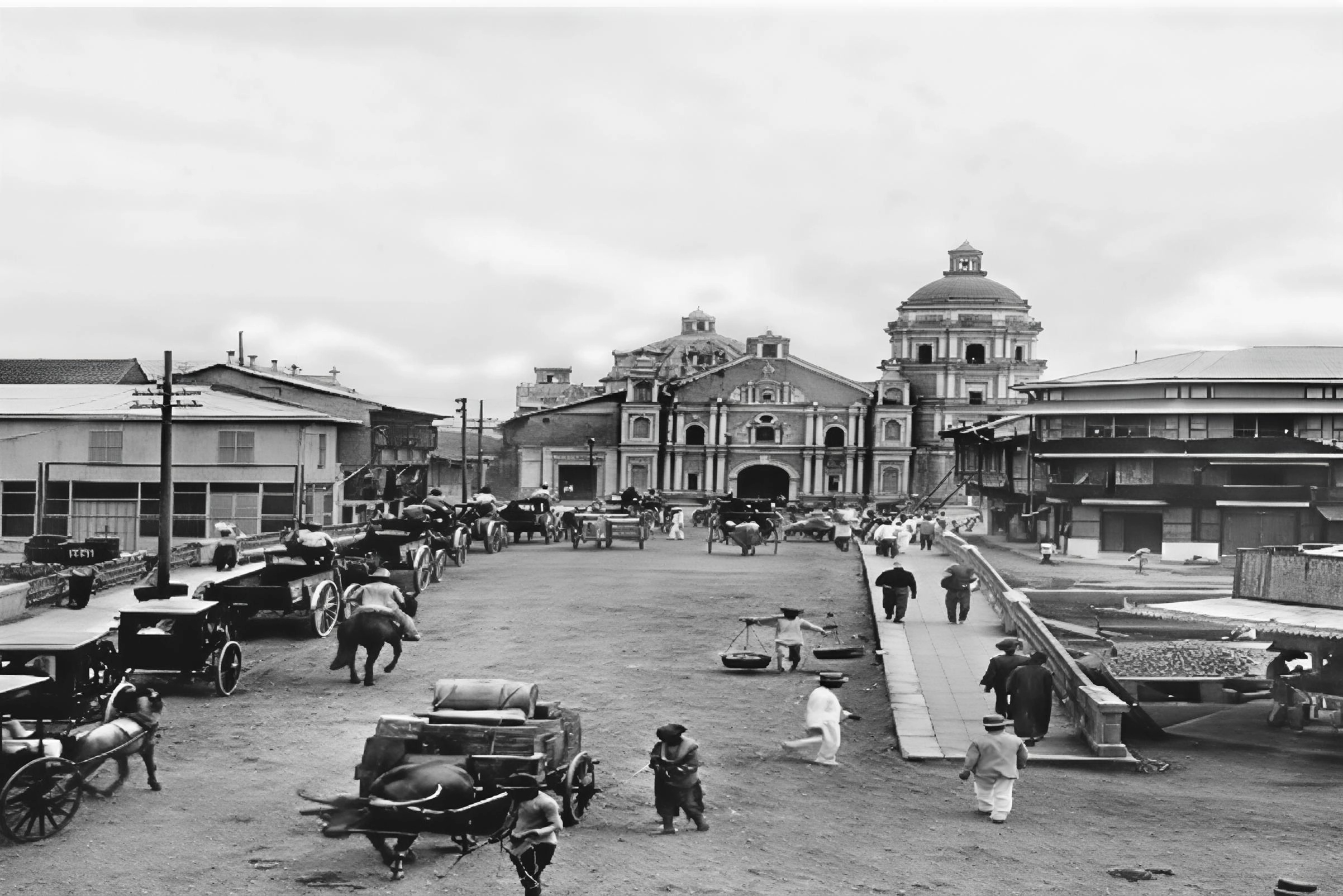

In many global capitals, a Chinatown signals migration and the stubborn endurance of culture far from its ancestral shore. In Binondo, those currents have been flowing since 1594, making it widely regarded as the world’s oldest existing Chinatown.
Across the Pasig River from Intramuros, the Spanish colonial government carved out a settlement for Chinese converts to Christianity—an experiment in commerce and control that would outlive empires. More than four centuries on, Binondo remains a working district where incense drifts past bank façades and gold shops, and where history is neither restored nor staged, but lived.
Today, as dragon dances thread through Ongpin Street and church bells toll in Plaza San Lorenzo Ruiz, Binondo stands as both archive and catalyst—its story inseparable from the making of Manila and the Filipino-Chinese community that helped build it.

From Parian to a merchant’s district
Long before the Spanish fortified Manila in 1571, Chinese merchants were already trading with polities such as Tondo and Butuan, exchanging porcelain and silk for gold and forest goods.
When Governor-General Luis Pérez Dasmariñas formally established Binondo in 1594 as a settlement for baptized Chinese migrants, the move reflected both pragmatism and fear: the Spanish needed Chinese enterprise, yet sought to keep it at arm’s length from Intramuros.
Non-Christian Chinese were confined to the Parian, a commercial quarter near what is now Liwasang Bonifacio. Those who converted were resettled across the river under Dominican care; the friars founded what is today the Minor Basilica and National Shrine of San Lorenzo Ruiz in 1596, better known as Binondo Church.
Conflict marked the early decades. In 1603, amid rumors of invasion, Spanish authorities suppressed a Chinese uprising in a massacre that scarred relations for generations. Yet commerce endured. Chinese traders participated in the Manila–Acapulco galleon trade, and over time intermarriage gave rise to a mestizo de sangley class—entrepreneurs and ilustrados who would shape colonial and later national life.
By the early 20th century, under American rule, Escolta Street earned the moniker “Wall Street of the Philippines,” lined with banks and art deco buildings such as the First United Building (Perez-Samanillo) and the 1914 El Hogar. World War II devastated much of the district, scattering businesses to emerging hubs like Makati, but Binondo’s mercantile pulse never fully stopped.

Sacred spaces and shared tables
Walk through Binondo today and the layering of centuries is palpable. The octagonal bell tower of Binondo Church—one of the few elements to survive wartime bombardment—casts a shadow over streets that still bear old Hokkien names. At the foot of Jones Bridge rises the 19.4-meter Filipino-Chinese Friendship Arch, a ceremonial threshold linking past to present.
Binondo’s most persuasive ambassador, however, may be its food. Panciterias that once catered to dockworkers and traders now draw culinary pilgrims on the so-called “Binondo Food Crawl.” Institutions such as Toho Panciteria Antigua (established in 1888) serve miki bihon, pancit canton, and asado; stalls on Ongpin offer siopao and fresh dumplings; cafés reinterpret tradition with drinks inspired by Chinese herbal remedies.
The district’s vocabulary reveals its lineage. The word instik, from the Hokkien in-chek (“uncle”), lingers in everyday speech. Incense curls before Marian statues; lion motifs appear in stonework; Lunar New Year fuses dragon dances with Filipino street celebrations. In Binondo, assimilation did not erase origins—it braided them.

Commerce through the centuries
Commerce remains Binondo’s backbone. Ongpin Street—named after businessman Roman Ongpin—thrums with jewelers and goldsmiths, earning its reputation as the country’s jewelry capital. Divisoria and nearby wholesale markets supply retailers across the archipelago, continuing a tradition of bulk trade that stretches back to the port economies of Tondo.
Real estate pressures and infrastructure upgrades are reshaping the skyline. Heritage buildings such as El Hogar have survived earthquakes, bombings, and even proposed demolition, saved through conservation efforts that underscore Binondo’s symbolic weight. New malls and residential towers rise alongside century-old façades, signaling both opportunity and tension between preservation and profit.
Binondo’s resilience is rooted not merely in its surviving façades, but in the community that has animated them for centuries. From early Chinese migrants carving space within a wary colony to modern business families operating in a global economy, the district has continually recalibrated without surrendering its core identity.
Four hundred thirty-two years after its founding, Binondo is no museum piece staking a claim as the world’s oldest Chinatown. It is a living quarter—where commerce opens at dawn, incense burns before both altar and shrine, and the Filipino-Chinese narrative advances not in monuments, but in the steady rhythm of enterprise and everyday life.
For historical references on Binondo’s founding and early colonial context, see the National Historical Commission of the Philippines and the Official Gazette of the Republic of the Philippines.
For broader context on Manila’s pre-colonial and colonial trade networks, consult the National Museum of the Philippines.
Stay updated—follow Philippines Today on Facebook and Instagram, and subscribe on YouTube for more stories.