
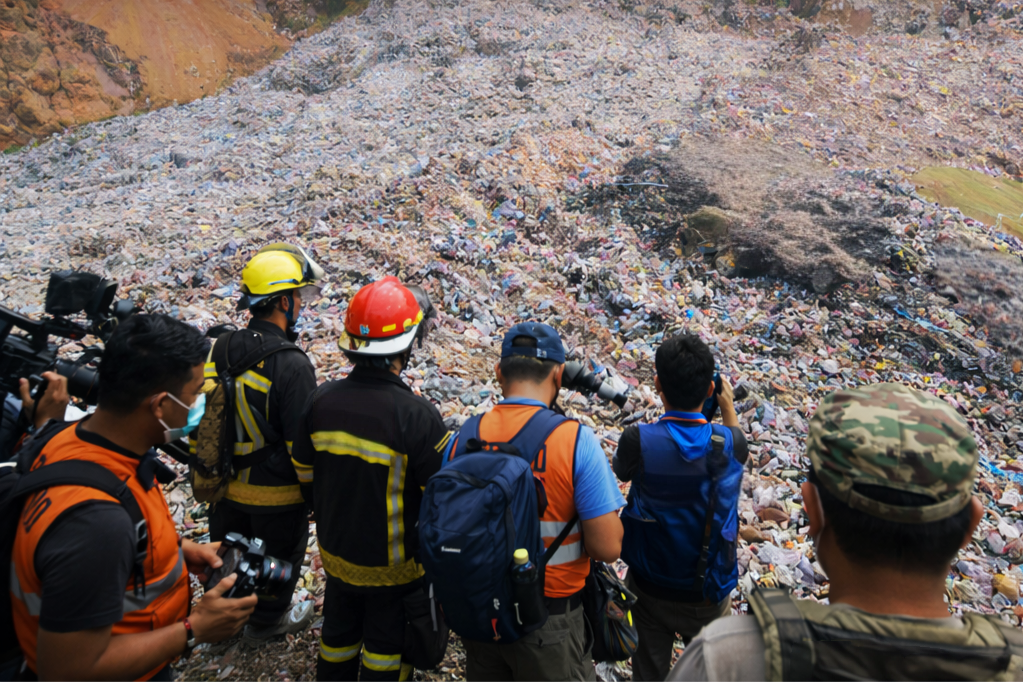

A mountain of garbage gave way at the Rizal Provincial Sanitary Landfill in Rodriguez, Rizal on February 20, sending an estimated 420,000 cubic meters of waste cascading down a slope in Barangay San Isidro.
According to reports, at least one person was killed and two others were missing. Three units of heavy equipment were buried beneath the debris.
In the days that followed, environmental advocates called for an independent investigation into what caused the collapse and whether the facility had complied with environmental and safety standards. The disaster, they said, exposed deeper failures in how the country manages its waste.
Residents and waste workers questioned the official toll released by the Montalban Disaster Risk Reduction and Management Office, which listed three casualties. Some witnesses feared more people had been trapped beneath the waste.
Allegations circulated that company marshals had focused on retrieving heavy equipment before conducting rescue operations and had offered money to families in exchange for leaving possible remains undisturbed — claims that intensified demands for transparency.
The landfill is operated by International Solid Waste Integrated Management Specialist Inc. through its subsidiary, Green Leap Solid Waste Management Inc. The company also manages a landfill in San Mateo, Rizal, and faced a Senate inquiry in 2024 over alleged labor violations in Quezon City.
In the aftermath of the collapse, some called for landfill fees to be used to support the families of victims.
“We must formalize and protect informal waste workers and scavengers, ensuring their occupational safety, rights, access to protective equipment, social protection, and compensation funds during disasters. Despite being on the frontlines of waste management and exposed to toxic chemicals, they remain neglected,” said Thony Dizon, advocacy and campaign officer of BAN Toxics.
The February 20 trash slide was not the first at the facility. The landfill has recorded six previous collapses, a fire in April 2025, and recurring leachate floods during the rainy season. Four days after the disaster, the Department of Environment and Natural Resources suspended operations in the landfill’s Phase 5, an area of about six hectares.
For many, the scene recalled earlier tragedies. In 2000, a garbage dump in Payatas collapsed, killing more than 200 people and burying thousands of homes. In January 2026, a trash slide at the Binaliw Landfill in Cebu City left 36 people dead and 18 injured. Each disaster renewed scrutiny of the Ecological Solid Waste Management Act of 2000, which requires local governments to reduce and divert waste through recycling, composting, and other recovery measures.
Under the law, local government units must divert at least 25% of their solid waste, with targets rising every three years. Yet compliance has been uneven. A 2023 report by the Commission on Audit found that only 39% of barangays—16,418 out of 42,046—had operational material recovery facilities in 2021, leaving much of the country’s waste unsegregated and bound for landfills.
Environmental groups argue that the government’s response has focused too heavily on managing waste after it is produced, rather than preventing it. They are pressing for stricter enforcement of the Extended Producer Responsibility law, enforceable targets for reducing plastic, bans on single-use plastics and a shift toward refill and reuse systems. They also warn against turning to incineration or waste-to-energy projects as quick solutions, saying such approaches carry their own environmental and health risks.
“This disaster is not an isolated event—it is a warning. Without decisive reforms centered on waste prevention, corporate accountability, and workers’ rights, communities across the country will remain at risk,” Dizon said.
Stay updated—follow Philippines Today on Facebook and Instagram, and subscribe on YouTube for more stories.