

The Philippines’ retention of Tier 1 status in the 2025 U.S. State Department Trafficking in Persons (TIP) Report marks a decade of recognition for meeting global anti-trafficking standards. However, anti-trafficking advocates caution that the milestone should not breed complacency as technology-enabled crimes continue to evolve faster than traditional enforcement mechanisms.
The International Justice Mission (IJM) said significant gaps remain in the country’s fight against human trafficking, particularly as offenders increasingly use digital platforms and emerging technologies to facilitate exploitation.
The 2025 TIP Report, released by the U.S. State Department’s Office to Monitor and Combat Trafficking in Persons, commended the Philippine government for continuing to meet the minimum standards for eliminating sex and labor trafficking. It also noted that Philippine laws prescribe “sufficiently stringent” penalties for trafficking-related offenses.
Despite the favorable assessment, the report highlighted areas for improvement in the country’s anti-trafficking framework. “The lack of a centralized database tracking illegal recruitment and human trafficking hindered the government’s efforts to prevent trafficking and hold traffickers accountable,” the report said.
The report highlighted investigative efforts led by the National Bureau of Investigation and the Philippine National Police, while noting that the Department of Justice pursued cases through 25 interagency anti-trafficking task forces.
The IJM said those gains have not eliminated emerging threats. “Despite these achievements, the persistence of tech-enabled crimes remains a significant challenge.”
The group pointed to a 2022 prevalence study conducted with the University of Nottingham’s Rights Lab, which estimated that nearly 500,000 Filipino children—about one in every 100—had been trafficked to produce child sexual exploitation material for profit.
“The path forward requires continuous technological innovation and collaborative efforts, including among technology companies, law enforcement, and anti-trafficking experts,” the study states.
It added: “Prioritizing victim protection and technological accountability, we can leverage AI as a powerful tool in combating human trafficking, transforming potential threats into strategic opportunities for intervention to reduce risks, address vulnerabilities, and prevent the crime.”
Technology’s growing role
The study found that traffickers are increasingly exploiting technological advances to expand and conceal their operations. In particular, the study said traffickers have used digital communication platforms to facilitate online commercial sexual exploitation and sex trafficking, including crimes involving children.
Artificial intelligence (AI) presents both risks and opportunities.
While traffickers can use AI tools to scale operations and evade detection, the technology also offers law enforcement and anti-trafficking organizations new capabilities. These include identifying harmful online content, detecting suspicious digital activity, supporting multilingual public-awareness campaigns, analyzing online sex advertisements, recognizing trafficking patterns, and processing digital evidence more efficiently.
Emerging regional threats
The TIP report underscores the need for governments to continuously adapt to evolving trafficking methods, especially technology-facilitated crimes and vulnerabilities affecting migrant workers.
Human trafficking remains a major challenge across Asia. Data shows the region accounts for an estimated 59% of the world’s trafficking victims, or about 29.3 million people. Exploitation is driven by forced labor, sexual abuse, forced marriages, and the rapid growth of cyber scam operations that rely on trafficked workers.
Recent law enforcement actions have also highlighted broader security concerns.
American fugitive Herbert Leon Kimble, who appeared on the FBI’s list of most-wanted fraud suspects, was arrested in the Philippines and returned to the United States to face charges linked to a $1.2 billion healthcare fraud conspiracy.
According to a June 19 news report, Kimble pleaded guilty to fraud on April 4, 2019, but failed to appear for sentencing on October 7, 2024, resulting in the issuance of an arrest warrant.
“Fleeing the United States does not mean you can flee justice,” said Acting Attorney General Todd Blanche. “Instead of facing accountability for his $1.2 billion Medicare fraud crimes in the United States, Kimble fled to the Philippines hoping to escape justice.”
Authorities say his arrest, along with the continuing search for three Filipino-Americans on the same FBI list, has renewed attention on the country’s role as a destination for international fugitives.
Strengthening border defenses
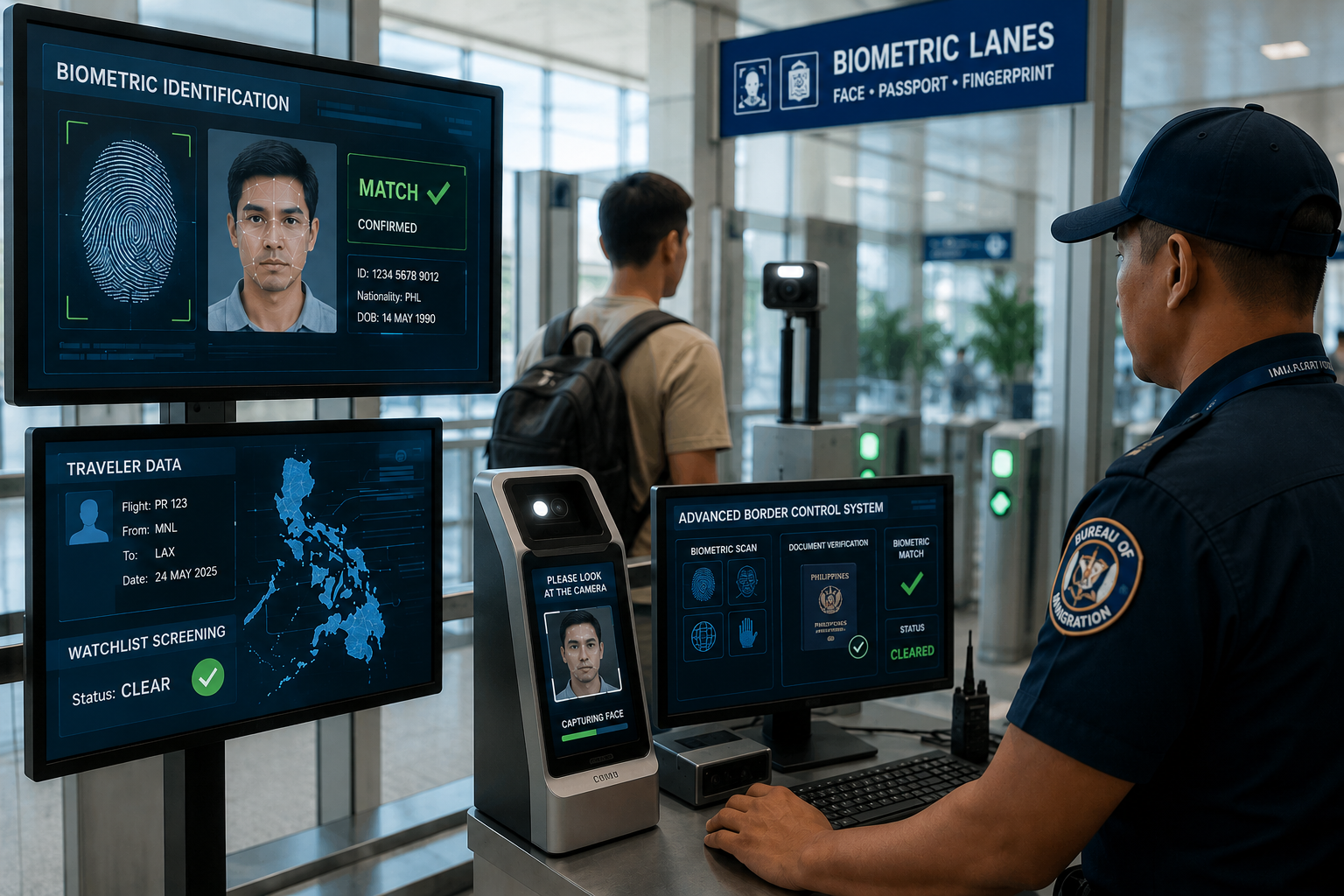
Philippine immigration officials have argued that stronger border security technology is essential to preventing traffickers and other criminals from entering the country.
The Bureau of Immigration (BI) recently proposed the Civil Aviation and Immigration Security Services (CAISS) project, a nationwide system designed to integrate artificial intelligence, biometrics, and real-time screening capabilities across major ports of entry.
According to BI spokesperson Dana Sandoval, the project would cover major airports, including Ninoy Aquino International Airport, Clark, Davao, Mactan-Cebu, Boracay, Iloilo, Kalibo, Laoag, Bohol-Panglao, Puerto Princesa, and Zamboanga, as well as the Zamboanga seaport and six border crossing stations.
The proposed ₱10.74 billion public-private partnership project would feature facial biometric contactless processing corridors compliant with standards of the International Civil Aviation Organization, criminal-record screening, and deception-detection technology.
Immigration officials said the system would be implemented at no cost to the government.
Sandoval said the technology is already available and could help the Philippines strengthen its anti-trafficking efforts while enhancing border security and keeping pace with regional counterparts.
As traffickers increasingly leverage digital tools and online networks, experts say sustained success will depend not only on enforcement and prosecution but also on the country’s ability to innovate, modernize data systems, and build stronger partnerships among government agencies, technology firms, and anti-trafficking organizations.
Stay updated—follow Philippines Today on Facebook and Instagram, and subscribe on YouTube for more stories.