
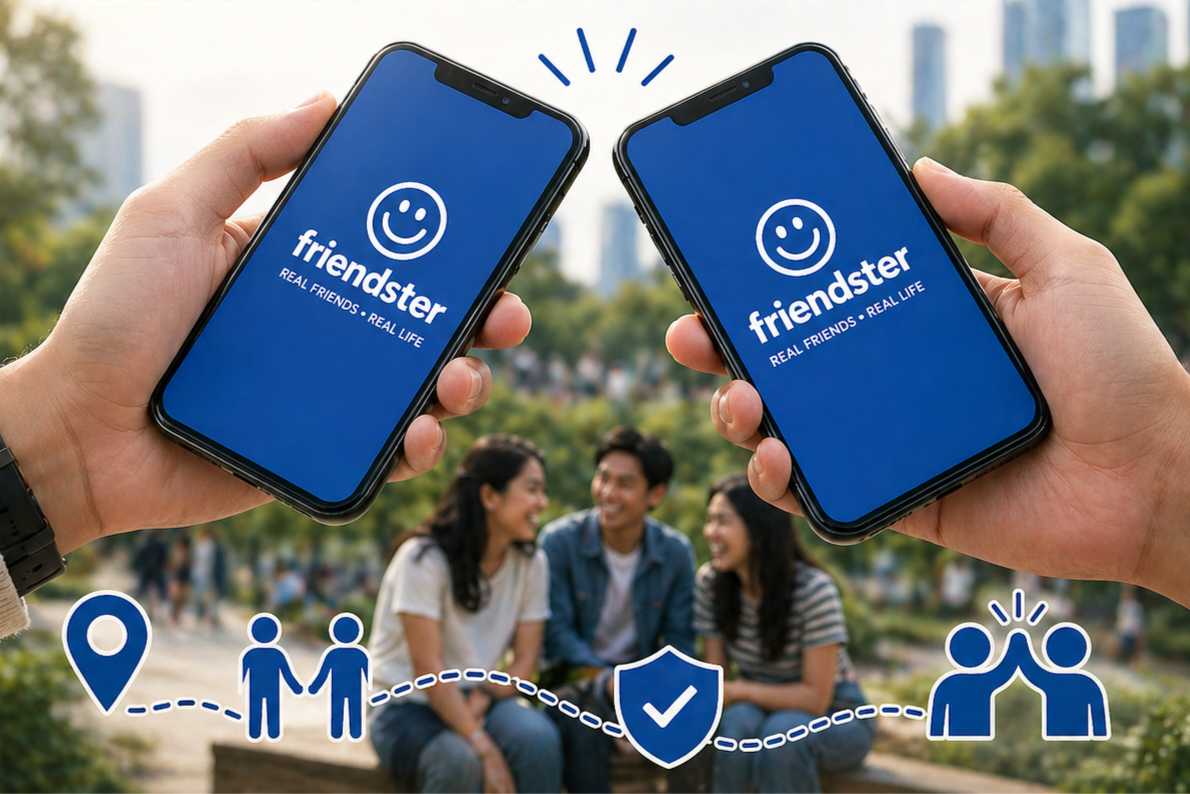

For millions of Filipinos who once spent hours curating profiles, collecting testimonials, and refreshing slow-loading pages, Friendster was more than a website—it was an early blueprint of online social life. Internet cafés were filled with users tweaking profile layouts and exchanging testimonials, turning the platform into a shared social ritual.
Now, in a twist shaped as much by nostalgia as by shifting digital habits, the platform is attempting a return by doing something few modern apps dare: forcing users to connect in person.
Launched in 2002 and widely regarded as the first modern social network, Friendster became a cultural phenomenon in the Philippines, which at one point accounted for nearly 39% of its global traffic. By the late 2000s, it had more than 13 million Filipino users, helping cement the country’s reputation as a global hub of social media activity.
Its popularity was so significant that the company even established a local office in Manila to support its growing base. Its eventual decline—marked by technical issues and a failed pivot to gaming—culminated in the site going offline in 2015 and the company shutting down in 2018.
Its revival is being led by technopreneur Mike Carson, who acquired the Friendster.com domain in a deal valued at about US$30,000, combining US$20,000 in Bitcoin with a revenue-generating domain. The address itself had reappeared in 2023 after years of inactivity, having previously been bought for just US$7,456 in an expired domain auction.
Carson later secured ownership of the Friendster trademarks on May 13, 2025, following a lengthy legal process, clearing the way for a relaunch.
“Today I feel that social networks foster a lot of negativity, but I remembered Friendster as being a really positive and enjoyable experience (except when the site would not load, which was really frustrating),” Carson wrote in a Medium post.
Rather than revive the platform in its original form, Carson has rebuilt it as an iOS app designed to reverse the logic of modern social media. There are no algorithms, no advertisements, and no data harvesting.
Instead, Friendster introduces a single defining rule: users can only add friends by physically tapping their phones together.
“The idea that the only way to connect as friends on Friendster is by tapping phones was fun because it would promote people meeting in person. It would also verify that you are connecting to real people, and people that you actually want to connect with,” Carson said.
The app extends this real-world emphasis through a “fading connections” feature that mirrors the natural drift of offline relationships. “If two friends go a full year without tapping phones, the link between them softens. Not a punishment — a gentle nudge that real friendships are kept alive in person, not online,” he wrote.
Users can still explore networks through “friends of friends”, allowing them to message second-degree connections. The design ultimately nudges them toward meeting offline to formalize those ties.
The model reflects Carson’s broader attempt to move social networking away from passive scrolling and towards intentional interaction, echoing early internet communities where connections were smaller but often more personal.
“I don’t really care about making money from Friendster, but I’d like it to eventually pay for itself,” he said, adding that premium features may be introduced later.
The relaunch comes as concerns grow globally over screen addiction, algorithm-driven content, and online toxicity—issues that have come to define platforms such as Facebook, Instagram, X, and TikTok.
Friendster’s “real-world-first” approach positions it as a counterpoint, though its reliance on physical interaction may limit its scale.
Still, in the Philippines—where Friendster once shaped digital identity and social status, from personalized profiles to the social currency of testimonials—the reboot carries a resonance few platforms can replicate.
Its success may ultimately depend on whether that nostalgia can translate into a new kind of engagement, one that reconnects users not just online, but face to face.
Stay updated—follow Philippines Today on Facebook and Instagram, and subscribe on YouTube for more stories.