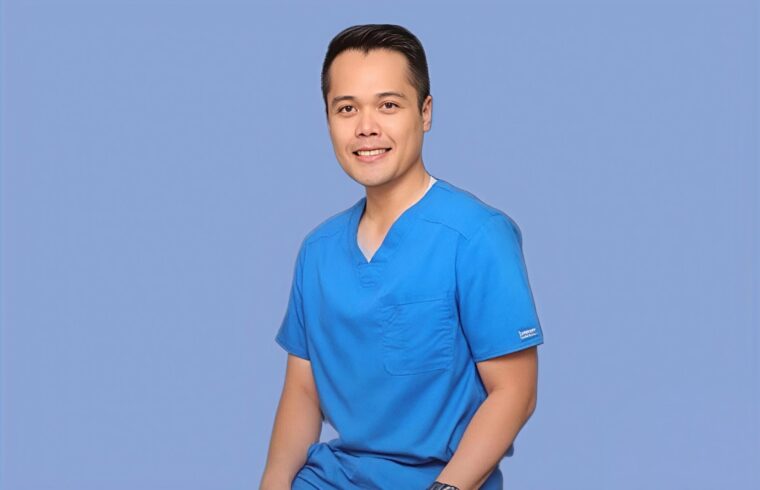
He crossed borders to earn a living but found his calling in fixing the systems that decide who gets cared for—and how well. For Job Marconi Mascardo, an overseas Filipino nurse, migration was never an escape; it was preparation for service at a scale far beyond the bedside.
Mascardo grew up in Dipolog City in a household shaped by absence and endurance, the quiet architecture of many overseas Filipino worker (OFW) families.
His father, Eugene, worked abroad as a home health caregiver, while his mother, Myrlen, raised four children on remittances and resolve. In such homes, ambition is collective and education is survival, not self-expression; success belongs to the family that waits together. That early lesson—discipline forged by distance—would later anchor him through repeated setbacks.
Nursing was not his first dream. He once imagined life at sea. But in the Philippines, nursing is a practical hope: a profession that promises dignity, mobility, and the chance to lift an entire household.
Mascardo and his siblings chose it together. At Silliman University, the course tested him hard. He failed subjects, repeated classes, and nearly missed graduation because of a senior research setback. Self-doubt weighed heavily, but quitting was not an option; too many sacrifices had already been made. He finished on time, tempered by failure rather than broken by it.
Passing the Nursing Licensure Examination did not deliver the turnaround often implied in success stories. Jobs were scarce, pay was low, and benefits were rare. Like many newly licensed Filipino nurses, Mascardo volunteered and accepted short-term contracts to build experience.
He served with the Philippine Red Cross in Cebu, responding to disasters and disease outbreaks while training communities in first aid and life support. “What began as unpaid work became one of the most formative chapters of my life,” he said.
That period, often omitted from glossy narratives, is where many overseas dreams either fracture or deepen. His nearly ended before it began: days before the board exam, severe illness left him dehydrated and unsure he could even sit for it. He recovered just enough to proceed, carrying a lesson that endurance is as spiritual as it is physical.
Then came the long wait. U.S. visa retrogression stretched into years, demanding patience rather than momentum. Mascardo kept working in the Philippines, sharpening clinical skills and emotional resilience. The delay, he later realized, was not dead time but conditioning—an education in resourcefulness and purpose that would prove decisive.
When he finally migrated, the United States was not a spectacle but a classroom. In Missoula, Montana, he worked long shifts in long-term care and rehabilitation, tending to older adults through punishing winters. Like many overseas Filipinos, he worked overtime, sent money home and learned to rebuild life from scratch—credit histories, bank accounts, and retirement systems included. Small failures accumulated quietly. He failed his first driving test, passed on the second. He lost nearly $10,000 after following online investment hype promising quick gains. Each mistake stripped away shortcuts and replaced them with patience.
The pandemic sharpened his trajectory. Remaining at the bedside during COVID-19, Mascardo often became the only human presence for patients at their most vulnerable. The experience clarified a hard truth: compassion alone cannot compensate for fragile systems. If caregivers are unsupported, care itself becomes unsustainable. The insight did not pull him away from nursing; it pushed him deeper into its structural core.
He pursued advanced education not as ornament but as leverage, earning an MBA and a master’s degree in nursing, along with U.S. board certifications in leadership, case management, and healthcare quality. For a migrant nurse, the credentials signaled credibility and belonging—permission to speak where decisions are made. “Contrary to what people think, success abroad is built, not gifted,” he said.
In Houston, he worked with a managed care organization, helping prevent avoidable hospitalizations and contributing as a subject matter expert to safer discharge protocols. The work expanded his reach beyond individual patients to population-level outcomes.
Purpose, however, drew him closer to home. When offered a role in Guam, Mascardo accepted immediately. Limited resources, tight-knit communities, and high stakes mirrored the conditions that had shaped him. At Guam Memorial Hospital Authority, he now works as a Hospital Nurse Quality Improvement Specialist, strengthening patient safety, improving discharge planning, and reviewing mortality cases. His influence touches thousands, but his focus remains on nurses who feel unseen and depleted. He led the introduction of the DAISY Awards on the island, a deliberate act of recognition for a workforce that often measures appreciation in rare moments rather than material rewards.
For Mascardo, the overseas Filipino story is frequently misread as a chase for titles, visas, or income. He frames success differently—as freedom from constant financial fear, the ability to rest without guilt, and presence with family across borders. That conviction has turned him into an advocate for financial literacy among nurses, arguing that hard work without guidance leaves many vulnerable even after decades of sacrifice.
The quiet arc of his family tells the story best. All four siblings are now registered nurses, educated in the Philippines and practicing in North America—a collective outcome of an OFW household’s long bet on education.
Mascardo credits faith, his parents’ endurance, and the communities that tested him. He returns often to the words of national hero Dr. José Rizal: “Ang hindi lumingon sa pinanggalingan, hindi makarating sa paroroonan.” (“He who does not know how to look back at where he came from will never reach his destination.”)
Between struggle and service, he has learned that migration is not simply about leaving home behind in search of opportunity. It is about carrying the values shaped by home—resilience, responsibility, and care for others—into hospital wards, health systems, and everyday decisions, wherever one is needed most.
Follow PHILIPPINES TODAY on Facebook and Instagram, and subscribe on YouTube for the latest updates.