
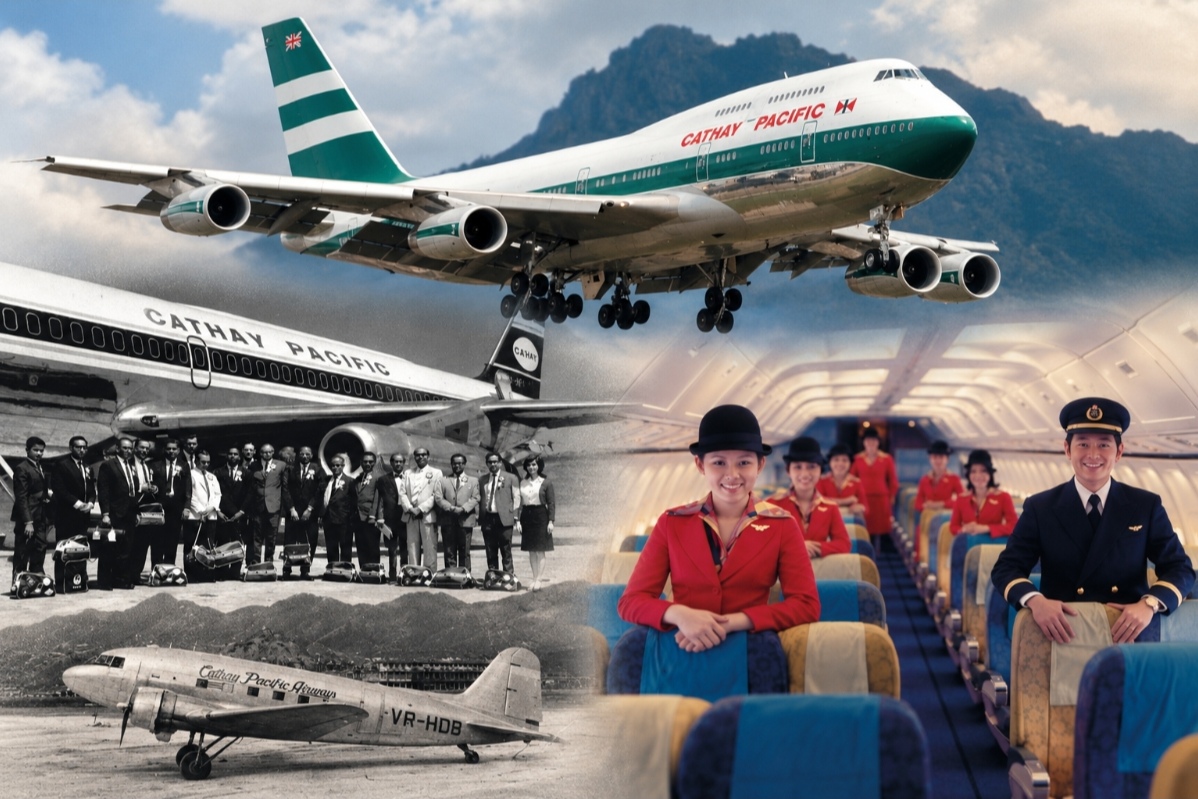

Cathay Pacific marked its 80th anniversary in Manila on September 3 with a celebration at The Manila Hotel, paying tribute to a little-known piece of aviation history: the Philippine capital is where the airline’s name was coined in 1946.
The celebration brought together Cathay Pacific executives, trade partners, corporate clients, and members of its Philippine community. Leading the event were Philippines country manager Vishnu Rajendran, Southeast Asia and Oceania regional general nanager Aldric Chau, and chief customer and commercial officer Lavinia Lau.
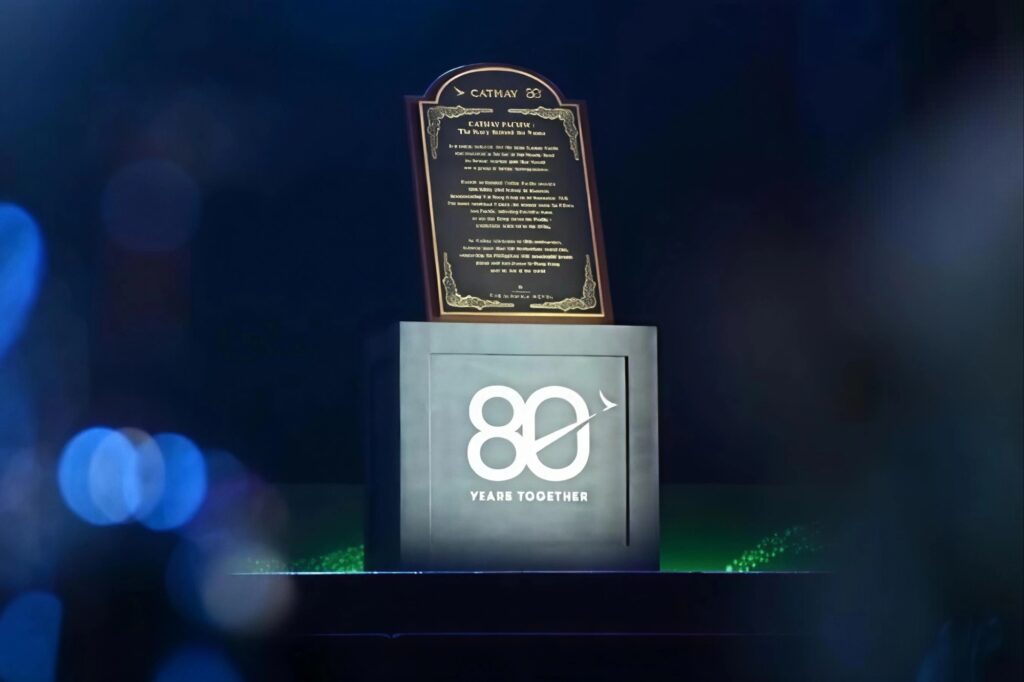
A historical marker was unveiled at The Manila Hotel to commemorate the property’s unique place in the airline’s history, cementing a connection that predates Cathay Pacific’s first commercial flight.
The Manila connection dates back to the months after World War II. According to Cathay Pacific’s official history, co-founder Roy Farrell was at the hotel’s Tropicana Bar in 1946 discussing possible names for a new airline with foreign journalists when “Cathay Pacific Airways” emerged. “Cathay” referred to China, while “Pacific” reflected Farrell’s ambition to one day operate flights across the Pacific Ocean.
Cathay Pacific was formally established on September 24, 1946, by former wartime pilots Roy Farrell and Sydney de Kantzow. A day after the company was registered in Hong Kong, it operated its first flight from Sydney to Hong Kong using a converted Douglas DC-3 aircraft affectionately known as Betsy.
The Philippines became part of that journey almost immediately. Manila joined Cathay Pacific’s network in December 1946, making it one of the airline’s earliest international destinations outside Hong Kong and Sydney—and one of its oldest overseas routes.
Cathay Pacific steadily expanded its presence in the Philippines over the following decades, introducing daily Manila flights in 1962 before extending its network to Cebu in 1992 through a four-times-weekly Hong Kong-Cebu service launched in partnership with Philippine Airlines. Today, the Philippines remains one of Cathay Pacific’s key markets in Southeast Asia, connecting Filipino travelers to Hong Kong and onward to destinations across Asia, Europe, North America, and beyond.

The Manila celebration also reflected on how the airline has evolved from a single-aircraft operation into a global carrier serving more than 100 destinations worldwide. Over eight decades, Cathay Pacific expanded through the jet age, introduced Boeing 747s that transformed its long-haul network, and continued investing in new aircraft, upgraded cabins, and a broader travel and cargo network.
“Since our earliest days, Cathay has helped open new horizons for people, businesses, and communities,” Cathay Group chief executive Ronald Lam said in the airline’s 80th anniversary stories. “That purpose has defined our first 80 years, and it continues to guide us today.”
The anniversary is part of Cathay Pacific’s global “80 Years Together” campaign, with commemorative events and initiatives taking place across markets where the airline operates throughout 2026.
“As we celebrate 80 Years Together, we do so with gratitude for everyone who’s been part of our journey,” Lam said. “Our responsibility now is to honor that legacy by building on it, so future generations can continue to discover the joy of travel.”
For an airline whose story is often associated with Hong Kong, one of its defining first chapters was written hundreds of miles away in Manila—a reminder that the Philippines was not simply an early destination, but part of the history that helped shape one of Asia’s most enduring aviation brands.
Stay updated—follow Philippines Today on Facebook and Instagram, and subscribe on YouTube for more stories.