
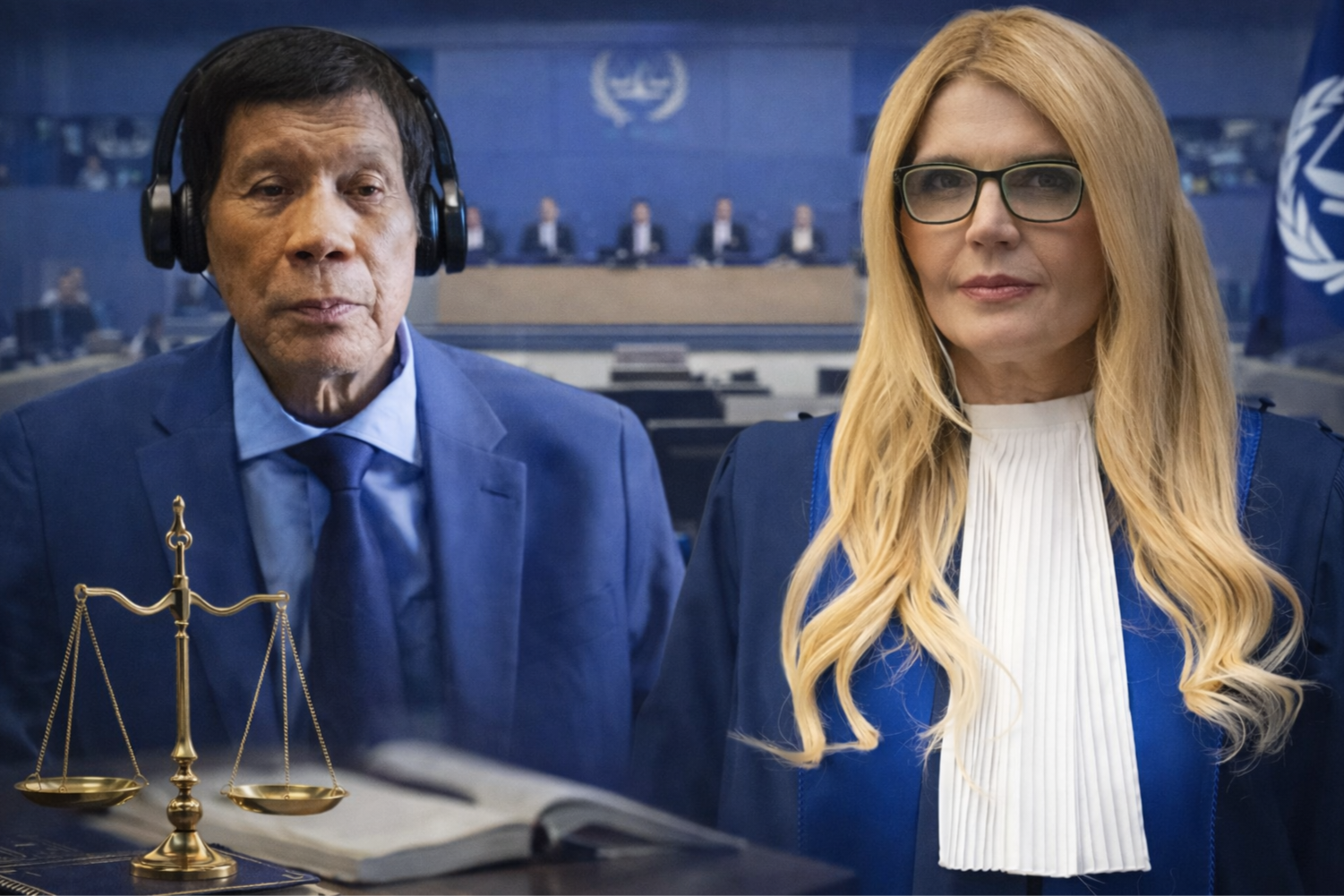

The International Criminal Court’s (ICC) first public hearing on former Philippine president Rodrigo Duterte opened on Monday, February 23, with a pointed reminder: this is not a trial—and the court has not found him guilty of anything.
From the bench in The Hague, Presiding Judge Iulia Antoanella Motoc underscored that Duterte enters the proceedings cloaked in the presumption of innocence, as prosecutors seek to convince judges there are substantial grounds to move the case forward.
Motoc, presiding over Pre-Trial Chamber I at the ICC, emphasized that the hearing’s purpose is procedural—not punitive. The session, she said, is meant to assess whether the Office of the Prosecutor (OTP) has presented enough evidence to establish “substantial grounds to believe” Duterte committed the crimes alleged against him.
“At this stage of pretrial proceedings, the OTP alleges that Mr. Duterte is responsible for the crimes that the court officer shall read out shortly,” Motoc said at the outset of the hearing.
She was explicit about the chamber’s limited role.
“The chamber shall not take any decision with regard to the guilt or innocence of Mr. Duterte during this hearing,” she said. “Indeed, the role of the chamber is to determine whether there is sufficient evidence to establish substantial grounds to believe that Mr. Duterte committed the crimes with which he is charged.”
The case against Duterte stems from the ICC prosecutor’s investigation into alleged crimes against humanity linked to his administration’s anti-drug campaign, which human rights groups say left thousands dead. The Office of the Prosecutor has argued that there is a reasonable basis to believe the killings were widespread and systematic—a key threshold for crimes against humanity under the Rome Statute, the court’s founding treaty.
Under Article 61 of the Rome Statute, a pretrial chamber must confirm charges before a case can proceed to trial. The standard is not proof beyond reasonable doubt—the bar required for conviction—but whether there is sufficient evidence establishing substantial grounds to believe the accused committed the crimes.
Motoc pointed to Article 66 of the statute, reiterating a bedrock principle of international criminal law: “a person shall be presumed innocent until proved guilty before the Court.”
“The burden of proof is upon the OTP, which must produce sufficient evidence to prove the charges against Mr. Duterte at the required standard of proof,” she said.
If judges confirm all or part of the charges, the case will move to a trial chamber, where prosecutors would then be required to meet the higher standard of proof beyond reasonable doubt. If the charges are not confirmed, the case could be dismissed at this stage, though prosecutors may seek to present additional evidence.
Motoc also highlighted the procedural safeguards afforded to Duterte under the Rome Statute. She noted that the defense has the right to challenge the prosecution’s evidence, object to jurisdiction and admissibility, and present counterarguments. Those rights are enshrined in Articles 61 and 67 of the statute, which guarantee fair trial protections, including the right to counsel and adequate time to prepare a defense.
The ICC, based in The Hague, was established in 2002 to prosecute individuals accused of genocide, crimes against humanity, war crimes, and the crime of aggression when national courts are unwilling or unable to do so. The Philippines withdrew from the court in 2019 under Duterte’s administration, but the tribunal has maintained that it retains jurisdiction over alleged crimes committed while the country was still a state party.
Duterte has repeatedly defended his anti-drug campaign, arguing that it was necessary to combat criminality. His lawyers have questioned the ICC’s jurisdiction and are expected to challenge the sufficiency of the prosecution’s evidence during the confirmation process.
Monday’s hearing marks a critical procedural milestone but not a determination of criminal responsibility. The confirmation stage functions as a filter, ensuring that only cases supported by sufficient evidence proceed to full trial.
For now, the court’s message was clear: the proceedings are about evidence, not verdicts.
As Motoc reminded the courtroom, the presumption of innocence remains intact—and it is up to prosecutors to meet the legal threshold required to advance the case.
Stay updated—follow Philippines Today on Facebook and Instagram, and subscribe on YouTube for more stories.