
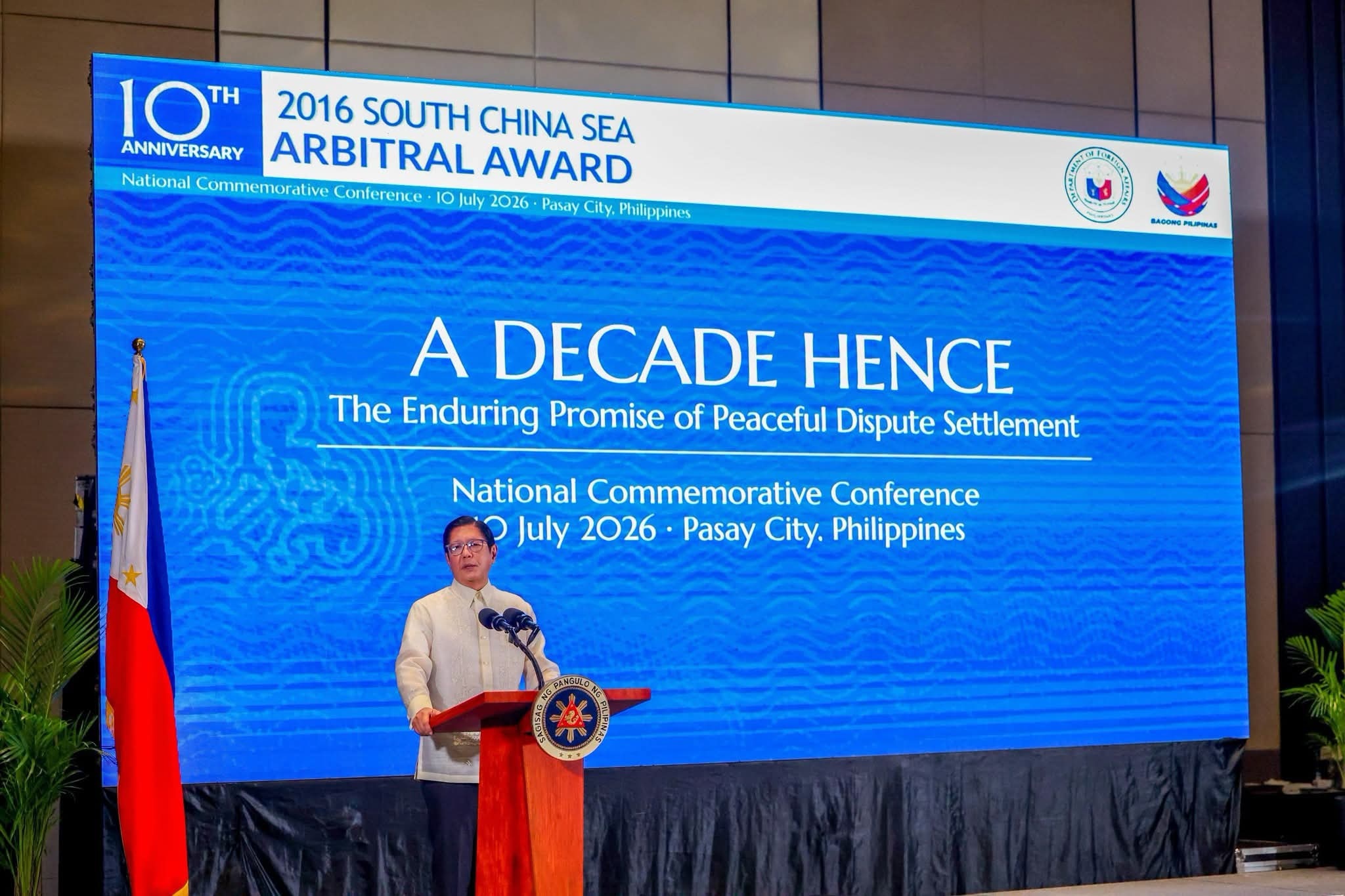

A decade after an international tribunal issued a landmark ruling on the South China Sea, President Ferdinand Marcos Jr. on Friday, July 10, renewed the Philippines’ commitment to international law, saying the decision remains central to Manila’s pursuit of peace, stability, and a rules-based order.
The July 12, 2016 award, issued by a tribunal constituted under the 1982 United Nations Convention on the Law of the Sea (UNCLOS), overwhelmingly favored the Philippines in its case against China.
The tribunal found that Beijing’s “nine-dash line” claim had no legal basis under the convention and affirmed the Philippines’ sovereign rights within its exclusive economic zone. China rejected the ruling as “null and void” and has continued to assert its claims, while Manila has consistently maintained that the award is final and legally binding.
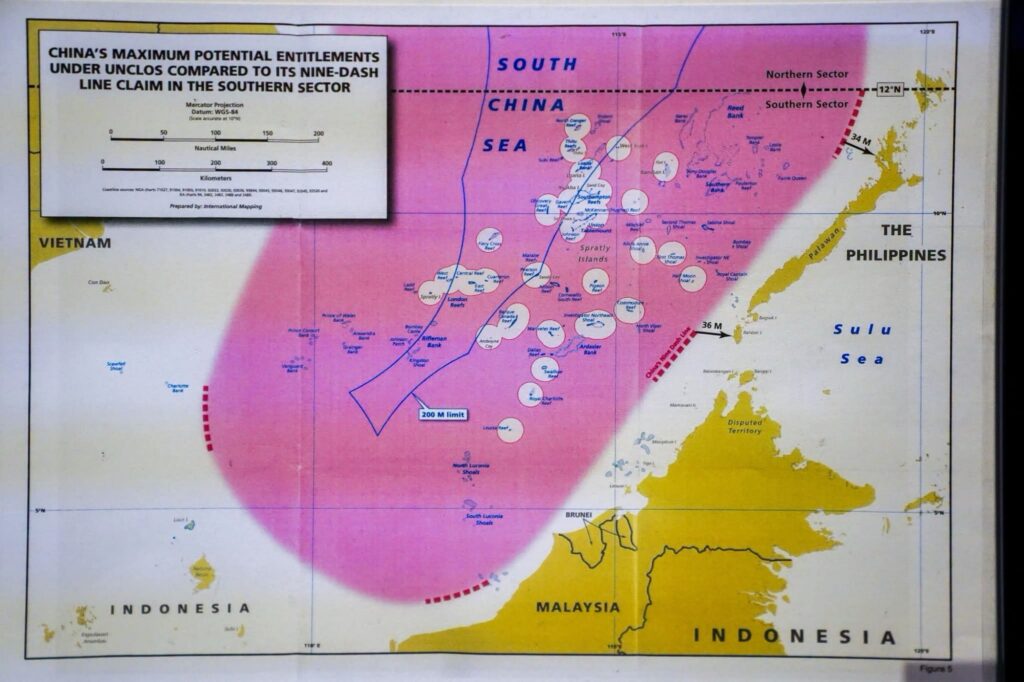
For Solicitor General Darlene Marie Berberabe, the significance of the award extends well beyond legal doctrine. “It means the fish that feed our coastal towns are in law, Filipino fish. It means the gas beneath Recto Bank is in law, Filipino gas. And that Bajo de Masinloc, in law, remains a traditional fishing ground from which our fishermen may not lawfully depart.”
Speaking at a diplomatic reception in Pasay City ahead of the ruling’s 10th anniversary, Marcos described the award as more than a legal victory, saying it reaffirmed the principle that disputes between states should be resolved peacefully through international law rather than coercion or the use of force.
“As we mark the conclusion of today’s landmark commemorative conference, we gather not merely to celebrate a legal milestone, but to reaffirm a living truth that peace can only endure when it is anchored on justice, mutual respect, and the sovereign equality of all nations.”
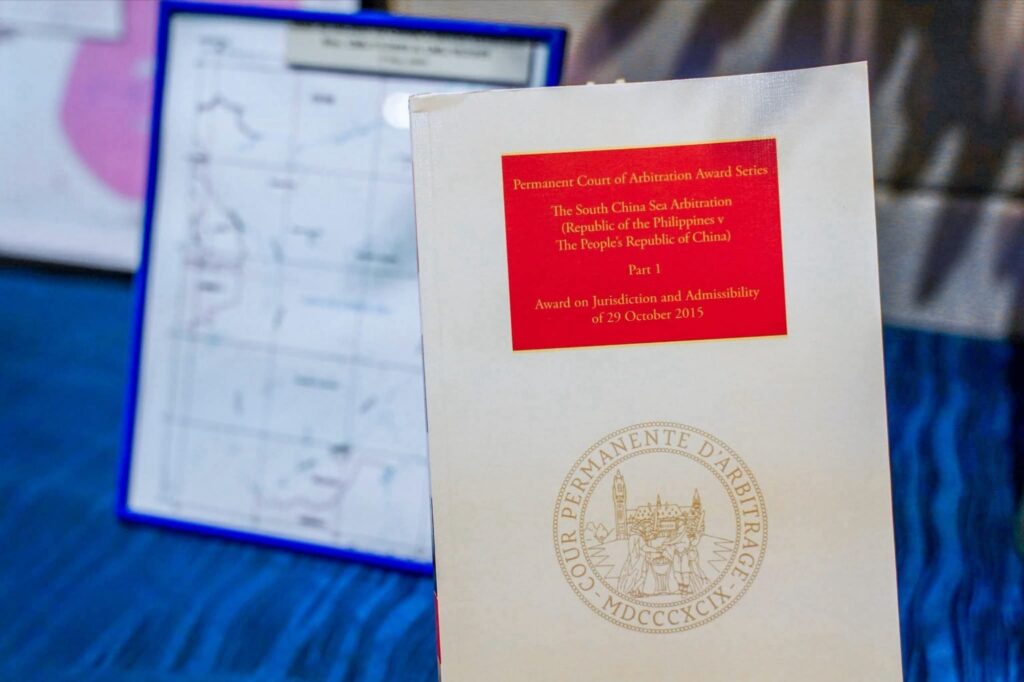
Marcos said the Philippines’ decision to initiate arbitration in 2013 reflected a deliberate choice to pursue legal remedies instead of confrontation. He said the rule of law remained “the great equalizer of all nations,” ensuring that justice is determined not by military strength, territorial size, or economic power, but by universally accepted legal principles and treaty obligations.
He said the award’s significance ultimately lies not in competing maritime claims but in the people whose lives depend on the sea.
“At its heart, this award is about people. It is about our fisherfolk whose ancestors have cast their nets in these waters for many generations, and who deserve to fish in peace, in safety, and with the dignity to feed their own families. It is about our coastal communities whose survival is tied to the health and ecological integrity of our oceans.”
Marcos said the award has, over the past decade, become an important reference in the interpretation and application of UNCLOS, strengthening confidence in the peaceful settlement of disputes and reinforcing the principle that international agreements must be honored. He reiterated that the Philippines remains committed to the UN Charter and UNCLOS while pursuing constructive engagement with all countries.
“The South China Sea must never be an arena of conflict. It must remain a sea of peace, cooperation, and connectivity. A body of water that sustains livelihoods, fosters trade, protects marine biodiversity, and unites rather than divides our nations.”
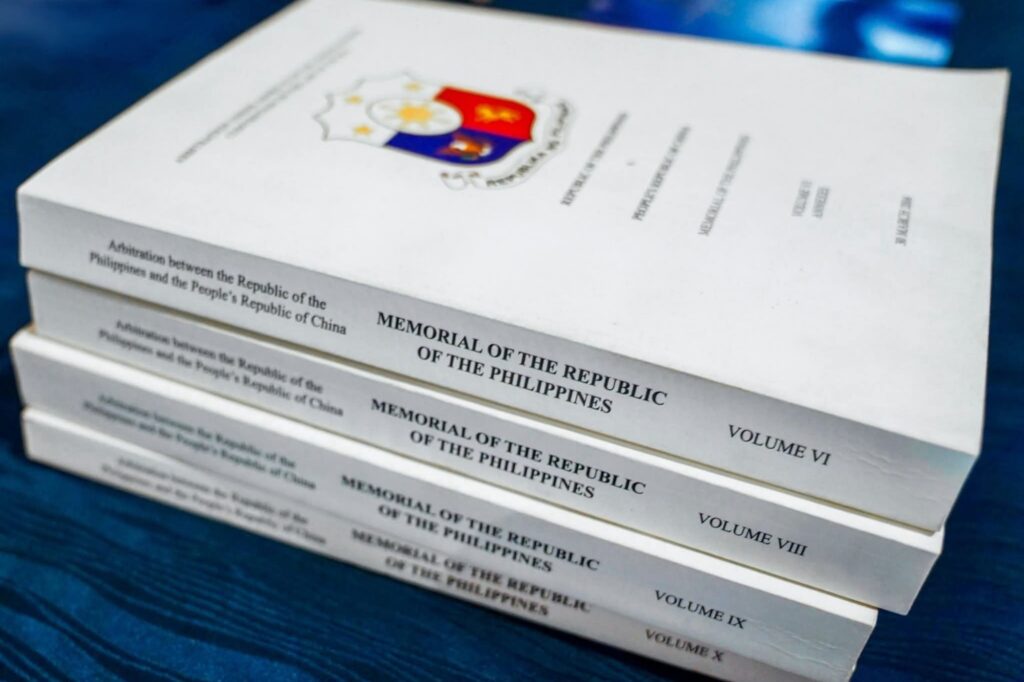
Meanwhile, Berberabe said the ruling has quietly strengthened the country’s legal and institutional foundations over the past decade, outlasting changes in political leadership and becoming embedded in domestic laws, government institutions, and maritime governance.
“Administrations change. Emphases shift. Budgets rise and fall. The Republic, however, is a continuing client, and this decade’s work has moved the award’s protection beyond the reach of any single season of politics.”
She said the award continues to shape the work of government agencies, from the Department of Foreign Affairs’ diplomatic protests and the Philippine Coast Guard’s operations to the Bureau of Fisheries and Aquatic Resources’ support for fisherfolk and the National Mapping and Resource Information Authority’s charting of the country’s maritime domain.
Marcos concluded by calling on governments, diplomats, legal experts, and the wider international community to continue strengthening cooperation and upholding international law, saying the responsibility for carrying forward the legacy of the arbitral award now belongs to all who seek a peaceful, stable, and rules-based maritime order.
Stay updated—follow Philippines Today on Facebook and Instagram, and subscribe on YouTube for more stories.