

The internet rarely waits for context.
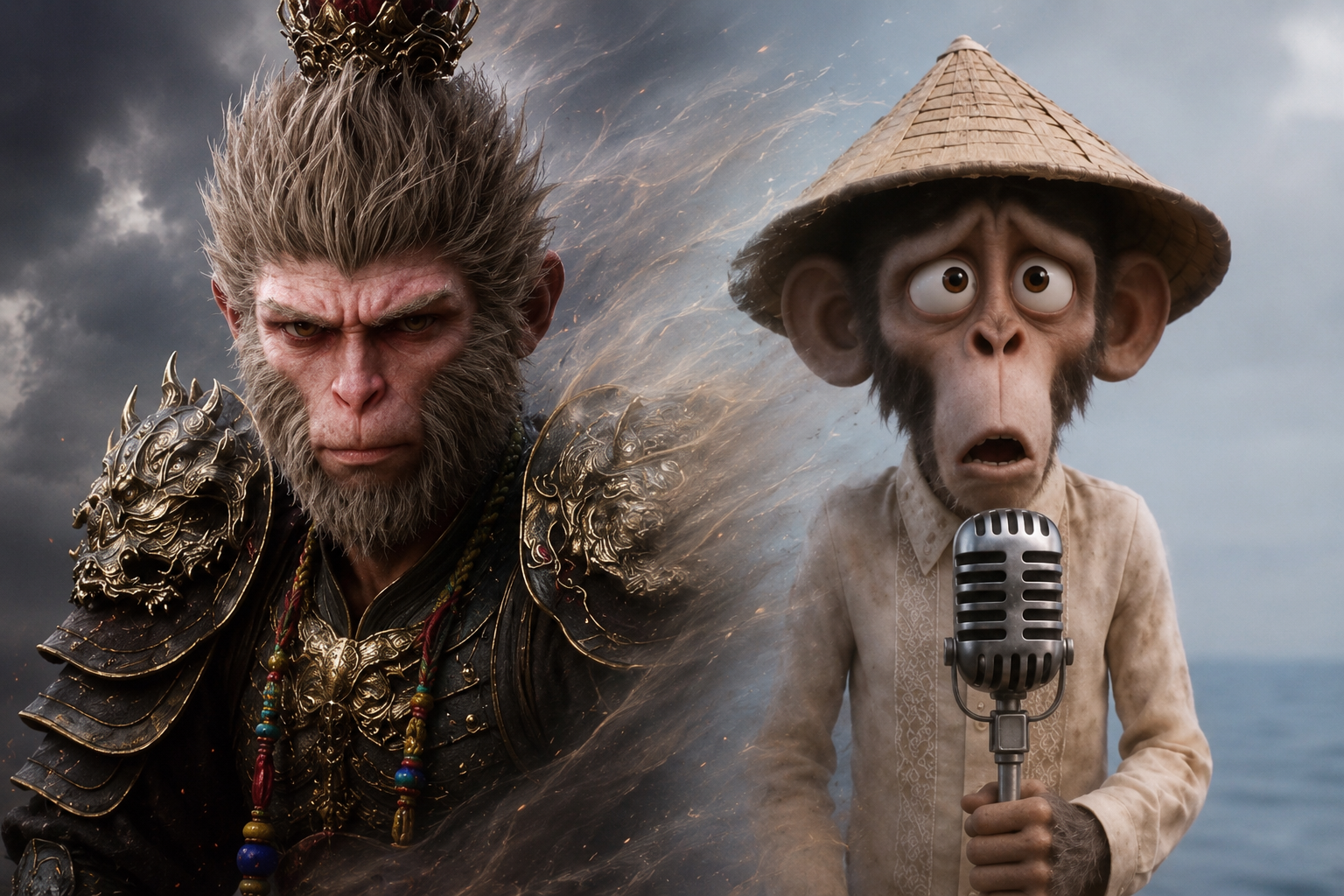
Last week, China’s state-run China Daily posted an AI-generated video featuring a monkey dressed in a barong Tagalog. In the animation, arms bearing the Japanese and American flags shove the monkey onto a rickety karaoke stage set atop a boat. After being scolded for singing the “wrong” song, it holds up a placard reading “South China Sea arbitration award” before being hurled into the sea and blasted with a water cannon.
The imagery quickly drew criticism online. To many Filipinos, the monkey appeared to represent the Philippines—a depiction that evoked a long history of using simian imagery to demean people.
That first impression is difficult to dismiss.
But history has a habit of complicating what seems obvious.
Long before social media, before AI-generated propaganda and maritime disputes, Chinese literature gave the world one of its most celebrated heroes: Sun Wukong, better known as the Monkey King.
He is no ordinary monkey.
Sun Wukong is the unforgettable protagonist of the 16th-century classic Journey to the West. Born from stone, gifted with impossible strength, armed with a magical staff and the ability to transform into dozens of forms, he is remembered not because he obeyed authority—but because he challenged it.
He refused to accept the place assigned to him.
He questioned heaven’s hierarchy, declared himself the equal of the Jade Emperor, and paid dearly for that defiance. Imprisoned beneath a mountain for centuries, he eventually found redemption by protecting the monk Tang Sanzang on a dangerous pilgrimage, earning a place among Buddhism’s enlightened beings.
For generations of Chinese readers, Sun Wukong became far more than a mythical creature. He became the ultimate underdog—clever, fearless, stubborn, and impossible to suppress.
His story survived dynasties, revolutions, cinema, television, comics, and now even modern video games.
That raises an uncomfortable question.
If a monkey occupies such an honored place in Chinese culture, what exactly was China Daily trying to say?
Was the character simply meant as an insult directed at the Philippines?
Or did the creators reach for an image whose cultural meaning inside China differs sharply from how it would almost certainly be received abroad?
Chinese symbolism often carries layers unfamiliar to foreign audiences. In one tradition of Chinese folk art, the monkey can represent advancement and high office because the character for monkey, hóu (猴), is a homophone of hóu (侯), or marquis—an ancient noble rank. Images of monkeys have long been used as visual puns wishing someone promotion, honor, or success.
Yet symbols rarely travel unchanged. Images that appear harmless—or even complimentary—in one tradition may evoke something entirely different elsewhere.
Political communication does not happen inside cultural bubbles. A message intended for one audience inevitably reaches another, where different histories shape different interpretations.
That may explain why the video drew such sharply different readings. Released amid continuing tensions between Manila and Beijing over the West Philippine Sea, the animation was bound to be viewed through the prism of an increasingly fraught relationship. In that context, a monkey wearing a barong was no longer just a literary or cultural symbol. It became a political one.
Some observers have pointed to an irony. If the Philippines is cast as the Monkey King, then the comparison carries unexpected implications. Sun Wukong is remembered not because he yielded to a stronger power, but because he stood up to one. He challenged a mighty empire, endured punishment for his defiance, and emerged as one of the most celebrated figures in Chinese literature.
Whether that parallel was deliberate is impossible to know. Nor does it erase the fact that many Filipinos found the imagery offensive. Symbols are shaped as much by those who receive them as by those who create them.
Perhaps that is the more revealing story.
The controversy is not only about an AI-generated monkey. It is also about how meaning shifts as symbols cross cultures, languages, and political divides. What is intended as satire in one place may be understood as a slur in another. What is seen as a literary reference by one audience may evoke a painful history for another.
Perhaps that is why dialogue, sustained engagement, and, when necessary, mediation remain essential. They offer a chance to test assumptions, clarify intentions, and narrow the distance between what is meant and what is understood. In a region where history and symbolism often shape perceptions as much as policy, mutual understanding rarely happens by accident.
In an age when AI can generate images in seconds and social media can send them around the world just as quickly, those differences in interpretation matter more than ever. Technology may have accelerated the spread of symbols, but it has not erased the cultural baggage they carry.
The monkey in China Daily‘s animation has become more than a digital character. It has become a test of how history, culture, and politics shape the way we see the same image.
Some will see mockery.
Others will see mythology.
Still others may see an example of how the most powerful symbols are often the most contested.
The question, then, is not simply what China Daily intended.
It is which story readers believe the monkey was telling.
Stay updated—follow Philippines Today on Facebook and Instagram, and subscribe on YouTube for more stories.