

In a country of more than 7,000 islands, many Filipino children today are growing up immersed in worlds that look and sound nothing like their own.
Their favorite characters often speak with foreign accents, their adventures unfold in distant settings, and their understanding of childhood is increasingly shaped by stories imported from elsewhere. Against that backdrop, a new animated series is seeking to bring young Filipinos back to the landscapes, languages, and values that have long defined life in the archipelago.
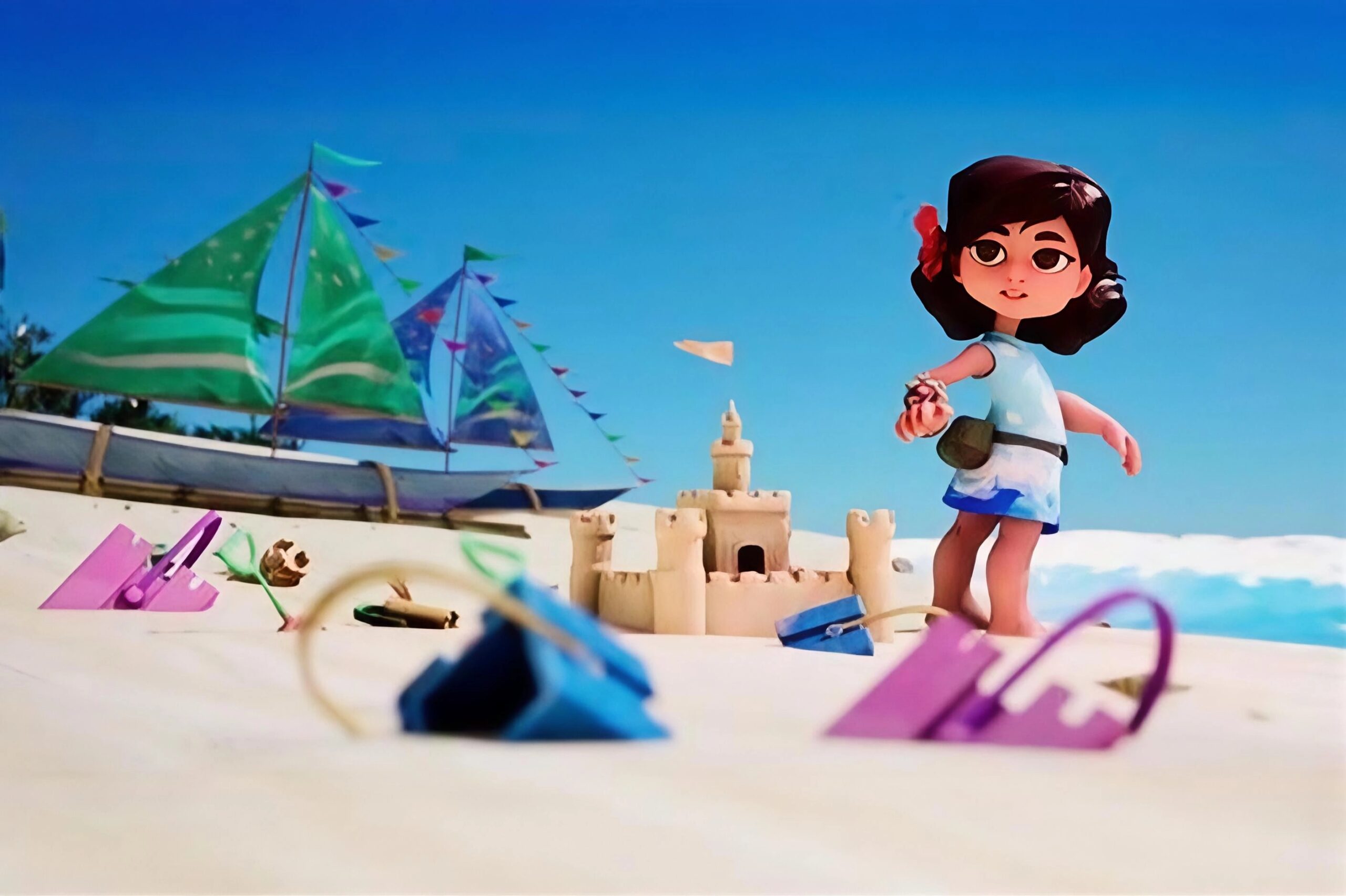
At the center of that effort is Agos, a curious five-year-old whose adventures form the heart of Agos, Ang Batang Isla. With sun-browned skin, a love for the outdoors, and an instinctive connection to her surroundings, she embodies a childhood that many Filipinos once knew intimately—one shaped by community, nature, and family.
The series follows Agos as she explores island life, meeting neighbors, workers, native animals, and fellow children along the way. Each day begins with a simple ritual: asking permission from her parents before venturing outdoors. By sunset, she returns home to the familiar call of her mother, bringing with her new discoveries and lessons gathered from the world beyond her doorstep.
Behind the gentle storytelling lies a larger cultural ambition.
“We want to create an animated series for the Filipino kids where we highlight the importance of being family-oriented while including the art of play, and love for culture and the environment,” said Jacque Manabat, chief executive of Amber Studios Manila and the project’s lead creator, in a Rappler interview.
For Manabat, the idea emerged from a growing concern that Filipino children are increasingly disconnected from stories that reflect their own experiences. During a consultation stint with the National Council for Children’s Television, she was struck by the limited number of locally produced programs available to young audiences.
“I don’t think we have a lot of animated series for Filipino kids these days,” she said. “If you observe the younger generation now, they speak like Bluey, Peppa Pig, or Miss Rachel.”
The observation touches on a broader question confronting many societies in an age of global media: what happens when children rarely see themselves represented in the stories they consume?
For generations of Filipinos, programs such as Batibot and Sineskwela offered lessons rooted in local realities, blending education with language, culture, and everyday life. Manabat, who later built a career producing and writing for Matanglawin, sees Agos as part of that tradition.
“This project started with a troubling realization during a short consultation stint with the National Council for Children’s Television where I saw the massive gap in local children’s programming. It is alarming to see the literacy rates of Filipino children falling behind our neighbors, and I believe that when kids do not see themselves reflected in the media they consume, they lose an important connection to learning.”
The challenge is particularly urgent in the Philippines, where the World Bank has reported that 91 per cent of 10-year-olds struggle with foundational reading comprehension and literacy skills.
“We hope to address a 91% literacy gap in the Philippines and a crisis of identity,” Manabat said.
Rather than creating another fantasy universe detached from local realities, the creators chose to root the series firmly in the rhythms of Filipino life. Even the title carries symbolic weight. Agos, meaning the flow of water, evokes movement, continuity and connection, while batang isla—child of the islands—speaks to a shared national identity shaped by geography and culture.
The character herself was inspired by a real child from Zambales, whom Manabat and creative director Cedric Hornedo met at Greenspace Artist Village. Her curiosity, independence and closeness to the natural environment became the foundation for the animated protagonist.
The production also reflects a deliberate effort to combine modern technology with local artistic talent. While the series employs sophisticated motion-capture techniques, its creators insist that authenticity remains at its core.
“We use world-class motion capture, but we anchor every movement in the nuanced performances of Filipino theater actors like Aliyah Hailey. I’ve seen the difference it makes. An algorithm can’t replicate the soul of human storytellers who understands our culture, or the genuine, unscripted wonder of a child exploring her home. We’ve built a team of experts like the pioneer in XR virtual production and real-time animation @cedricusmann who mentors young animators from Samar.”
The voice of Agos likewise draws from lived experience rather than studio convention.
“When the main character Agos speaks, she does so with the raw, innocent cadence of my seven-year-old niece, Zoe, guided by the iconic voice of Kim Atienza.”
For Manabat, the project is ultimately about more than animation. It is an attempt to preserve a sense of cultural belonging at a time when childhood itself is increasingly mediated by algorithms and global entertainment platforms.
“I grew up on a steady diet of Filipino-made children’s shows which eventually led me to a career of producing and writing for Matanglawin at ABS-CBN,” she recalled.
“Project Agos is our way of ensuring the next generation has that same foundation. I am especially proud of how we have centered local talent by using motion capture technology with a theater actress and for the pilot episode featuring the voices of my niece alongside Kuya Kim Atienza,” Manabat said.
“While Cedric Hornedo, our creatives director, can speak more to the technical complexities, the heart of this is simple: we are building a Filipino animated series, by Filipino creatives, for the Filipino child,” she added.
In many ways, Agos, Ang Batang Isla is a quiet act of cultural reclamation. Through a child wandering along the shores of her island home, it seeks to remind a new generation that their own stories, languages, and traditions are not merely worthy of preservation—they are worthy of wonder.
Stay updated—follow Philippines Today on Facebook and Instagram, and subscribe on YouTube for more stories.