
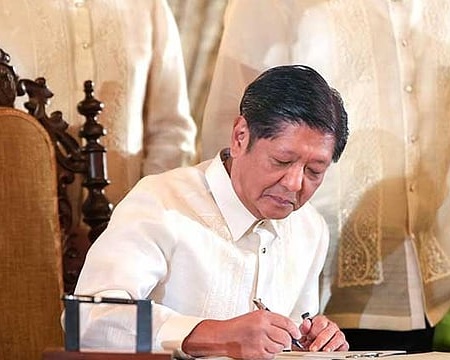

President Ferdinand Marcos Jr. has signed an executive order updating the Philippines’ investment regime, setting out sectors open to foreign participation and those subject to restrictions.
Executive Order No. 113, dated April 13, amends the 12th Regular Foreign Investment Negative List (RFINL), which outlines foreign equity limits across industries. The list serves as a key policy tool used by the government to define where foreign capital may enter and the extent of allowable ownership.
According to the Department of Economy, Planning, and Development, “there is a need to amend the 12th RFINL to reflect changes to Negative Lists A and B, pursuant to existing laws and consistent with the policy to ease restrictions on foreign participation in certain investment areas or activities.”
Under the updated list, foreign equity remains fully prohibited in a number of sectors. These include mass media, except for recording and internet-based businesses, as well as the corporate practice of professions such as architecture.
Cooperatives, private security agencies, and small-scale mining are also closed to foreign investors. The restrictions extend to the utilization of marine resources in archipelagic waters, the territorial sea, and the exclusive economic zone.
Foreign ownership is likewise not allowed in the ownership, operation, and management of cockpits. The manufacture, repair, stockpiling, and distribution of nuclear, biological, chemical, and radiological weapons and anti-personnel mines are also prohibited. The manufacture and retail of firecrackers remain on the list of restricted activities.
The order specifies sectors where partial foreign ownership is permitted. Up to 25% foreign equity is allowed in private recruitment for local or overseas employment and in contracts involving the construction of defense-related structures. Advertising allows foreign participation of up to 30%.
A wider range of industries is subject to a 40% foreign equity cap. These include retail trade enterprises with paid-up capital of less than ₱25 million and the exploration, development, and utilization of natural resources, including the appropriation of water directly from a natural source, except in agreements entered into with the country’s president. Ownership of private lands also falls under this limit.
The same 40% ceiling applies to the operation of public utilities and educational institutions. It also covers the culture, production, milling, processing, and trading of rice and corn. Government procurement of goods, infrastructure projects, and consulting services are included, along with the operation of commercial fishing vessels and ownership of condominium units.
For telecommunications, the order allows up to 100% foreign ownership in the operation and management of firms, subject to reciprocity. This means the investor’s home country must grant similar rights to Philippine nationals. In the absence of reciprocity, foreign equity is limited to 50%.
The order also identifies areas where foreign ownership may be regulated on the basis of national security, defense, public health, and safety, and the protection of small and medium-sized enterprises.
Executive Order No. 113 will take effect after its publication, at which point the revised Negative List will apply to foreign investments in the Philippines.
Stay updated—follow Philippines Today on Facebook and Instagram, and subscribe on YouTube for more stories.