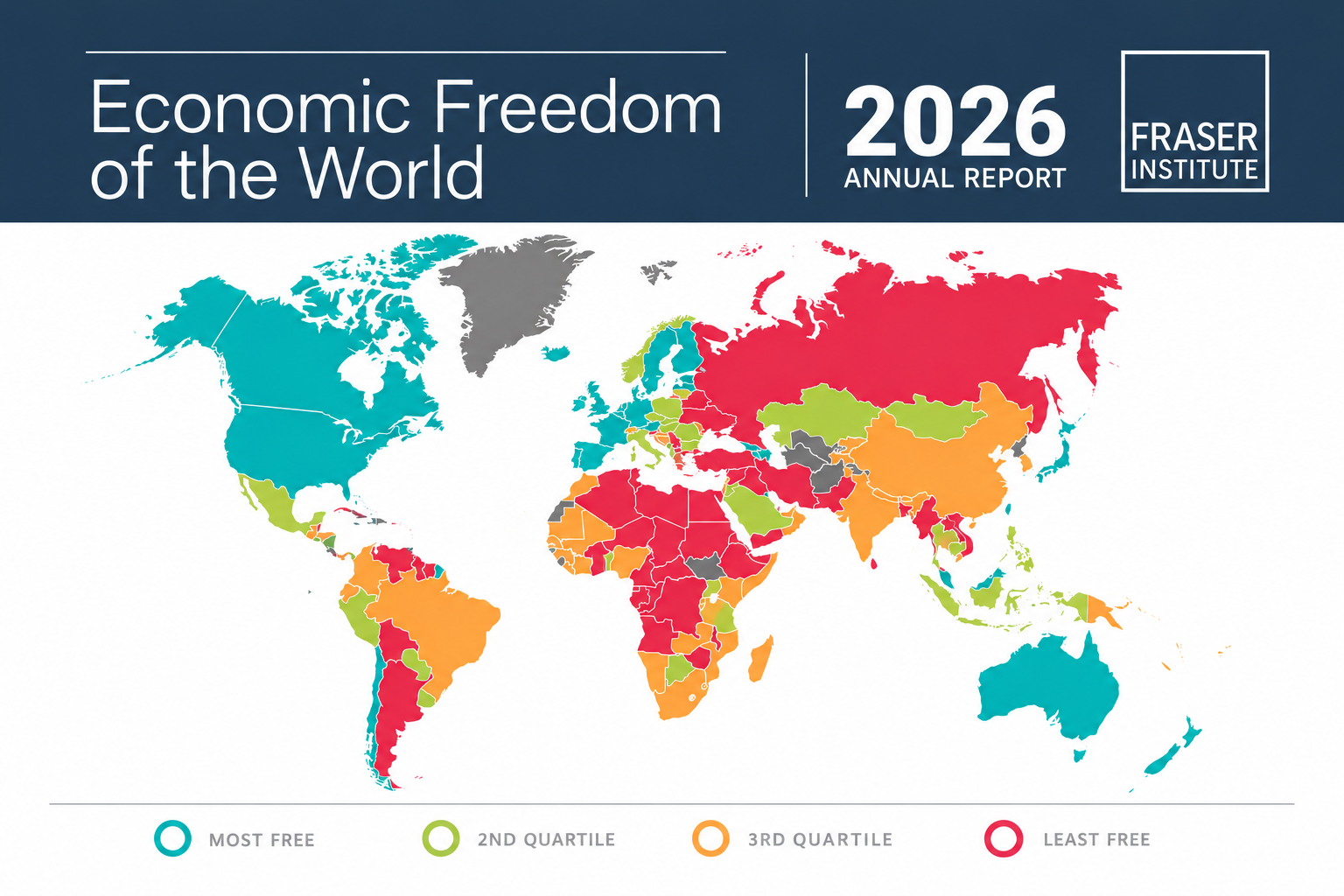

The Philippines improved one place to 61st among 165 economies in the Fraser Institute’s latest Economic Freedom of the World report, as stronger scores in several areas lifted its overall rating despite continued weaknesses in its legal system and property rights.
The Philippines posted a score of 7.16 out of 10 in the 2026 edition, up from 7.05 in the previous report, which was based on 2023 data. The latest ranking uses 2024 data, the most recent year for which comparable information was available across all 165 jurisdictions.
The improvement puts the Philippines in the second quartile of the global ranking and ahead of several major emerging markets, including Indonesia (ranked 72nd), Mexico (77th), India (88th), and China (110th).
Within Asia-Pacific, however, the Philippines remained behind the region’s leading economies. It trailed Hong Kong, Singapore, New Zealand, Australia, Taiwan, Japan, Malaysia, South Korea, Thailand, and Brunei Darussalam.
The Fraser index measures economic freedom through five broad areas: the size of government, legal system and property rights, sound money, freedom to trade internationally, and regulation. The index is designed to assess how policies and institutions allow individuals to make economic choices, including decisions about work, consumption, investment, and business formation.
For the Philippines, the strongest component in 2024 was sound money, where the country scored 9.34 out of 10. It also scored 7.86 for size of government, 7.15 for freedom to trade internationally, and 6.75 for regulation.
Its weakest area was legal system and property rights, with a score of 4.71, highlighting the country’s relatively weaker institutional performance in this part of the index.
The latest results represent a modest improvement after the Philippines slipped to 62nd in the previous edition. Its score had risen to 7.05 in 2023 from 7.01 in 2022, following a nine-place jump in the 2024 report based on 2022 data.
The improvement also comes against a broader global backdrop in which economic freedom has yet to fully recover from the deterioration recorded during the pandemic.
“Global economic freedom fell during the pandemic as policymakers imposed new regulations, raised barriers to trade, increased government spending and taxes, and then printed money to pay for spending,” Matthew Mitchell, a senior fellow at the Fraser Institute and co-author of the report, said.
The Fraser Institute said global economic freedom is now beginning to recover, but the rebound has been uneven and remains below its pre-pandemic level. The report’s 2026 edition covers 165 countries and territories and is based primarily on 2024 data.
Hong Kong retained the top position, with a score of 8.53, although its rating has declined in recent years. Switzerland moved into second place at 8.45, overtaking Singapore, which ranked third at 8.43. New Zealand placed fourth with 8.38, while the United States ranked fifth with 8.21.
Ireland ranked sixth, followed by Denmark and Australia. The United Kingdom, Finland, and the Netherlands shared 10th place, while Japan ranked 13th and Canada fell to 18th. Germany was 19th.
The 10 lowest-ranked jurisdictions were Congo, Egypt, Malawi, Algeria, Iran, Myanmar, Libya, Sudan, Zimbabwe, and Venezuela.
The Fraser Institute also found a substantial gap in economic outcomes between countries with high and low levels of economic freedom. In 2024, countries in the top quarter of the index had average per-capita GDP of $65,596, compared with $9,552 among countries in the bottom quarter.
Extreme poverty was also far less prevalent in the most economically free group: 2% of the population lived on less than $4.10 a day, compared with 41% in the least-free quarter. Life expectancy averaged 81 years in the most economically free countries versus 67 years in the least-free group.
For the Philippines, the latest ranking suggests continued progress in the overall policy environment, but the large gap between its legal-system score and its performance in areas such as sound money and trade remains a key feature of the country’s profile.
Stay updated—follow Philippines Today on Facebook and Instagram, and subscribe on YouTube for more stories.