
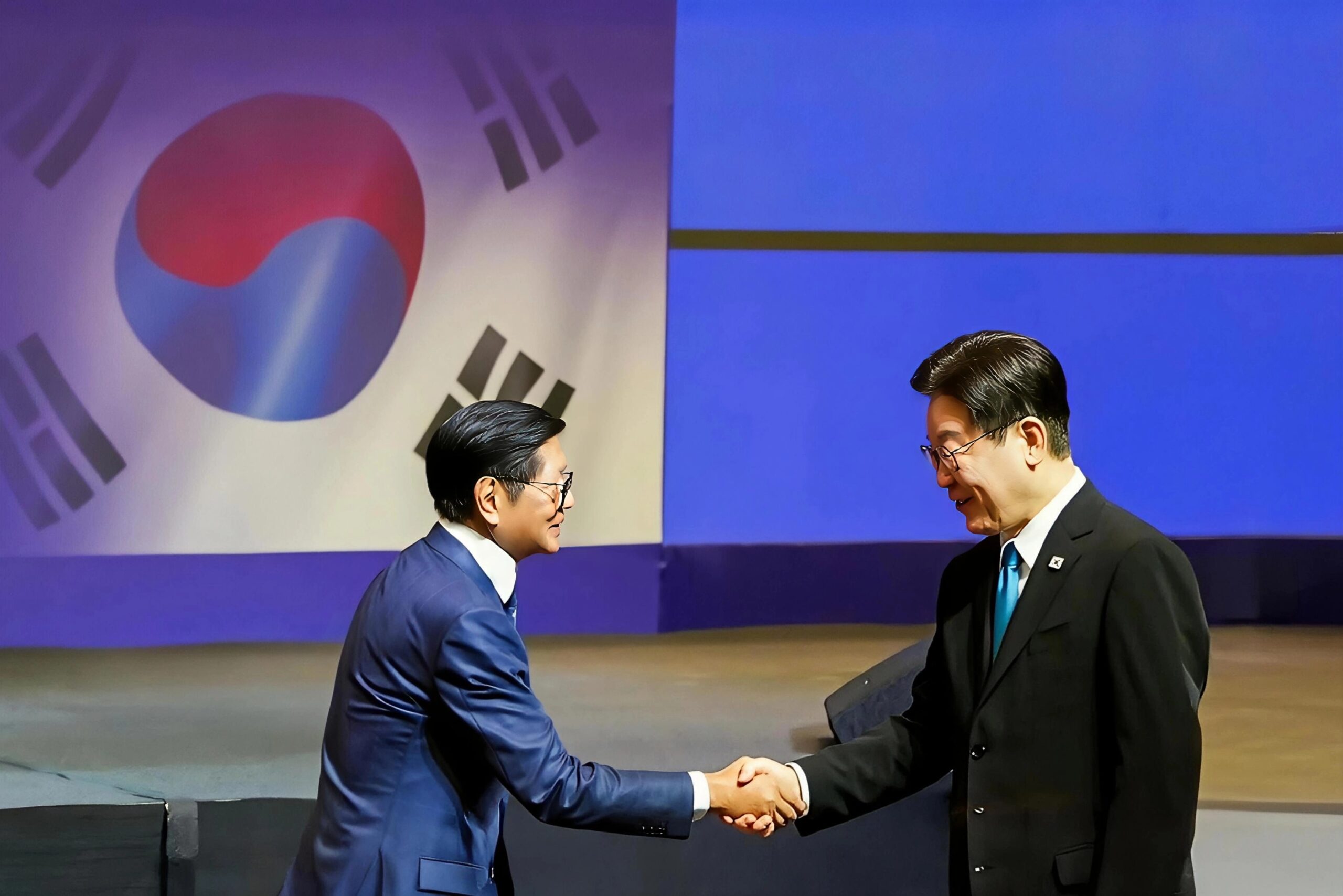

President Ferdinand Marcos Jr. on Wednesday urged South Korean investors to expand their footprint in the Philippines, highlighting sweeping economic reforms and new investment incentives as Manila seeks to deepen trade ties with Seoul and position itself as a regional hub for strategic industries.
Speaking at the Philippines–Korea Business Forum in Pasay City attended by South Korean President Lee Jae-myung and top business leaders, Marcos said the Philippines is strengthening policies designed to improve investor confidence and ensure that economic growth benefits a wider segment of society.
“In a rapidly changing world, resilience is built not in isolation, but in partnership,” Marcos said. “It is therefore both strategic and principled to work closely with reliable partners such as the Republic of Korea.”
The forum underscored the growing economic relationship between the two countries, with business agreements signed in sectors including shipbuilding, nuclear energy, aerospace, critical minerals, supply chains, retail, and health and wellness. Marcos said these deals could translate into new investments, projects, and employment opportunities for Filipinos.
South Korea is among the Philippines’ key economic partners and a major source of trade, tourism, and foreign investment. Marcos noted that decades of cooperation have helped build a relationship grounded in “mutual respect, enriched by cultural exchange, and strengthened by genuine friendship,” adding that Korean culture has also become deeply embedded in Filipino society.
To attract more capital, Marcos highlighted reforms under his administration aimed at lowering business costs and improving the country’s competitiveness.
Central to that effort is the CREATE MORE Act, which offers enhanced incentives to large-scale investments that either inject at least ₱50 billion into the economy or generate 10,000 jobs. “Through the CREATE MORE Act, we are opening the door to bigger investments that bring real opportunities to our people,” Marcos said.
The government has also enacted the Capital Markets Efficiency Promotion Act, which reduces the stock transaction tax from 0.6% to 0.1% to encourage equity investments and improve capital formation.
Other measures include amendments to the Foreign Investments Act to ease entry for startups and technology ventures, and the Retail Trade Liberalization Act, which lowered the minimum capital requirement for foreign retailers to ₱25 million from $2.5 million (about ₱146 million).
Marcos said the reforms are part of a broader strategy to build “an economy that is dynamic, inclusive, and resilient,” while initiatives such as the government’s “green lanes” for strategic investments aim to speed up permits and approvals for major projects.
The president also called for stronger cooperation in priority industries such as automotive manufacturing, electronics, and biotechnology, sectors he said would shape the next phase of Philippine economic development.
“Progress finds meaning only when it improves lives,” Marcos said, adding that economic agreements and policy reforms must ultimately translate into opportunities for ordinary Filipinos.
He said the Philippines and South Korea should continue building on decades of cooperation, describing their partnership as one that has evolved from solidarity into shared prosperity.
“The story of Philippine–Korean relations is one of solidarity transformed into partnership, and partnership transformed into shared success,” Marcos said.
Stay updated—follow Philippines Today on Facebook and Instagram, and subscribe on YouTube for more stories.