
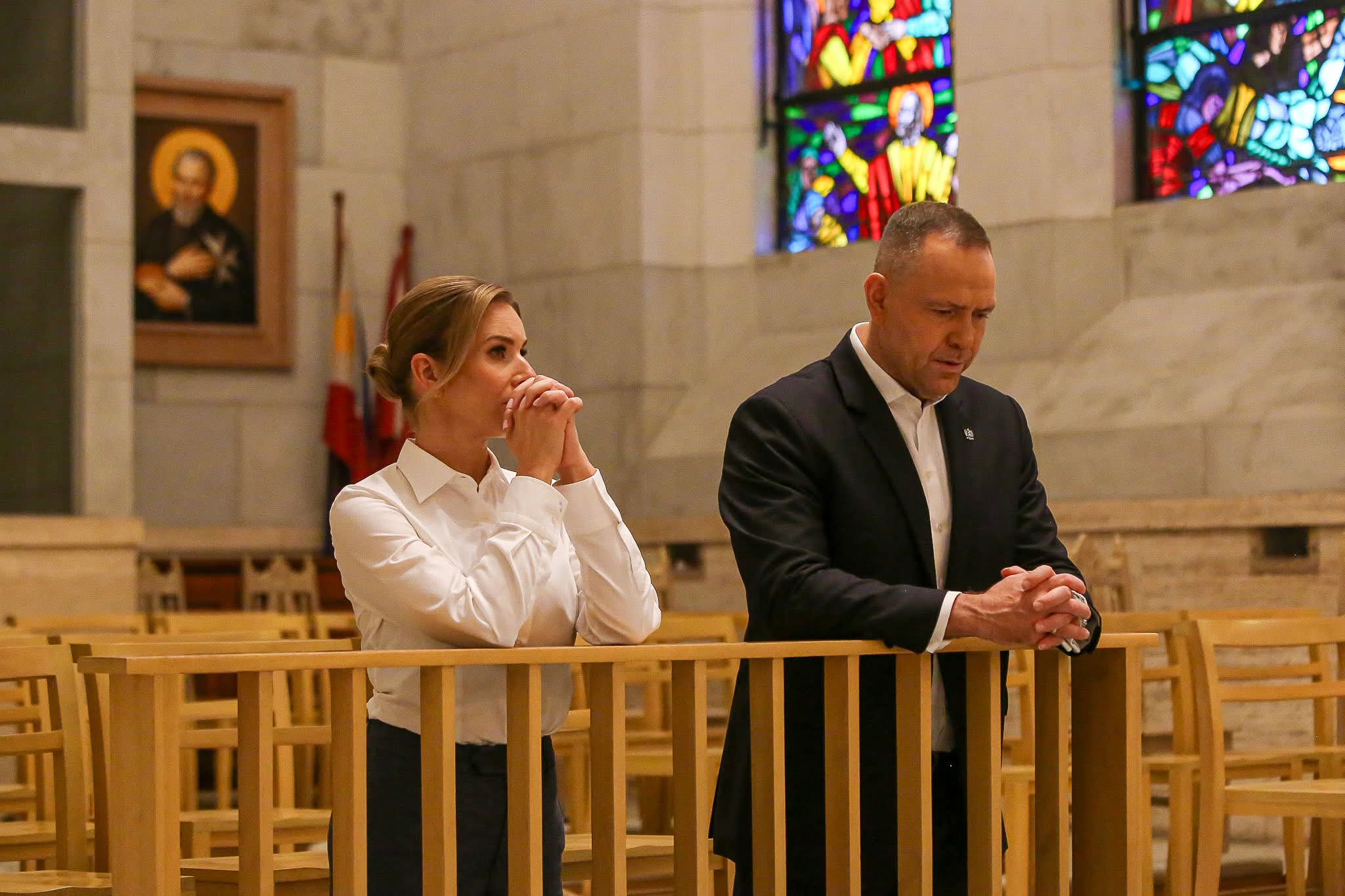

The distance between Poland and the Philippines may span thousands of kilometers, but Polish President Karol Nawrocki sees a bond that runs deeper than geography: a Catholic faith that has helped shape the values and identities of both nations.
“Although Poland and the Philippines are separated by thousands of kilometers, religion plays an important role in both our societies,” Nawrocki said in a speech at the University of Santo Tomas (UST) in Manila on October 7.
“Catholicism has helped to shape our values, strengthening our attachment to family, solidarity, responsibility, and care for others,” he said.
For Nawrocki, that shared faith is also part of a much longer history of connections between the two countries.
He traced some of the earliest links to Catholic missionaries who arrived in the Philippines during the Spanish colonial period, including Jesuit priest Wojciech Męciński, a native of Kraków who is believed to have been the first Pole to visit the Philippines in the 17th century.
Centuries later, another Polish figure would leave a far greater mark on the Philippines.
Nawrocki highlighted St. John Paul II, who visited the country in 1981 and 1995 as pope. His second visit coincided with World Youth Day in Manila, the first time the international Catholic gathering was held in Asia.
“His second visit coincided with the first World Youth Day held in Asia, here in Manila—a powerful reminder of the role young people play in shaping the future,” Nawrocki said.
“I know that he also visited this university, and I am proud to see how deeply you continue to remember and honor his legacy,” he added.
But Nawrocki’s message went beyond religious history. He portrayed Catholicism as one of several forces that helped both nations preserve a sense of identity through periods of foreign domination.
Poland disappeared from the map of Europe for 123 years after being partitioned by neighboring powers in the late 18th century. Nawrocki said the Polish nation survived through its language, culture, religion, and determination to remain free.
The country later endured communist rule and Soviet domination after World War II, before the Solidarity movement helped pave the way for democratic change in Central and Eastern Europe.
The Philippines followed a different historical path, but also spent centuries under colonial rule before gaining independence. Nawrocki said those experiences helped foster a shared appreciation for freedom and national self-determination.
“These shared experiences help explain why freedom, sovereignty, and national independence hold such a special place in both our nations,” he said.
That history, Nawrocki suggested, also gives the two countries common ground in confronting today’s security challenges.
He said Poland and the Philippines shared a commitment to international law, national sovereignty, and the peaceful settlement of disputes, while rejecting the use of force or coercion to expand spheres of influence.
“Aggression, coercion, and threats cannot be legitimate instruments of foreign policy or means of expanding spheres of influence,” he said.
His remarks came against the backdrop of Russia’s invasion of Ukraine and continuing security concerns in the Philippines, particularly in the maritime domain. Nawrocki said Poland supported peaceful solutions based on international law and recognized the importance of protecting sovereign rights.
The speech was part of Nawrocki’s October 5 to 8 state visit to the Philippines, the first by a Polish president since the two countries established diplomatic relations in 1973.
He was accompanied by his wife, First Lady Marta Nawrocka, as well as Polish officials and business representatives.
President Ferdinand Marcos Jr. welcomed Nawrocki at Malacañang on October 6, where they discussed cooperation in defense and security, trade, agriculture, technology, tourism, and cultural exchanges.
Yet Nawrocki emphasized that the relationship should not be defined only by government agreements.
He urged Filipino students to visit Poland and called for more educational and cultural exchanges, saying personal connections could give the relationship a deeper and more lasting foundation.
“Our partnership is built on people,” he said.
“Because we, as leaders, can open doors, but lasting relationships are built by people,” he added.
It was a fitting message at UST, one of the Philippines’ oldest universities and a Catholic institution whose own history stretches back more than four centuries.
Nawrocki closed by invoking the university’s patron, St. Thomas Aquinas, whose writings he used to frame the relationship between the two distant countries in terms of friendship.
“Charity, by which God and neighbor are loved, is the most perfect friendship,” he said.
Stay updated—follow Philippines Today on Facebook and Instagram, and subscribe on YouTube for more stories.