
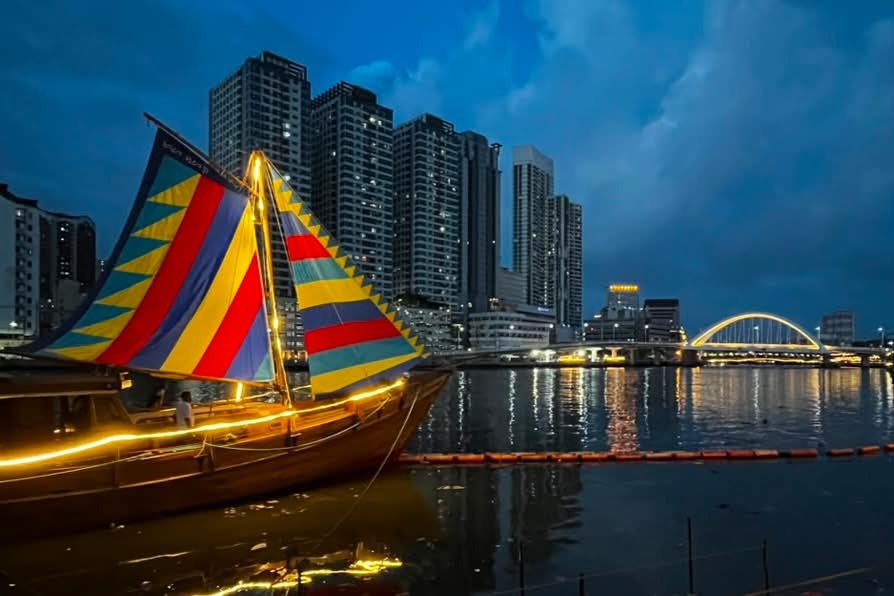

At first glance, it looks like a relic from another age. Its curved wooden hull, woven rigging, and towering sail belong to a time before engines, satellites, and national borders.
But the B.B. Florentino Das is no museum piece. Since its launch in 2024, the country’s largest and only operational motorized balangay has sailed to Pag-asa Island in the West Philippine Sea, promoted the revival of traditional navigation, and become a symbol of the Philippines’ vision for its 2026 ASEAN chairmanship.
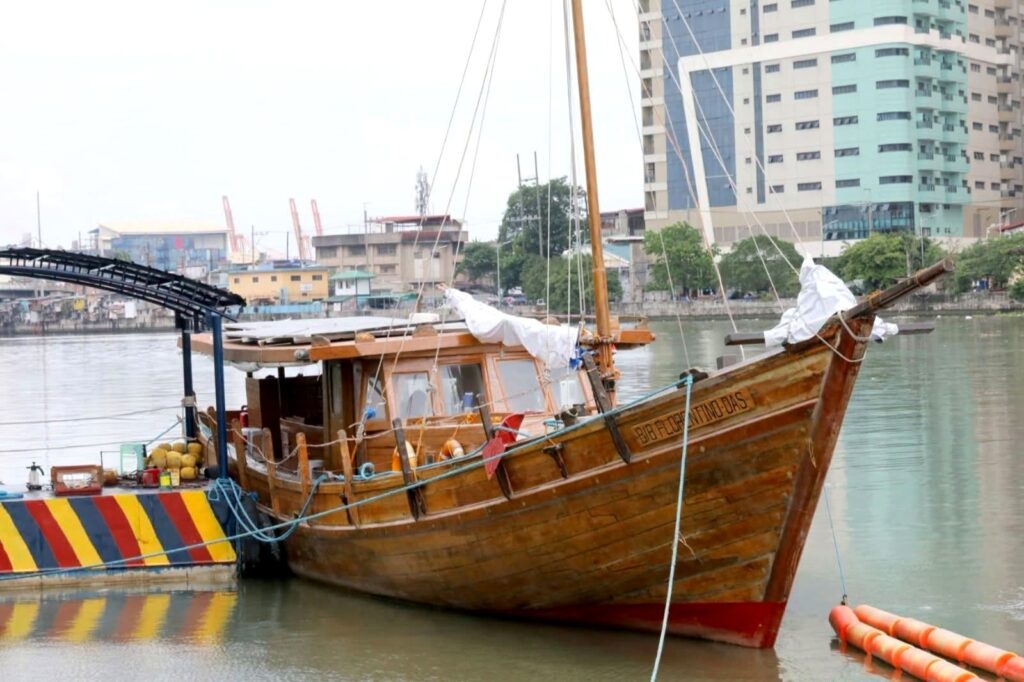
Built in Butuan City, the 24-meter vessel blends ancient craftsmanship with modern engineering. Its hull follows the centuries-old lashed-lug construction technique used by early Austronesian boat builders, while an engine, air-conditioned cabins, Wi-Fi, and modern safety equipment allow it to undertake long-distance voyages. Constructed from Philippine ironwood sourced from Siargao, it is the largest operational balangay ever built in the country.
Its first major expedition reflected that blend of history and contemporary purpose.
Days after its formal launch on May 27, 2024, the Florentino Das departed Butuan with a crew of 19 and sailed west toward Pag-asa Island in the West Philippine Sea. The mission delivered medical assistance to the island community while also underscoring the Philippines’ presence in waters where competing territorial claims continue to fuel regional tensions.
The voyage carried a deeper message. Long before today’s maritime boundaries, Filipino ancestors had already crossed these seas aboard balangays, linking communities across Southeast Asia through trade, migration, and diplomacy.
That history is rooted in Butuan, where archaeologists uncovered the country’s oldest known balangay boats. Dating back more than a thousand years, the discoveries revealed an advanced maritime civilization whose wooden vessels connected the Philippine archipelago with present-day Indonesia, Malaysia, Brunei, Thailand, and Cambodia centuries before European ships reached the region.
Many historians also believe the word barangay—the Philippines’ smallest political unit—originated from the balangay, reflecting how entire communities once traveled together aboard a single vessel before establishing new settlements.
The vessel is named after Florentino Das, whose remarkable journey embodied the same spirit of exploration. In 1955, Das set sail alone from Honolulu aboard his small yacht, Lady Timarau, navigating largely with a compass and the stars. After surviving powerful storms and spending months in Micronesia repairing storm damage, he reached Siargao in 1956, becoming the first Filipino to complete a solo trans-Pacific voyage. President Ramon Magsaysay later awarded him the Philippine Legion of Honor, securing his place among the country’s greatest seafarers.
His story lives on in the B.B. Florentino Das, which has become the flagship of the Balangay Voyage movement. Since 2009, the initiative has sought to revive traditional boatbuilding and indigenous navigation by retracing ancient sea routes using the stars, winds, currents, waves, and bird movements rather than relying solely on modern instruments.
One of its landmark achievements came in 2010, when a fleet led by Diwata ng Lahi completed a nine-month expedition across Southeast Asia, visiting Brunei, Cambodia, Indonesia, Malaysia, Singapore, and Thailand. The journey demonstrated that the region’s maritime connections long predated European exploration and highlighted the shared seafaring heritage of ASEAN member states.
The balangay has now become the centerpiece of the Philippines’ 2026 ASEAN chairmanship under the theme “Navigating Our Future, Together.” More than a nod to the country’s maritime past, the vessel reflects the chairmanship’s vision of a region bound by shared history and collective progress. Its symbolism also aligns with the Philippines’ three priorities as ASEAN chair: strengthening peace and security (including maritime security), advancing economic prosperity and connectivity, and empowering people across the region.
Archaeologists have also discovered similarly built vessels across Southeast Asia, pointing to a shared Austronesian maritime tradition that connected communities through trade, migration, and cultural exchange centuries before modern states emerged. In that context, the balangay represents not only the Philippines’ maritime heritage but also a common regional identity that predates modern borders and continues to underpin ASEAN’s vision of cooperation.
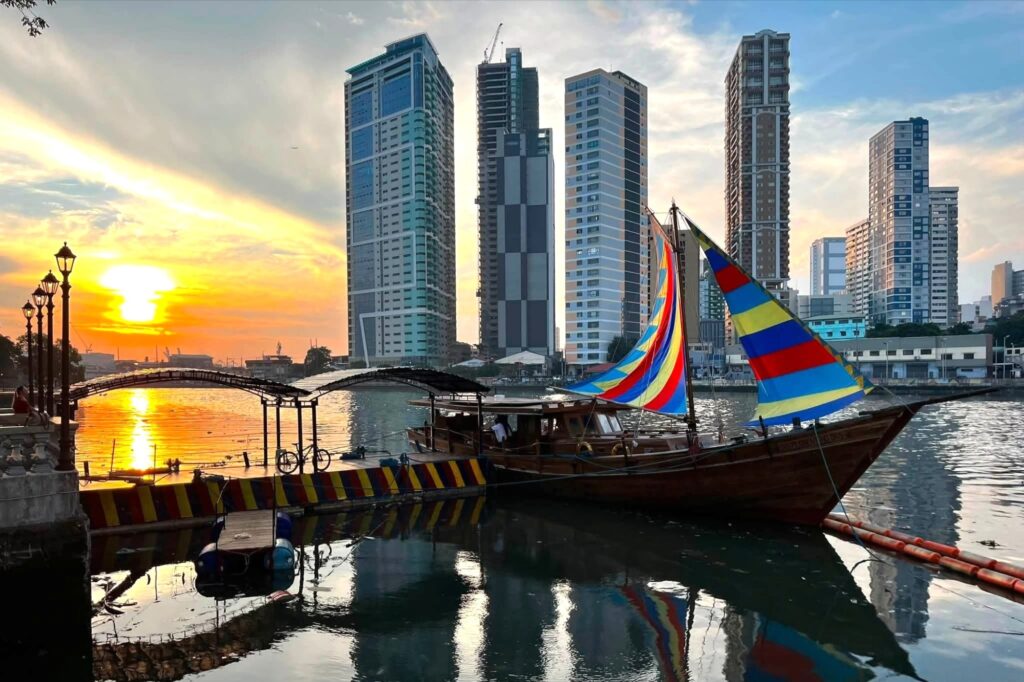
That message was brought directly to the public in May 2026, when the Florentino Das sailed along the Pasig River before docking near the historic Escolta district. The voyage supported efforts to rehabilitate the Pasig River and promote its recognition as a National Cultural Treasure while giving thousands of Filipinos a rare opportunity to see a centuries-old maritime tradition brought back to life in the heart of the capital.
For expedition leader Art Valdez, who has led the Balangay Voyages since 2009, the Florentino Das marks another milestone in preserving one of the world’s oldest seafaring traditions. Although it is the sixth balangay replica built in the Philippines, it is the only one currently operational and the largest ever constructed.
Whether crossing the West Philippine Sea or gliding along the Pasig River, the B.B. Florentino Das is more than a replica of an ancient boat. It carries forward a maritime tradition that once connected the peoples of Southeast Asia through trade, migration, and cultural exchange.
As the Philippines chairs ASEAN in 2026, the vessel has become a fitting emblem of the country’s vision: that the seas which have long linked the region can continue to serve as pathways for peace, prosperity, and closer ties among its people.
Stay updated—follow Philippines Today on Facebook and Instagram, and subscribe on YouTube for more stories.