The world is entering a moment of uncertainty not because power is disappearing, but because restraint is becoming uneven. Rules still exist, yet their force increasingly depends on who invokes them and under what circumstances.
For countries that rely on law rather than leverage, this shift is no longer theoretical. It is shaping how foreign policy is practiced, tested, and defended.
Recent global events have sharpened this reality. The United States’ military operation in Venezuela, which resulted in the capture of President Nicolás Maduro, triggered intense debate not only over legality but over precedent. Washington framed the action as an extraordinary law-enforcement measure. Many governments, however, viewed it as a troubling departure from multilateral process and respect for sovereignty.
Beyond the immediate controversy lies a deeper concern: when major powers act outside widely accepted frameworks, the predictability of international order weakens for everyone else.
For the Philippines, this matters even when it unfolds far from Asia. Manila’s foreign policy has long rested on the premise that international law, while imperfect, remains the most credible shield for states without overwhelming military power. When legal norms appear elastic—firm for some, flexible for others—the foundation of that strategy becomes less stable.
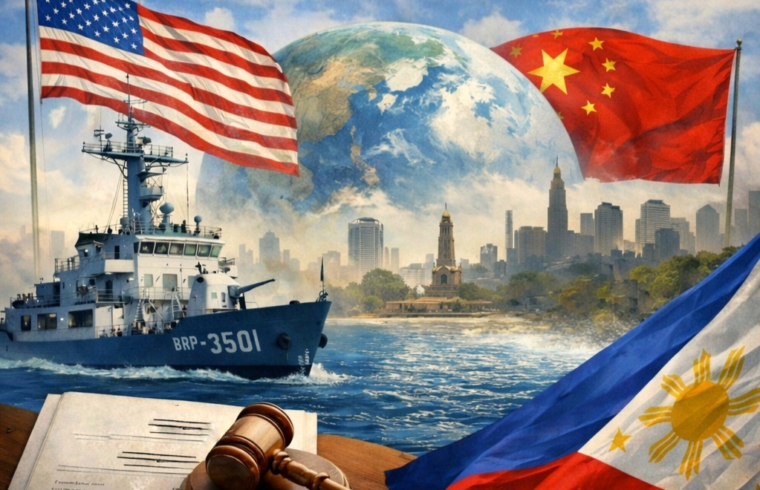
That fragility is already familiar closer to home. In the South China Sea, the Philippines continues to navigate a steady pattern of maritime pressure. Encounters involving water cannons, close shadowing, and contested resupply missions have become part of a prolonged test of resolve and restraint. These incidents rarely escalate dramatically, but their cumulative effect is strategic: they probe limits, shape behavior, and normalize pressure without crossing clear thresholds.
What makes the Philippine predicament uniquely difficult is that its two most consequential external relationships pull in different directions. Economically, China remains an important partner; strategically, it is also the state most directly challenging Philippine maritime rights. Security cooperation with the United States—anchored in the Mutual Defense Treaty and reinforced through arrangements such as Enhanced Defense Cooperation Agreement (EDCA)—provides deterrence and capacity-building, but it also carries a persistent concern: the risk of entanglement in a great-power contest beyond Manila’s control.
This is where the Venezuela episode becomes relevant to Philippine statecraft. It is tempting to view Washington’s decisiveness as reassurance that alliance commitments are real. At the same time, it underscores the volatility of a system in which major powers may treat law less as a boundary than as a vocabulary. The Philippines, which has secured its most consequential strategic gains through legal means—most notably arbitration under the United Nations Convention on the Law of the Sea (UNCLOS)—cannot afford a world in which legal process is optional. Nor can it credibly insist that rules constrain China in the West Philippine Sea while dismissing departures elsewhere as simply how power operates. For smaller states, selective legalism is rarely cost-free.
This tension highlights a reality often understated in foreign policy debates: external partnerships, however important, cannot substitute for internal strength. Former national security adviser Hermogenes Esperon Jr. articulated this clearly when he argued that peace in the Indo-Pacific begins at home, not at sea. His point was not isolationist, but foundational—that national security ultimately rests on social cohesion, economic resilience, strong institutions, and public trust. Alliances matter most when anchored in domestic stability.
That logic remains compelling. A country confident in its internal foundations engages externally with greater steadiness. It negotiates without insecurity, deters without excess, and cooperates without dependence. Internal strength allows restraint to be a choice rather than a vulnerability.
The Philippines’ emphasis on maritime transparency reflects this approach, moving disputes from quiet pressure at sea to open legal scrutiny. While it cannot resolve sovereignty claims alone, transparency limits misrepresentation and reinforces legitimacy.
Still, law and transparency must be matched with strategic clarity. The Philippines faces difficult questions about priorities and thresholds: what it seeks to deter, what risks it is prepared to manage, and how it communicates these positions consistently to both partners and counterparts. The objective is not rigidity, but coherence—policy that appears deliberate rather than reactive.
It is in this unsettled environment that remarks delivered last April by Singapore Prime Minister Lawrence Wong have taken on renewed relevance. He described a world in “a messy transition,” shaped by rivalry and distrust. “America and China are now locked in a fierce contest for global supremacy,” he said, noting that while neither side seeks open conflict, “there is deep mistrust and suspicion on both sides.” Miscalculations over sensitive flashpoints, he warned, could trigger wider escalation.
Wong also captured a concern shared quietly by many middle and small powers: “America is stepping back from its traditional role as the guarantor of order and the world’s policeman. But neither China nor any other country is willing—or able—to fill the vacuum.” The result, he argued, is a world becoming more fragmented, with states increasingly turning inward to protect narrow interests.
For the Philippines, this is not a prediction but a condition already shaping its choices. The task is not to align reflexively with one power or distance itself from another, but to preserve agency in an unsettled environment. That requires a steady commitment to international law, calibrated partnerships, and credible domestic foundations.
The global transition may be messy, and the Philippines cannot control the behavior of major powers. It can, however, control its own consistency. Aligning defense readiness with diplomatic restraint, and alliances with principle, offers the best chance of navigating a disorderly world without undermining sovereign authority or diplomatic credibility.
Stay updated—follow Philippines Today on Facebook and Instagram, and subscribe on YouTube for more stories.