
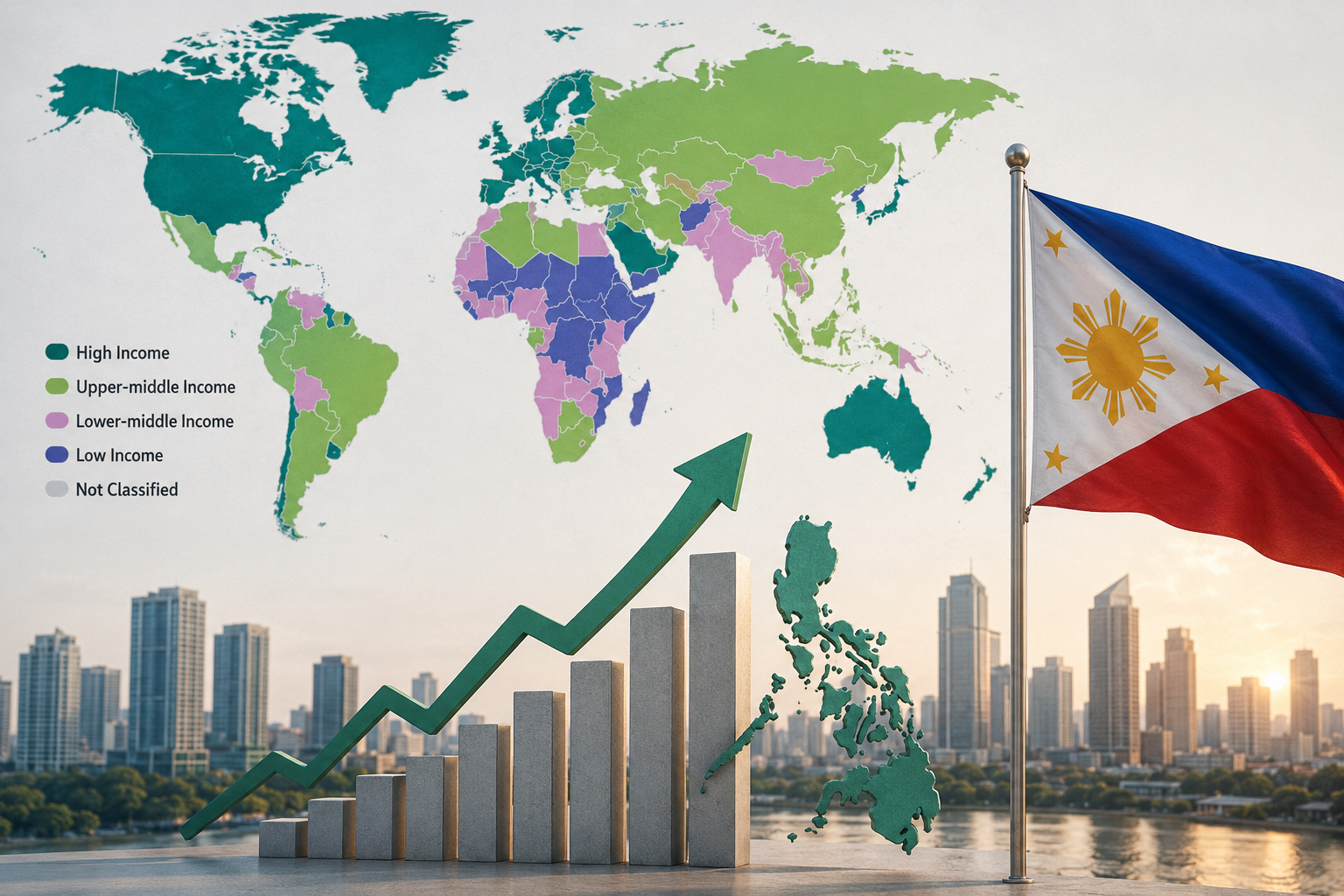

The Philippines has officially joined the World Bank’s upper-middle-income economies, marking its first upgrade in nearly four decades after gross national income (GNI) per capita climbed to US$4,850 in 2025, surpassing the US$4,636 threshold required for the classification.
The move ends the country’s stay in the lower-middle-income category, where it had remained since 1987, and places it alongside Asian peers including Malaysia, Thailand, Indonesia, Vietnam, and China, while still below high-income economies such as Singapore, Japan, and South Korea.
For businesses and investors, the new designation signals an economy that has become larger, more resilient, and increasingly attractive for long-term investment. The government expects the upgrade to reinforce the country’s credit profile, boost investor confidence, and attract higher-quality investments that generate better-paying jobs. For ordinary Filipinos, however, the benefits will depend on whether stronger economic growth translates into higher incomes, lower poverty, and broader opportunities.
The milestone also comes with trade-offs. As countries become wealthier, they gradually lose access to concessional loans and some forms of development assistance reserved for lower-income economies. To offset this, the Philippine government said it will rely more heavily on public-private partnerships, deepen domestic capital markets, and tap market-based financing to sustain infrastructure and other development spending.
The World Bank announced the reclassification in its annual country income assessment released on July 1, which determines income groups for the 2026-2027 fiscal year using 2025 GNI per capita data calculated under the Atlas methodology. The classification serves as a global benchmark used by governments, investors, and development institutions to assess economic progress and determine eligibility for concessional financing.
GNI per capita measures the average income generated by a country’s residents, including earnings from abroad such as remittances from overseas Filipino workers (OFWs), making it broader than gross domestic product (GDP), which measures only domestic economic output. The World Bank calculates the figure using its Atlas methodology, which smooths exchange-rate fluctuations, while income thresholds are adjusted annually to account for inflation.
For the current classification cycle, economies with GNI per capita of US$1,175 or below are considered low income; US$1,176 to US$4,635 lower middle income; US$4,636 to US$14,375 upper middle income; and above US$14,375 high income.
Unlike countries propelled by commodity windfalls or a single export industry, the Philippines crossed the threshold through broad-based expansion.
“The Philippines achieved its reclassification through broad-based expansion. GDP grew at an average of 5.8% per year over five years, reflecting gains across all major industries, not a single sector boom, but an economy-wide shift,” the World Bank said in a separate blog explaining this year’s income classifications.
The Department of Economy, Planning, and Development (DEPDev) said the upgrade reflected years of sustained growth, prudent macroeconomic management, and structural reforms rather than a temporary surge in income.
“This confirms the resilience of the Philippine economy. Despite global and domestic shocks, we have relentlessly pursued inclusive growth, strengthened fundamentals, and remained on track with our development agenda,” DEPDev Secretary Arsenio Balisacan said.
The government believes the country’s stronger economic standing will help attract more private capital while improving access to financing for infrastructure and other long-term investments. Balisacan said any gradual reduction in concessional official development assistance would likely be outweighed by stronger economic fundamentals and improved access to market-based financing.
Malacañang likewise described the upgrade as more than a symbolic achievement.
“Hindi lang ito titulo. Ibig sabihin nito, mas lumalago ang ekonomiya natin,” Executive Secretary Ralph Recto said.
“Mas dumarami ang trabahong nalilikha, mas lumalaki ang kita ng ating mga kababayan, at mas maraming investors ang nagtitiwala sa Pilipinas,” he added.
Balisacan also credited OFWs for helping lift the country’s GNI, noting that their earnings abroad form part of the calculation.
“Our OFWs have played an important role in reaching this milestone. At the same time, our long-term goal is to create more high-quality jobs at home so overseas employment becomes a choice, not a necessity,” he said.
Still, both the World Bank classification and government officials acknowledge that a higher income category does not automatically mean higher living standards for everyone.
“We acknowledge that income disparities persist, and many continue to face economic difficulties. Our priority is to ensure that growth becomes more inclusive, and that its benefits reach all Filipinos,” Balisacan said.
The Philippines was one of five economies upgraded this year from lower-middle to upper-middle income, alongside Jordan, Micronesia, Sri Lanka, and Vietnam, according to the World Bank.
The upgrade answers one question about where the Philippine economy stands in the world. A more consequential one remains: whether stronger growth, greater investment, and improved financing will translate into tangible gains for the millions of Filipinos who have yet to feel the benefits of the country’s economic rise.
Stay updated—follow Philippines Today on Facebook and Instagram, and subscribe on YouTube for more stories.