
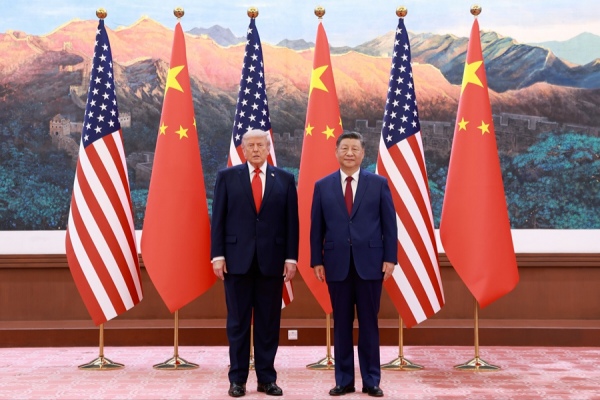

“Can China and the United States overcome the Thucydides Trap and create a new paradigm of major-country relations?”
When Chinese President Xi Jinping posed that question to U.S. President Donald Trump in Beijing, it sounded less like a diplomatic flourish and more like one of the defining questions of the 21st century.
The phrase “Thucydides Trap,” popularized by American political scientist Graham Allison, refers to the danger that emerges when a rising power challenges an established one. Drawing from the writings of the ancient Greek historian Thucydides, Allison argued that history shows how fear, rivalry, and miscalculation can push nations toward conflict even when neither side actively seeks war.
But perhaps the most important point is often overlooked: conflict is not inevitable.
That is why Xi’s question matters.
At a time when global politics is increasingly shaped by strategic competition, both Beijing and Washington are trying to define what coexistence between two major powers should look like. The United States remains the world’s leading military and financial power. China, meanwhile, has emerged as a technological, economic, and diplomatic force with growing global influence.
The challenge is not simply about who leads. It is about whether competition can remain stable, predictable, and peaceful.
Today, the risks are no longer theoretical. Trade disputes can spill into technology restrictions. Maritime incidents can trigger diplomatic crises. Cybersecurity tensions and disagreements over Taiwan or the South China Sea can quickly intensify regional anxieties.
Yet the deeper danger may be psychological rather than military.
Too often, discussions about the U.S.-China relationship are framed as though confrontation is unavoidable. Once nations begin to believe conflict is predetermined, every action is interpreted through suspicion. Defensive moves appear offensive. Dialogue becomes harder. Strategic caution gives way to political posturing.
This is precisely the kind of dynamic Thucydides warned about centuries ago.
His account of the Peloponnesian War was not merely about shifting power balances between Athens and Sparta. It was also about fear clouding judgment and leaders becoming trapped by pride, pressure, and miscalculation.
In many ways, that lesson remains relevant today.
To its credit, both Beijing and Washington continue to emphasize communication even amid rivalry. Xi spoke of building a “constructive China-U.S. relationship of strategic stability,” while Trump described the relationship as one of the world’s most consequential partnerships.
Such language matters. Diplomacy may appear ceremonial, but it creates political space for restraint. In periods of geopolitical tension, even symbolic gestures can help prevent misunderstandings from escalating.
For countries like the Philippines, the stakes are especially high.
The Philippines sits at the intersection of the Indo-Pacific’s evolving security landscape. Its longstanding alliance with the United States coexists with extensive economic engagement with China. Like many nations in Southeast Asia, Manila does not benefit from heightened rivalry between major powers.
Instead, the region’s broader interest lies in stability.
ASEAN countries have long preferred engagement over confrontation, economic cooperation over bloc politics, and dialogue over escalation. This balancing approach is not indecision; it reflects the realities of geography and interdependence in Asia.
The Philippines, in particular, understands that peace in the region cannot rely solely on military deterrence. It also requires bilateral engagement, economic resilience, and sustained communication between competing powers.
This is why the Thucydides Trap should be viewed not as a prophecy, but as a warning.
History offers examples of rivalry leading to war, but it also offers examples of restraint. The Cold War between the United States and the Soviet Union, despite moments of extreme tension, ultimately avoided direct military confrontation between the two nuclear powers. Strategic communication, negotiated limits, and recognition of mutual risk helped preserve global stability.
The relationship between China and the United States is different in many ways, especially because their economies remain deeply interconnected. Neither side can realistically pursue outright confrontation without severe consequences for the global economy and international order.
That reality creates both pressure and opportunity.
Competition between major powers is natural. But competition does not have to eliminate cooperation. Climate change, global trade, public health, technological governance, and regional security all require continued engagement between Washington and Beijing.
For countries pursuing strategic balance like the Philippines, the hope is not for one side to prevail over the other, but for both to manage their differences responsibly.
Xi’s question to Trump ultimately carried a message larger than measured statecraft. It was a recognition that the future of international stability may depend on whether major powers can resist the historic temptation to treat rivalry as destiny.
The Pacific is vast enough for competition. The challenge is ensuring it remains large enough for coexistence.
And in an era shaped by uncertainty, that may be the most important test of leadership of all.
Stay updated—follow Philippines Today on Facebook and Instagram, and subscribe on YouTube for more stories.