
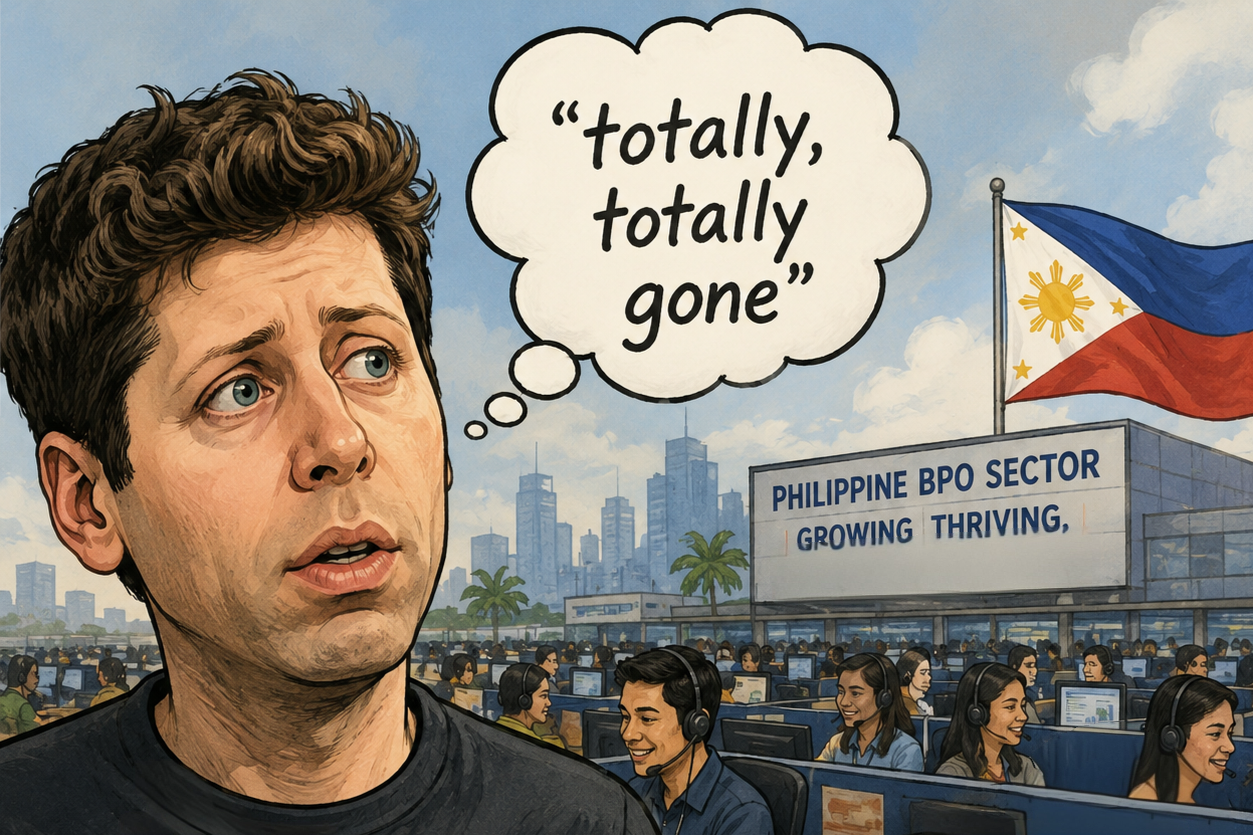

“Some areas, again, I think are just like totally, totally gone.” That was Sam Altman’s blunt prediction about the future of work as artificial intelligence (AI) advances.
Speaking at a Federal Reserve conference in July 2025, the OpenAI chief executive singled out customer support as particularly vulnerable, envisioning AI systems that could answer calls, understand customers, and resolve problems without phone trees, transfers, or waiting.
It has barely been more than a year since Altman made that prediction—and the Philippine experience suggests he was wrong, at least about the timing and scale of the disruption.
The country’s information technology and business process management (IT-BPM) industry has not collapsed. It has expanded. In 2025, the sector surpassed US$40.3 billion in revenues, supported about 1.9 million digital Filipino workers, and contributed roughly 8% to national GDP. For 2026, industry group I.T. & Business Process Association of the Philippines (IBPAP) is targeting about US$42 billion in revenues and 1.97 million full-time employees.
Those are hardly the numbers of an industry being erased by AI. But they also do not mean the threat is exaggerated.
The more accurate interpretation is that Altman may have identified the direction of technological change but underestimated how complicated the transition would be.
AI is replacing tasks before it replaces entire jobs. A customer-service agent may spend part of a shift answering routine questions, while also handling an angry customer, interpreting an ambiguous policy, or resolving a problem that does not fit a script. AI can automate some of these activities while making the worker faster at others.
That creates an important economic paradox: AI can reduce the labor needed for a particular task while increasing the amount of work a company can afford to undertake.
If an AI-assisted agent can serve more customers, a company may eventually need fewer people for the same workload. But lower costs can also make outsourcing more attractive, help companies win new contracts or allow them to expand into services they previously could not afford. Employment can, therefore, continue to grow even as automation advances.
That helps explain the Philippine business process outsourcing (BPO) industry’s resilience.
The sector is not simply trying to preserve the traditional call-center model. It is moving toward higher-value services and global capability centers (GCCs), which handle functions such as finance, healthcare, information technology, and other specialized business operations. There are now roughly 160 GCCs in the Philippines, according to the IBPAP.
The shift is strategically important. The Philippines cannot indefinitely compete with machines on the cost of routine labor. If an AI system can handle thousands of basic inquiries simultaneously, offering human workers at a slightly lower price will eventually cease to be enough.
The country’s proposition must evolve from “Filipinos can do this work cheaply” to “Filipinos can do more valuable work with technology.”
That transition, however, carries its own risks.
A BPO company can become more productive and profitable while employing fewer people in a particular function. An operation that once needed 150 agents might need only 100 after AI improves productivity, even if the broader industry grows because lower costs generate new business.
For the worker who loses one of those 50 positions, industry growth offers little consolation.
That matters because BPO work has long been an entry point into the Philippine middle class. Young workers could start in customer service, acquire professional skills, gain exposure to international business, and eventually move into supervisory or specialized roles.
AI could narrow that career ladder.
If machines increasingly handle the simplest customer interactions, companies may need fewer entry-level workers—the very positions that traditionally provided a foothold into the industry. Telling workers to “upskill” is therefore not enough. The country needs credible pathways from jobs being automated into jobs being created.
The government and industry are beginning to respond. The government has committed ₱740 million over four years to Project UNLAD, aimed at developing AI and digital skills. The investment is significant, but its real measure will be whether reskilling becomes a sustained national economic strategy rather than a collection of training initiatives.
This is where the Philippine experience offers a more useful correction to the AI debate. Altman’s prediction may have been ahead of its time. But declaring victory over AI would be just as premature.
Technology rarely moves directly from invention to mass unemployment. Costs fall, demand changes, companies create new services, workers acquire new skills, and new forms of employment emerge. The Philippine BPO industry is demonstrating that adaptability now.
AI has not killed BPO. It is changing what BPO means.
The Philippines, therefore, has a narrow but valuable opportunity: move from being primarily a destination for outsourced labor to becoming a destination for AI-enabled expertise. That means higher-value services; stronger technical capabilities; and workers who can manage, supervise, and complement increasingly capable machines.
The real question is no longer whether AI can answer a customer’s question. It clearly can. The question is whether Filipino workers can move into roles where judgment, expertise, and accountability remain valuable faster than automation erodes the work they currently perform.
And the answer may depend on what happens next. If the Philippine BPO industry continues to grow by moving workers into higher-value, AI-enabled roles, Altman’s prediction may ultimately prove too sweeping. If automation eventually eliminates large numbers of routine jobs faster than new opportunities emerge, his warning may look less like a failed prediction than an early one.
For now, the Philippines has something more valuable than certainty: time. The challenge is to use it wisely—turning AI from a force that makes Filipino workers redundant into a tool that makes their skills more valuable.
Stay updated—follow Philippines Today on Facebook and Instagram, and subscribe on YouTube for more stories.