
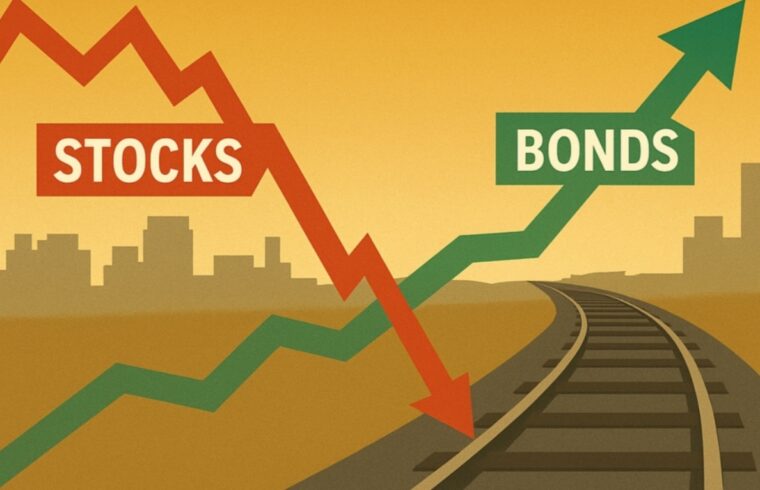
Investors navigating the Philippine market are behaving as if they are changing lanes on a busy highway: even as stocks slow to a crawl under the weight of a deepening flood-control scandal, traffic in government bonds is moving steadily—and in some auctions, even accelerating. The shift reveals not just a preference for safety but a deeper recalibration of where Filipinos place their financial trust when uncertainty rises.
The usual narrative says stocks and bonds act like a seesaw: when one drops, the other climbs. But the Philippine market is showing something more nuanced—not simply the textbook “flight to safety,” but a conscious reshuffling of risk where bonds are evolving from temporary shelter into a working compass.
The local stock market has been battered by the widening probe into alleged anomalies in flood-control projects, triggering bouts of foreign selling and leaving the benchmark index vulnerable to every political headline. Yet government debt remains oversubscribed, with National Treasurer Sharon Almanza noting that auction demand has not only held but stayed strong enough to keep yields aligned with U.S. Treasury securities—a sign that investors see no fundamental damage to sovereign credit despite the controversy. That divergence, where equities wobble but bonds remain firm, is less about panic and more about strategy: when a country’s politics look messy but its fiscal footing looks solid, bonds emerge as the asset class investors feel they can still read.
Local investors, in particular, are leading this rebalancing. Domestic bids are filling the gaps left by foreign funds that have been retreating from equities for weeks. These upticks in the stock market—brief, hesitant, but real—suggest that locals still see value in battered share prices, but not enough certainty to abandon the predictability of fixed income. In simple terms, investors are keeping one foot on the accelerator and one on the brake, testing opportunities while anchoring their portfolios in what feels most stable.
The behavior reflects a broader risk-off sentiment, with investors adjusting their exposure not out of panic but in response to how clearly they can forecast returns. At a time when political noise is blurring visibility in equities, the clean, rules-based nature of government securities looks easier to digest.
That confidence has been reinforced by the Philippines’ recent credit upgrade signal. S&P’s affirmation of the country’s BBB+ rating with a positive outlook—delivered at the height of the scandal—telegraphed to markets that the nation’s macroeconomic fundamentals remain intact. Strong domestic demand, resilient services, manageable inflation, and improving labor metrics give bond investors a macro cushion that political turbulence alone cannot shake.
Finance Secretary Frederick Go’s emphasis that a stronger rating lowers borrowing costs and supports long-term fiscal consolidation underscores why bond buyers feel justified in staying the course. When the debt market senses that the government’s financial machinery continues functioning smoothly despite political shockwaves, appetite for securities stays firm.
More crucially, S&P’s view that the flood-control investigation is unlikely to derail the country’s external position or growth trajectory sends a signal that the scandal is a political issue, not a macroeconomic one. Investors are quick to differentiate the two. Political scandals introduce noise; macro fundamentals determine returns. And in this case, the message from rating agencies is that the noise is temporary, but the fiscal foundation remains durable. This clarity allows bond investors to act with conviction even as equity traders remain skittish.
This evolving stock–bond dynamic tells a larger story: in emerging markets like the Philippines, correlations do not strictly follow textbook patterns. When economic indicators remain stable but governance headlines turn volatile, bonds and stocks can sometimes move independently—or even in the same direction—depending on which risk investors are trying to avoid.
In the current cycle, bonds are absorbing excess caution, while stocks handle speculative sentiment. The interplay is less a simple inverse correlation and more a negotiation between fear and opportunity, discipline and instinct.
But the trend also carries a warning. If investors become too reliant on bonds as the dependable counterweight to equities, any future shift in global rates, inflation expectations, or credit outlooks could erode that protective buffer.
Positive stock–bond correlations—when both rise or fall together—reduce diversification benefits and expose portfolios to broader swings. For now, however, Philippine investors appear comfortable with the balance they are striking: bonds provide the anchor, equities provide the optionality.
The real takeaway is that trust, not just yield, is driving market behavior. In moments of political scrutiny, investors gravitate toward instruments whose value is governed by transparent rules rather than unfolding scandals. And in today’s Philippine market, government bonds have become the asset class where the rules still feel most reliable.
Follow PHILIPPINES TODAY on Facebook and Instagram, and subscribe on YouTube for the latest updates.