
The wind cuts across Altay Prefecture with a crystalline sharpness. Snow blankets the mountains in quiet sheets, and the chatter of distant travelers mixes with the sizzling aroma of kebabs on an open grill.
In Beitun, a small city tucked into the northeastern edge of Xinjiang, steam rises from hot tea served in delicate glass cups, mingling with smoke from wood fires and the distant howl of wind through the peaks. It is here, in this crossroads of Central Asia, that history, culture, and modern life converge in a way that feels both timeless and alive.
“Come here, try our kebabs,” calls Percev Timofei Nikolayevich, known locally as Jima, a Kazakh national who co‑owns a barbecue restaurant in Beitun with his Chinese wife, Guan Xinlan. Their story began at Jeminay Port, a historic border crossing linking China with Kazakhstan, Russia, and Mongolia. With more than a century of trading heritage, the port has long served as a gateway for commerce and connection.
Guan opened a modest eatery near the port in 2005 and taught herself Russian to serve foreign travellers. Jima, then a long‑haul truck driver on the China‑Kazakhstan route, became her informal tutor—bringing ingredients from Kazakhstan and building a connection that grew into marriage in 2009. He settled in Altay and joined the family business.
Recent enhancements in customs efficiency and a visa‑exemption agreement between China and Kazakhstan have eased cross‑border movement. For Jima and his family, Altay has become more than a stop—it’s a home. In April of this year they moved their restaurant into Beitun’s center, offering signature Russian‑style kebabs and welcoming a growing stream of tourists. “Altay is beautiful and well‑connected, attracting visitors from neighboring countries and beyond,” he says.
Altay’s mountains lie under snow for roughly a quarter of the year. In 2018, China’s National Climate Center officially designated it the “Snow Capital of China.” The region’s core ice‑and‑snow zone spans over 30,000 square kilometers—on par with the Alps or the Rockies—making it one of the world’s premier ski destinations.
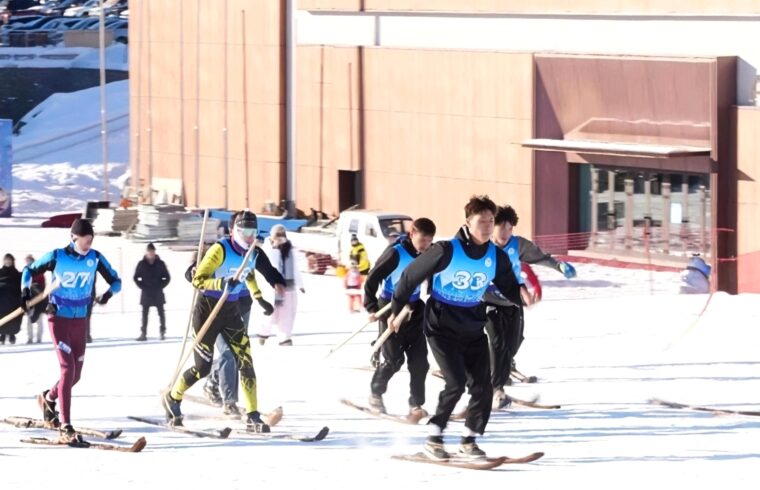
The region’s skiing heritage runs deep: in 2005, a local herder discovered ancient rock paintings in a valley of Altay depicting humans using primitive ski‑boards and a single pole to hunt. Researchers dated the drawings to some 10,000–20,000 years ago. At an international seminar on ancient skiing culture in 2015, scholars from 18 countries recognized Altay as the birthplace of human skiing.
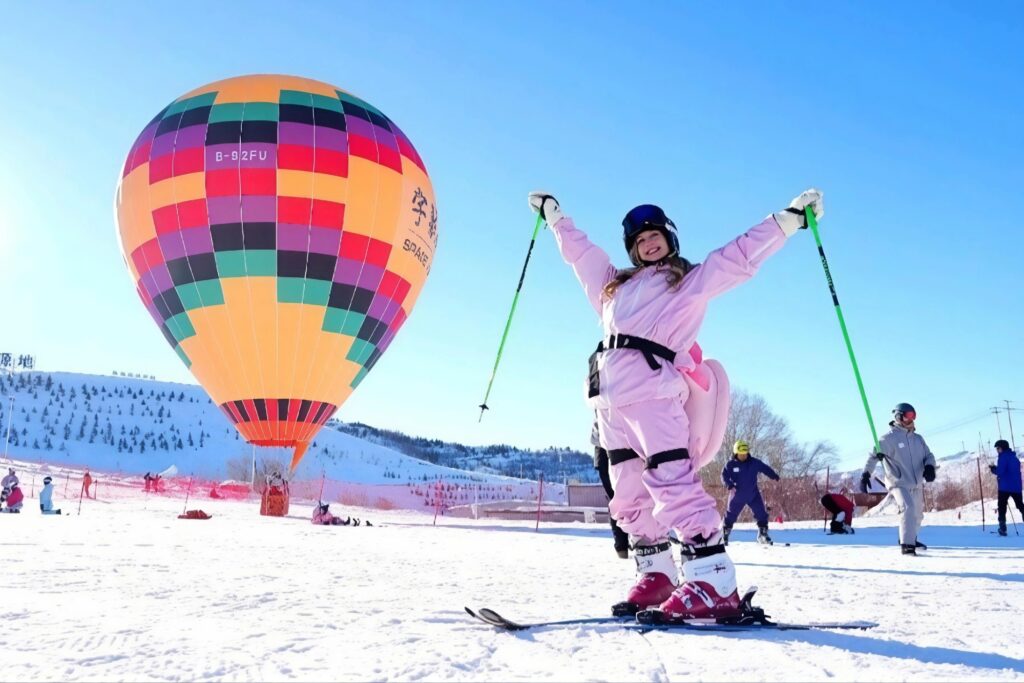
Today, Altay blends past and present. Nestled among the Altay Mountains, its Jiangjunshan International Ski Resort lies just 1.6 kilometers from the city’s central square and is classified as a national “5S” alpine destination. Annual snowfall regularly exceeds two meters, and the powdery drift has earned it the nickname “Asia’s powder‑snow paradise.”
“We’ve seen an increase in foreign visitors—from tropical countries like Malaysia to established winter‑sports nations such as Russia, South Korea, and Japan,” says Li Xia, head of the Jiangjunshan Mountain Ski Academy.
Ski infrastructure has exploded: beyond major resorts like Jiangjunshan and Koktokay, recreational ski facilities now exist in every county of Altay. In the most recent snow season, Altay welcomed 1.408 million ski tourists—a rise of 23.37% year‑on‑year.
Here in Altay, ancient ski‑tracks meet a modern, international winter‑sports hub. With snow as a bridge and culture at its heart, this borderland continues to foster stories of friendship, connection, and discovery.