When the Vatican recently declared that the title Co-Redemptrix would no longer be recognized in official Church teachings, the ruling surprised many Catholics and quickly stirred theological debate across the globe.
The November 2025 doctrinal note Mater Populi Fidelis, issued by the Dicastery for the Doctrine of the Faith, cautioned that the term co-redemptrix “carries the risk of eclipsing the exclusive role of Jesus Christ,” and added that Mary, “the first redeemed, could not have been the mediatrix of the grace that she herself received.”
The clarification made headlines in Europe and Latin America, but in the Philippines, where devotion to Mary is more a lived heritage than a matter of titles, her place in the nation’s soul remains unchanged. For many Catholic Filipinos, the Blessed Virgin Mary remains the trusted intercessor in bringing prayers and petitions before Christ.
Filipinos have long embraced Mary not through theological precision, but through processions, prayer, and an instinctive trust passed down through generations. Debate may shift vocabulary, but it does not alter the devotion of a people who have called themselves Pueblo Amante de María—the People in Love with Mary—for centuries.
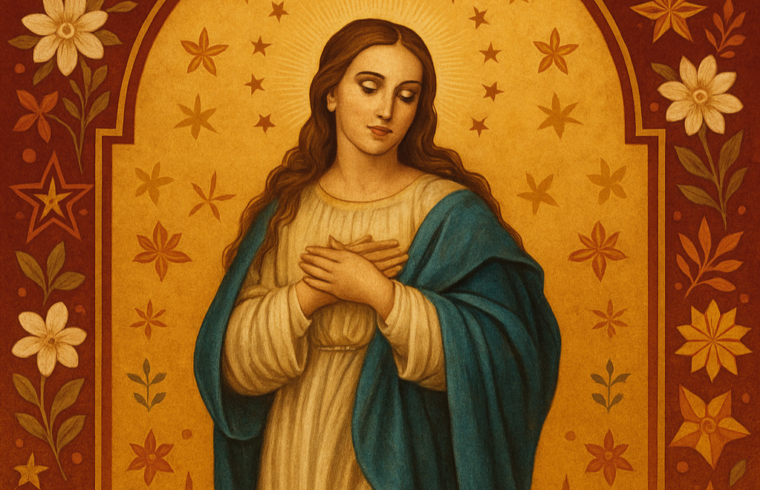
This affection finds its clearest expression in the country’s patronage under the Immaculate Conception, a title central to Filipino spiritual identity. Its roots reach back to the earliest years of Spanish rule, when the foundations of Catholic life were being laid across the archipelago.
In 1578, Pope Gregory XIII decreed that the Diocese of Manila—then the heart of a growing colonial capital—was to be placed under the invocation of the Conception of the Blessed Virgin. Nueva Segovia and Cáceres followed, establishing a pattern that made Marian patronage part of the country’s religious architecture.
By the early 20th century, this devotion had matured into something distinctly Filipino—an expression of faith resilient through wars, political upheavals, and cultural change. In 1942, as the world faced conflict, Filipino bishops petitioned Rome to grant formal recognition to what the faithful already held dear.
Pope Pius XII responded through the apostolic letter Impositi Nobis, declaring Mary under the title of the Immaculate Conception as the principal patroness of the Philippines. Saints Pudentiana and Rose of Lima—figures once regarded as patronesses of earlier centuries—were assigned secondary roles in deference to Mary’s preeminence.
The doctrine itself had been formally defined almost a century earlier. In 1854, Pope Pius IX proclaimed in Ineffabilis Deus, “We declare, pronounce, and define that the doctrine which holds that the most Blessed Virgin Mary, in the first instance of her conception, by a singular grace and privilege granted by Almighty God, in view of the merits of Jesus Christ, the Savior of the human race, was preserved free from all stain of original sin, is a doctrine revealed by God and therefore to be believed firmly and constantly by all the faithful.”
The proclamation shaped Catholic understanding of Mary’s unique role in salvation history. Four years later, in Lourdes, Mary reportedly appeared to Bernadette Soubirous identifying herself as the “Immaculate Conception,” a moment that spread devotion worldwide and found fertile ground in regions like the Philippines, where Marian faith was already deeply rooted.
In Filipino life, this devotion is expressed most vividly in its festivals and rituals. Each May, Flores de Mayo fills towns with children carrying flowers in her honor. Pilgrims travel to Manaoag in Pangasinan with petitions and thanksgiving. The Peñafrancia fluvial procession in Bicol draws thousands who accompany her image along the river, while the Obando Fertility Rites blend prayer, dance, and tradition in a centuries-old appeal for life and family. These celebrations reveal how devotion intertwines with culture, turning doctrine into lived experience.
The geographic breadth of this devotion is equally striking. The 1975 Catholic Directory lists more than 460 parishes dedicated to Mary, including over a hundred under the title of the Immaculate Conception. Many churches were established by Augustinian missionaries, whose early presence left a trail of Marian patronage across Bulacan, Pampanga, Batangas, Cebu, Iloilo, and the Ilocos region. Through the years, Rome has also affirmed Filipino devotion with several canonical coronations granted to images associated with the Immaculate Conception, including those in Malabon, Pasig, Malolos, Santa Maria in Bulacan, and Batangas City.
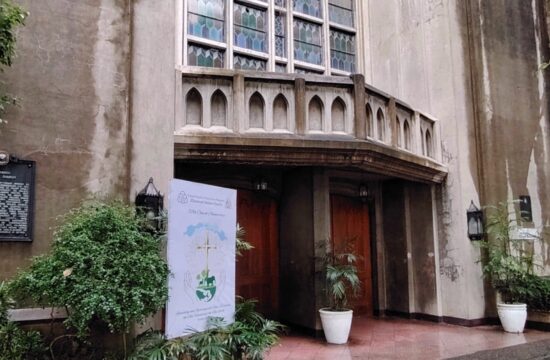
In 2017, the Immaculate Conception entered national civil life through Republic Act No. 10966, declaring December 8 a special non-working holiday. The day now draws families to dawn Masses and novenas, and fills city streets with processions. Nowhere is this more visible than in Manila’s historic Intramuros district, where the Grand Marian Procession gathers dozens of images in a sweeping tribute to centuries of devotion. At the heart of this celebration stands the Manila Cathedral—dedicated to the Immaculate Conception—a symbol of endurance repeatedly rebuilt after war, earthquakes, and fire.
Even as theological debates continue, Filipino devotion remains steady, intimate and profoundly cultural. The Catholic Bishops’ Conference of the Philippines (CBCP) once observed that this affection appears in “novenas to the Blessed Mother as preparation for the patronal feast, the block rosary, and the endless symphony of Marian names in the baptismal records,” a portrait of how deeply Mary is woven into everyday life.
As the Church refines its language about Mary, the Philippines continues to honor the woman who has stood beside its people through centuries of change. The Immaculate Conception—principal patroness of the nation—remains both symbol and guide, her presence stretching from old stone cathedrals to quiet altars in humble homes.
Titles may rise and fall, interpretations may shift, but devotion endures. And in a country that still calls itself Pueblo Amante de María, that devotion is not merely tradition—it is identity.
Follow PHILIPPINES TODAY on Facebook and Instagram, and subscribe on YouTube for the latest updates.