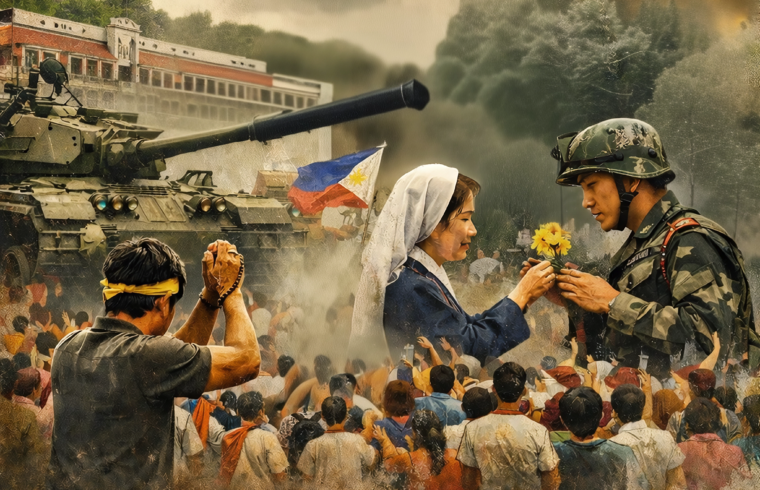
Each February, the story of the EDSA People Power Revolution returns in images that feel almost liturgical: civilians kneeling before tanks, rosaries raised toward rifle barrels, soldiers accepting flowers from strangers. It is remembered, rightly, as a triumph of civic courage over authoritarian power. A people stood their ground, and a regime fell.
But courage alone does not explain why four days of open confrontation in February 1986 did not descend into urban bloodshed.
One crucial factor absent from many accounts is hesitation.
On February 22, 1986, Defense Minister Juan Ponce Enrile and Armed Forces Vice Chief of Staff Fidel Ramos withdrew support from President Ferdinand Marcos Sr. and consolidated forces inside Camp Aguinaldo and Camp Crame. The declaration electrified the country, but its most immediate consequence was structural: it fractured the Armed Forces of the Philippines at the highest level.
Authoritarian regimes survive not through spectacle, but through unity and obedience within their ranks. Tanks and artillery matter only if command is seamless. Once senior leadership splits, obedience can no longer be assumed. Orders may still be issued from the palace, yet their execution becomes uncertain.
Would field commanders comply fully? Would further defections follow? In that uncertainty—inside barracks and command centers—hesitation took root within the very institution designed to enforce compliance.
The crisis might still have been resolved by force had it remained confined to a military dispute. But it did not. After Jaime Cardinal Sin, the Archbishop of Manila, appealed over Radio Veritas for civilians to support the breakaway officers, thousands poured onto Epifanio de los Santos Avenue or EDSA. Families, students, clergy, and religious communities placed themselves between loyalist troops and the rebel camps. What began as a fracture within the armed forces became a confrontation before witnesses.
The regime’s coercive capacity remained intact. Armored personnel carriers advanced. Marines mobilized. Soldiers stood within meters of unarmed civilians. The hardware of repression was present and operational. Yet the character of the standoff had changed. An order to fire would not simply have cleared a highway; it would have meant directing live ammunition at praying civilians under intense domestic and international scrutiny.
Each passing hour without gunfire increased the political and diplomatic cost of escalation. Violence risked immediate delegitimization at home and abroad.
Hesitation here was not softness. It was calculation.
Loyalist units moved toward the camps on February 23, but no sustained assault followed. The absence of decisive engagement reflected more than the size of the crowd. Once elite defection occurs, coordination becomes fragile. Commanders must calculate not only against the opposition but within their own ranks.
Would neighboring units hold their positions? Would soldiers obey an order to fire into a mass that included children and clergy? Could escalation trigger further splits?
Confidence is the hidden fuel of coercive action. As confidence erodes, hesitation multiplies. The camps were surrounded but never stormed—not because force was unavailable, but because its consequences were no longer predictable.
The uncertainty deepened on February 24 when helicopters from the Philippine Air Force approached rebel positions. Air superiority often determines the outcome of internal standoffs in minutes. Instead of attacking, several aircraft defected and landed in Camp Crame. The defection signaled that fragmentation had extended beyond ground forces. Control of the skies, like control of the streets, was no longer assured.
Escalation without certainty is a gamble. Authoritarian regimes survive on the projection of inevitability. When that projection falters—when even pilots switch sides—the use of force risks accelerating collapse rather than preventing it. The sky remained silent not because aircraft were lacking, but because authority over them was divided.
By February 25, the crisis had shifted from maneuver to legitimacy. Marcos was inaugurated at Malacañan Palace; hours later, Corazon Aquino took her oath at Club Filipino. Two inaugurations unfolded within the same day. Sovereignty itself appeared split before the nation.
Force is not only about guns—it’s about whether people accept one’s authority. When leadership is split, using force can look desperate instead of decisive. And a government that doubts its own legitimacy is more likely to hesitate before taking irreversible action.
That evening, Marcos and his family were transported from Malacañang to Clark Air Base and departed the country. No artillery barrage preceded the evacuation. No final assault cleared EDSA. The regime ended not with a crescendo of gunfire, but with withdrawal.
The absence of mass bloodshed was not accidental, nor was it guaranteed by courage alone. It was the cumulative product of hesitation across multiple centers of power: fractured command, civilian interposition, operational uncertainty, aerial defections, divided legitimacy, and mounting international scrutiny. At each critical juncture, those who could have ordered overwhelming force paused.
Revolutions are often defined for the violence they unleash. In February 1986, history was shaped just as decisively by the violence that did not occur.
The sound that marked those four days was not the roar of artillery, but the steady murmur of prayer, the rising shouts of protest—and the profound silence of weapons that never fired.
Stay updated—follow Philippines Today on Facebook and Instagram, and subscribe on YouTube for more stories.