
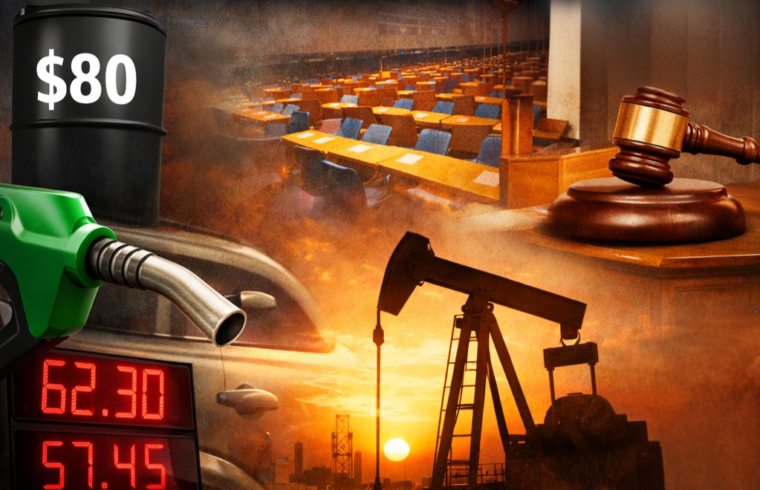
Filipino motorists may soon get relief at the pump after lawmakers approved a measure allowing the government to temporarily reduce or suspend fuel taxes—but despite the promise of cheaper gasoline and diesel, nothing is guaranteed yet.
The House of Representatives has approved a bill granting President Ferdinand Marcos Jr. the authority to ease excise taxes on petroleum products amid rising global oil prices. The proposal, certified as urgent and consolidating several measures, including House Bills No. 8292 and 8257, is being positioned as a fast-response tool to shield consumers from volatile fuel costs—but it still hinges on conditions that are not always within the government’s control.
Under the measure, the President may cut or suspend fuel excise taxes for up to six months, based on recommendations from an inter-agency panel. However, this power is not automatic. It can only be exercised if global oil prices—specifically Dubai crude—reach at least $80 per barrel for one month, or if a national emergency is declared due to extraordinary fuel price increases. This means that even as pump prices continue to rise, the government cannot simply activate the tax cut at will, a point also emphasized by economic managers.
If the policy is triggered, the impact could be immediate and significant. Government estimates presented during deliberations show that suspending excise taxes could reduce pump prices by around ₱10 per liter for gasoline and about ₱6 per liter for diesel, reflecting the current tax rates imposed under the Tax Reform for Acceleration and Inclusion (TRAIN) law. For commuters and transport operators already burdened by rising costs, that level of reduction could offer meaningful, if temporary, relief.
Yet the bigger question is timing—and certainty. The Philippines remains heavily dependent on imported oil, sourcing the vast majority of its fuel requirements from abroad, which leaves local prices highly sensitive to global market shifts. Recent spikes have been linked to geopolitical tensions and supply concerns in oil-producing regions, factors that are largely beyond the government’s control but have direct consequences on domestic inflation and consumer spending.
The measure also faces a legislative hurdle. While already approved by the House, it must still pass the Senate and secure the President’s signature before it becomes law—leaving the policy, for now, as a proposal rather than an actionable solution.
Economic managers have also cautioned that suspending fuel taxes could reduce government revenues, potentially affecting funding for infrastructure and social services.
Meanwhile, the effects of sustained fuel price increases are already rippling across the economy, pushing up transportation fares and contributing to higher costs of goods and services. While the proposed tax suspension is being framed as a solution, critics point out that it is reactive rather than preventive, offering relief only after prices have already surged.
For now, the prospect of cheaper gas is real—but conditional. The government is closer to having the authority to intervene, but whether Filipinos will actually feel relief at the pump depends on a combination of global oil prices, political timing, and how quickly the measure clears its final legislative hurdle.
Stay updated—follow Philippines Today on Facebook and Instagram, and subscribe on YouTube for more stories.